





Predictive maintenance technology for conveyors has moved beyond basic alarms and historical trend charts. It now shapes how facilities reduce unplanned stops, control spare-part exposure, and make maintenance timing more precise across mechanical transmission systems.
That shift matters because conveyor reliability depends on many linked elements. Bearings, belts, chains, couplings, motors, gearboxes, pulleys, seals, and sensors all influence whether a line keeps moving or fails without warning.
In operations where throughput, safety, and asset availability are tightly connected, the main question is practical: which predictive tools actually reduce downtime most, and where should evaluation begin?
Why conveyor prediction now has a higher business value
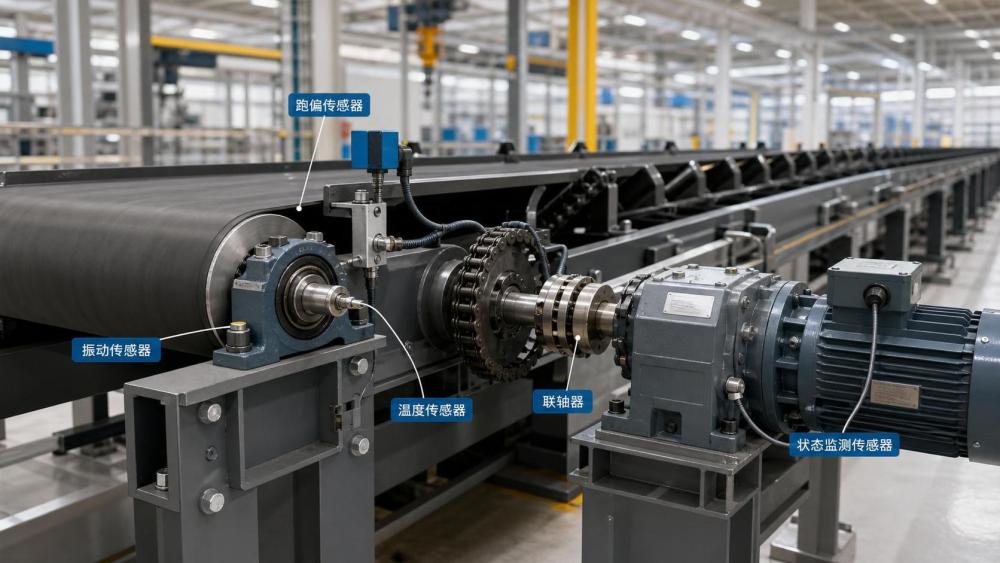
Conveyors often look simple from a distance. In reality, they combine rotating components, tensioned power transmission parts, lubrication points, load variations, and environmental stress that accelerate wear in uneven ways.
A single failed bearing can overheat a pulley. A misaligned belt can damage seals and increase motor load. Chain elongation can shift timing and overload sprockets. Downtime rarely comes from one isolated issue.
This is why predictive maintenance technology for conveyors is gaining attention across bulk handling, packaging, food processing, mining, logistics, ports, and heavy manufacturing. It supports earlier intervention before visible failure appears.
From the broader PCTS perspective, this topic sits at the intersection of tribology, transmission performance, sealing integrity, smart sensing, and MRO economics. Reliability decisions are no longer only mechanical. They are also data decisions.
What predictive maintenance technology for conveyors really includes
The term covers more than attaching sensors to a drive end. It includes three connected layers: condition capture, fault interpretation, and maintenance action based on measured risk rather than fixed calendar intervals.
Condition capture gathers signals such as vibration, temperature, acoustic activity, motor current, belt tracking deviation, speed variation, and lubrication condition. Different conveyor designs require different signal priorities.
Fault interpretation converts those signals into likely failure modes. That may involve simple threshold rules, trend analysis, pattern recognition, or edge-based models trained to identify abnormal behavior earlier.
Maintenance action is the part that determines business value. If alerts do not connect to inspection routines, spare parts planning, or shutdown windows, predictive maintenance technology for conveyors becomes a reporting tool instead of a downtime tool.
Which technologies usually cut downtime first
Not every monitoring option delivers the same return. In most conveyor applications, the strongest early gains come from technologies that detect common mechanical failure modes with enough lead time to schedule intervention.
Vibration monitoring
Vibration remains the most effective first-line method for rotating conveyor components. It is especially valuable for bearings, gearboxes, idlers, pulleys, and motor-drive assemblies.
It can reveal imbalance, looseness, bearing damage, misalignment, and mechanical resonance before heat becomes obvious. In many sites, this produces the earliest usable warning of developing failure.
Temperature monitoring
Temperature sensors are easier to deploy and often cost less, but they are usually a later indicator. They work well for overheated bearings, friction from belt mistracking, brake drag, and overloaded motors.
On their own, they rarely provide full root-cause clarity. Combined with vibration or current data, they become far more useful.
Motor current and power analysis
Current signatures help identify load changes, jams, rising friction, and drive inefficiency. This is particularly helpful when mechanical access is difficult or when conveyors run in distributed networks.
For long conveyors, current trends can also indicate progressive drag from seized idlers or belt resistance increases.
Acoustic and ultrasonic sensing
These methods can detect early friction, air leaks in pneumatic subsystems, and bearing distress in noisy environments. They are useful, but deployment quality matters because industrial background noise can distort results.
Belt and chain condition sensing
Tracking sensors, elongation checks, tension monitoring, and slip detection directly address failures that vibration alone may not explain. For systems centered on chains, belts, and sprockets, these tools can be decisive.
The failure modes worth prioritizing
Predictive maintenance technology for conveyors performs best when it is mapped to known failure mechanisms instead of deployed as a general digital upgrade.
The most common priorities include bearing spalling, lubrication breakdown, pulley misalignment, belt mistracking, chain elongation, seal degradation, gearbox wear, and motor overload under variable duty cycles.
Seals deserve more attention than they usually receive. Contamination ingress often accelerates bearing and gearbox damage. In dusty, wet, or chemically exposed environments, sealing condition can shape the entire monitoring strategy.
This is one reason PCTS-style analysis is useful. Conveyor downtime is not only a sensor question. It depends on how bearings, lubricants, sealing materials, chains, belts, and couplings behave under real operating stress.
Where data models help, and where they do not
Advanced analytics can improve predictive maintenance technology for conveyors, but only when baseline data quality is stable. Poor sensor mounting, missing load context, and inconsistent operating states weaken model accuracy quickly.
Rule-based alerts still work well for many assets. For example, rising bearing vibration plus local temperature increase plus speed loss is often enough to trigger a reliable inspection decision.
Machine learning becomes more valuable in complex networks with variable throughput, multiple conveyor types, and large fleets. It can separate normal production variability from emerging defects more effectively than static thresholds.
Edge computing also matters. Fast local processing reduces latency, lowers bandwidth demand, and supports earlier action when abnormal signals appear during high-speed operations.
How to evaluate conveyor solutions in practice
A useful evaluation starts with failure history, not vendor features. If downtime mainly comes from seized bearings, vibration and lubrication visibility should lead. If failures come from belt drift, tracking and tension data should lead.
It also helps to check whether the system can distinguish between critical and noncritical assets. Monitoring every conveyor point at the same depth often adds cost without reducing risk proportionally.
- Match sensors to dominant failure modes, not to generic digitalization goals.
- Confirm that alarms link to inspection workflows and spare-part decisions.
- Check environmental resistance for dust, washdown, heat, and vibration exposure.
- Review integration with CMMS, SCADA, PLC, or plant historian systems.
- Assess whether local teams can interpret outputs without heavy data science support.
Another key point is component context. A monitoring system that ignores bearing type, seal design, lubricant choice, chain geometry, or belt construction may identify symptoms without helping select the best corrective action.
What usually reduces downtime most
In most industrial settings, the largest reduction comes from combining three things well: vibration monitoring on critical rotating assets, transmission-specific sensing for belts or chains, and maintenance rules tied to operating severity.
That combination works because it detects common faults early, explains likely causes, and supports planned intervention before damage spreads across connected components.
Temperature-only systems tend to be useful, but usually not enough. Fully automated AI platforms can be powerful, but they often deliver slower value if sensor selection and failure mapping are weak at the start.
The best predictive maintenance technology for conveyors is therefore not the most complex stack. It is the one that sees the right failure modes early enough to change maintenance timing with confidence.
A practical next step for evaluation
A sensible next move is to rank conveyors by downtime cost, safety exposure, and failure frequency. Then map each high-priority line to its main components, known failure patterns, and the sensor evidence needed to act earlier.
From there, compare solutions through a lifecycle lens: detection lead time, false alarm rate, integration effort, environmental durability, and the effect on spare parts planning.
That approach keeps predictive maintenance technology for conveyors grounded in mechanical reality, not software promise alone. It also creates a clearer basis for judging bearings, belts, chains, seals, monitoring hardware, and service models across the wider industrial reliability market.
Related News
- 00
0000-00
How FFKM O-rings reduce seal failure in corrosive media - 00
0000-00
What global equipment manufacturing in the USA means for supply chain risk - 00
0000-00
How FFKM outgassing performance affects vacuum seal selection - 00
0000-00
When should heat resistant metallurgy belts be replaced? - 00
0000-00
When does a fluid power maintenance service reduce unplanned downtime?
Weekly Insights
Stay ahead with our curated technology reports delivered every Monday.