





AI predictive maintenance technologies attract attention because they promise earlier fault detection, fewer unplanned stops, and better lifecycle control. In industrial environments shaped by bearings, hydraulic pumps, pneumatic actuators, chains, belts, seals, and couplings, that promise matters. Yet plant results rarely come from AI alone. What actually works is the combination of reliable sensing, sound failure logic, and models that match operating reality.
Where AI predictive maintenance technologies create real value
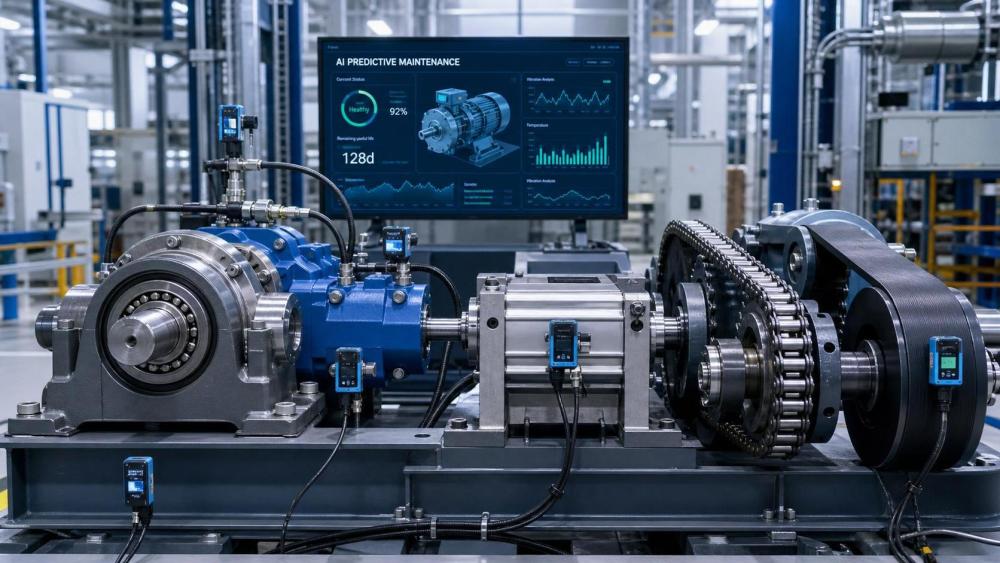
The strongest use cases appear where failure creates measurable operational loss. Rotating equipment, fluid power units, transmission assemblies, and critical sealing points fit that profile well.
A failing spindle bearing, for example, often produces vibration and temperature signals before damage becomes severe. A hydraulic pump may show pressure instability, rising contamination, or abnormal power draw. A chain drive may reveal wear through elongation, noise, or load variation.
In these situations, AI predictive maintenance technologies can help convert scattered condition signals into usable warnings. The benefit is not simply alarm generation. It is better timing for inspection, parts replacement, lubrication work, and shutdown planning.
This is why the topic continues to grow across precision components and industrial MRO. It connects reliability engineering, sensing, maintenance economics, and total cost of ownership in one decision framework.
The methods that usually work best
Many vendors position every algorithm as intelligent. In practice, the most dependable AI predictive maintenance technologies are often the least theatrical.
1. Condition monitoring with supervised models
This approach works when historical failure data is available and labels are trustworthy. Vibration signatures, temperature trends, current draw, pressure ripple, acoustic data, and lubricant analysis become model inputs.
Supervised models perform well on repeated assets with repeated duty cycles. Pump fleets, fan lines, conveyor drives, and standard motor-bearing assemblies are typical examples.
2. Anomaly detection for variable operations
When failures are rare, anomaly detection often outperforms classification. It establishes a normal operating envelope, then highlights behavior that departs from expected patterns.
This is useful for hydraulic systems with changing loads, pneumatic lines with cycle variation, and mixed production environments where fault labels remain incomplete.
3. Physics-informed and rule-assisted analytics
The most practical systems often combine machine learning with engineering rules. Bearing fault frequencies, seal leakage thresholds, pressure-drop logic, lubrication intervals, and wear-rate models improve interpretability.
That matters because maintenance action needs explanation. A black-box alert without a failure mechanism usually slows adoption.
4. Edge-based diagnostics for response speed
Edge computing is becoming one of the more effective AI predictive maintenance technologies for industrial sites. It reduces latency, limits bandwidth demand, and supports faster local decisions.
This is especially relevant for wind turbine bearings, automated handling systems, remote pumps, and distributed transmission assets where connectivity may be uneven.
What limits performance on the plant floor
The main reason predictive programs underperform is not algorithm weakness. It is mismatch between data quality and equipment reality.
Sensors are often installed too late, too far from the fault source, or without calibration discipline. In rotating machinery, poor mounting can distort vibration data. In hydraulic circuits, unstable sampling can miss transient events.
Context is another issue. A temperature rise may signal friction, but it may also reflect ambient shifts, load changes, or process timing. Without operating-state tagging, AI predictive maintenance technologies can produce false alarms or weak confidence scores.
Asset diversity also matters. A model trained on one bearing design, lubricant regime, or seal material may not transfer well to another. The same problem appears in pumps, couplings, belts, and cylinders exposed to different duty conditions.
Maintenance records can be just as limiting. If failure logs are vague, repair dates are inaccurate, or replaced parts are not linked to condition data, model training becomes unstable.
How the technology maps to component categories
Industrial assets do not fail in the same way, so evaluation should follow component behavior rather than software claims alone.
This component-first view is central to practical evaluation. It aligns with how PCTS connects tribology, fluid power, sealing performance, smart sensing, and reliability analysis across industrial supply chains.
What to check before selecting a solution
A useful evaluation process starts with failure modes, not dashboards. If the dominant problem is lubrication starvation, a generic AI layer will not compensate for missing oil data.
Several checkpoints tend to separate credible systems from weak ones.
- Clear linkage between sensor inputs and known failure mechanisms.
- Evidence of model performance under load changes, contamination, and environmental variation.
- Explainable outputs that support inspection planning and root-cause review.
- Integration with CMMS, SCADA, PLC, or historian systems already in use.
- Defined retraining logic as assets age, parts change, or maintenance strategy shifts.
- Measured outcomes such as reduced false positives, longer bearing life, or fewer emergency replacements.
It is also worth checking whether the solution can support component comparison across suppliers. In B2B settings, predictive insights increasingly influence spare-parts planning, warranty analysis, and procurement risk decisions.
What mature adoption looks like
The most successful AI predictive maintenance technologies are usually introduced in narrow, high-value zones first. A pilot around critical bearings, pumps, or sealing systems creates faster evidence than a site-wide launch.
Mature adoption also avoids one common mistake: treating predictive maintenance as a software purchase. It is really an operating model that combines instrumentation, domain knowledge, maintenance response, and feedback loops.
Over time, the program should answer practical questions. Which pump family shows earlier contamination sensitivity? Which seal material degrades faster under corrosive media? Which transmission line creates the highest unplanned cost per hour?
Those answers matter because they improve not only uptime, but also component selection, replacement cycles, stocking policy, and lifecycle cost decisions. That broader value is where AI predictive maintenance technologies become strategically useful rather than technically interesting.
A practical next step
The best next step is to build an evaluation matrix around a small number of critical assets. Rank failure consequences, available signals, maintenance history quality, and response options. Then compare vendors or internal models against those conditions.
For organizations working across bearings, hydraulics, pneumatics, transmission systems, and sealing applications, that approach creates a more reliable baseline than broad digital claims. It also makes external intelligence more useful, especially when technical analysis, supplier visibility, and condition-monitoring trends are reviewed together.
AI predictive maintenance technologies do work, but they work best when grounded in asset physics, disciplined data, and measurable maintenance action. That is the point where prediction starts turning into operational advantage.
- pneumatic actuators
- wind turbine bearings
- hydraulic pumps
- O-rings
- industrial MRO
- hydraulic pumps and motors
- precision components
- transmission systems
- hydraulic systems
- condition monitoring
- predictive maintenance
- Predictive Maintenance Technologies
- Total Cost of Ownership
- Tribology
- AI predictive maintenance technologies
Related News
- 00
0000-00
How FFKM O-rings reduce seal failure in corrosive media - 00
0000-00
What global equipment manufacturing in the USA means for supply chain risk - 00
0000-00
How FFKM outgassing performance affects vacuum seal selection - 00
0000-00
When should heat resistant metallurgy belts be replaced? - 00
0000-00
When does a fluid power maintenance service reduce unplanned downtime?
Weekly Insights
Stay ahead with our curated technology reports delivered every Monday.