





On July 15, 2026, ECHA updated REACH Annex XVII to expand PFAS restrictions to fluorinated elastomer sealing products, with FFKM O-rings explicitly included. From October 1, 2026, exports to the EU of FFKM sealing products containing PFAS must be accompanied by a declaration of conformity and a substance concentration test report. For sealing product manufacturers, EU importers, and cross-border supply chain teams, this is not just a wording change in a regulation; it directly affects export compliance preparation, testing arrangements, document readiness, and delivery scheduling.
What the updated REACH requirement confirms
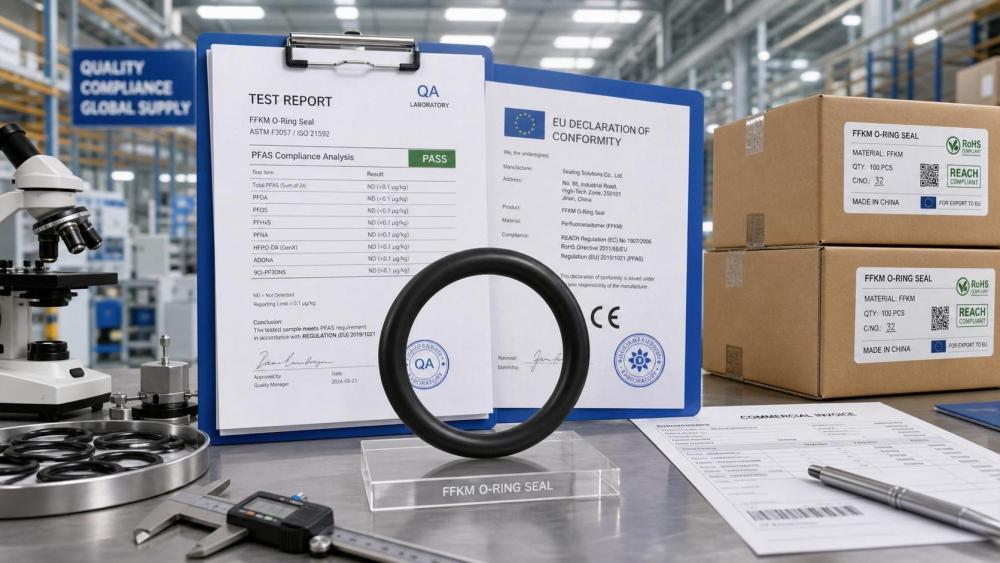
The confirmed facts are limited but clear. ECHA formally updated REACH Annex XVII on July 15, 2026. The scope of PFAS restrictions was expanded to fluorinated elastomer seals, and FFKM O-rings were expressly covered. The new requirement states that, starting on October 1, 2026, exporters shipping PFAS-containing FFKM sealing products to the EU must provide a conformity declaration together with a substance concentration test report. The change directly affects the compliance pathway for Chinese sealing manufacturers exporting to the EU, while importers are expected to begin supplier reviews and assessments of alternative options.
Where the pressure will appear across the supply chain
Export compliance moves closer to the shipment stage
From an industry perspective, exporters are likely to feel the impact first because the new requirement is tied to goods shipped to the EU. The practical pressure point is no longer only product composition, but whether shipment files can be assembled in time. What deserves closer attention is the need to align declarations, test evidence, and shipment schedules before goods leave the factory or distribution channel.
Manufacturing teams face added testing and document coordination
For manufacturers of FFKM O-rings and related sealing products, the change may affect laboratory planning, internal compliance review, and production release timing. Analysis shows that even where a product line is commercially established, the export file now has a more explicit substance-reporting requirement. That can increase coordination between production, quality, and export documentation functions, especially where delivery dates are tight.
Importers and buyers will need stronger supplier verification
EU-facing importers and procurement teams are also exposed because the rule change creates a more immediate need to verify whether suppliers can support the required declaration and concentration report. Observably, the issue is not only whether a supplier can produce the part, but whether it can produce the compliance file in a form acceptable for trade and receiving processes. This may affect purchasing decisions, onboarding reviews, and requests for alternative materials or supply options.
Testing and related service providers may become part of delivery planning
Testing service providers and compliance support firms may see greater involvement in export preparation because the rule now explicitly links shipment readiness to substance documentation. It is more appropriate to understand this as a procedural effect on export execution rather than a confirmed market outcome. The immediate operational issue is whether testing lead time can be matched with customer delivery commitments.
What companies should review before October 2026
Check whether affected products are already mapped clearly
Analysis shows that companies dealing in FFKM sealing products should first confirm which exported items fall within the newly highlighted PFAS control scope. The key issue is product mapping against export flows to the EU, because compliance risk begins with misidentifying which shipments require the new supporting documents.
Rebuild document packs around the new filing expectation
What deserves closer attention is the completeness of shipment documentation. Companies should review whether existing conformity materials are sufficient and whether substance concentration test reports can be prepared in a way that fits customer and customs-facing document workflows. The input information does not provide the detailed execution format, so this remains an area for close follow-up rather than a settled procedure.
Reassess lead times, testing slots, and order commitments
Observably, the rule change may affect delivery planning because testing and document issuance can become part of the shipment timeline. Exporters, contract manufacturers, and procurement teams should pay closer attention to order cut-off dates, sample preparation, internal approval steps, and whether customer delivery promises need to reflect added compliance handling time.
Start supplier reviews and alternative assessments early
For importers and sourcing teams, the immediate practical question is supplier readiness. Analysis shows that supplier review is no longer only about price, specification, and consistency, but also about whether the supplier can maintain compliant supporting records under the updated REACH requirement. The event summary also points to evaluation of alternatives, which suggests companies should monitor how procurement specifications and tender documents may evolve after the rule takes effect.
Why this should be read as an execution signal
Analysis shows that this development is better understood as an operational compliance signal rather than a distant policy discussion. The effective date is already defined, the covered product category is expressly identified, and the export documentation expectation is stated. At the same time, it would be premature to treat every implementation detail as settled, because the provided information does not include fuller guidance on review practice, document acceptance standards, or how downstream buyers will update their internal requirements. That is why market participants still need to watch official wording, procurement behavior, and execution feedback closely.
How to interpret the change at this stage
At this stage, the update points to a concrete tightening of export compliance requirements for PFAS-containing FFKM O-rings shipped to the EU. The immediate business relevance lies in documentation, testing, supplier verification, and delivery planning rather than in broad market conclusions. It is more appropriate to understand this as a rule change that has already entered the implementation window, while the detailed enforcement approach, customer-side acceptance practice, and broader industry response still require continued observation.
Basis of this article and what still needs verification
This article is generated from the user-provided news title, event date, and event summary. For events of this type, commonly relevant source categories may include official regulatory notices, releases from supervisory authorities, customs or trade administration information, industry association updates, standards-related documents, and reporting by established trade media. A specific official source link was not provided in the input, so the exact source document should be verified on an ongoing basis. What still needs continued monitoring includes detailed policy wording, practical compliance interpretation, document acceptance requirements, procurement and tendering changes, industry feedback, and how companies implement the new requirement in actual export operations.
Want to dive deeper into these market dynamics, or need data-driven support for your next business move? Drop a line below and let the analysts at PCTS provide customized insights.
We respect your privacy. Your information is strictly confidential.
Related News
- 00
0000-00
How sealing technology reduces contamination in semiconductor manufacturing - 00
0000-00
Where to install vibration sensors on rotating machinery - 00
0000-00
NTSB Probe Finds Boeing Warned of MD-11 Engine Bearing Risk Years Earlier - 00
0000-00
How to size pneumatic grippers for packaging system integration - 00
0000-00
How to size alloy steel power transmission chains for heavy loads
Weekly Insights
Stay ahead with our curated technology reports delivered every Monday.