





Industrial automation is shifting the piston pumps market toward precise control, lower energy use, and easier integration with machine monitoring systems. The commercial opportunity lies in how reliably a pump supports the production process: maintaining force during a pressing cycle, adjusting flow as demand changes, and helping maintenance teams identify deterioration before it stops a line.
This does not mean every automated machine needs a digitally connected piston pump. Adoption makes the strongest economic sense where hydraulic power is essential, operating cycles vary, and downtime or wasted energy carries a meaningful cost. Automation can increase the value of each installation while also exposing applications where simpler hydraulics or electric actuators offer a better fit.
Automation changes what customers expect from a pump
A conventional pump evaluation often starts with pressure capability, displacement, purchase price, and availability. Automated production adds questions about response time, repeatability, control interfaces, and performance across the complete operating cycle.
Consider an automated hydraulic press. Rapid approach requires substantial flow at relatively low pressure. Forming demands higher pressure at a different flow rate. Holding and return introduce further operating conditions. A pump that meets the maximum pressure requirement may still waste energy or create control difficulties during the rest of the cycle.
Piston pumps are relevant because many designs can operate at high pressure, and variable-displacement versions can adjust the volume delivered per revolution. In suitable systems, electronic controls coordinate this adjustment with machine demand. Variable-speed motor drives provide another way to regulate output, sometimes combined with displacement control.
These options change the purchasing question from “Can this pump deliver enough power?” to “How effectively can this hydraulic system follow the process?” The answer depends on the pump, motor, valves, controller, sensors, and mechanical load working together.
Energy efficiency is becoming a system purchasing decision
Automated equipment frequently moves between demanding work, light loading, holding, and waiting. When hydraulic output exceeds demand and excess flow passes through relief or throttling paths, energy becomes heat. That heat may increase cooling requirements and affect fluid and seal life.
Demand-based pump control can reduce these losses. However, variable displacement and variable speed solve different parts of the problem. Displacement control changes delivery per revolution; speed control changes how quickly the pump turns. Their suitability depends on pressure, required response, minimum operating speed, lubrication conditions, and the machine’s cycle.
A pressure-compensated variable-displacement pump may already reduce delivery during holding. Replacing it with a more elaborate system therefore requires a different business case from replacing a fixed-displacement pump that continuously unloads excess flow.
The comparison should use energy consumed per acceptable production cycle. A component efficiency figure at one operating point cannot show whether the complete machine saves energy while preserving output and quality. Startup, idle periods, cooling demand, and production rate all affect the result.
This creates room for suppliers that can measure a baseline, select a suitable control arrangement, and demonstrate performance under representative operating conditions. It also limits the value of broad efficiency claims that lack a clear reference system.
Where automation creates the strongest demand
The effect on the piston pumps market varies by application. High force requirements, repetitive cycles, and changing pressure or flow demand create different opportunities from simple, lightly used machinery.
New machinery offers a relatively straightforward path to integrated designs because the hydraulic architecture and machine controller can be developed together. Existing equipment presents a different opportunity: retrofits may improve efficiency or monitoring, but available space, motor compatibility, older controls, and shutdown windows can constrain the result.
Replacement demand also follows its own logic. A plant restoring a stopped machine may prioritize interchangeability and immediate availability over advanced functions. Market assessments should distinguish new equipment, modernization projects, and maintenance replacements because their buying criteria and sales cycles differ.
Condition monitoring adds value when it leads to action
Pressure, temperature, vibration, motor current, and fluid condition can help reveal changes in hydraulic performance. Monitoring may identify abnormal loading, contamination, overheating, or developing wear. The commercial benefit comes from connecting those signals to a useful maintenance decision.
A single reading rarely identifies the cause. Higher temperature could reflect internal leakage, restricted cooling, changed production conditions, or an incorrect control setting. Vibration also varies with speed, mounting, and machine operation. Effective monitoring needs an operating baseline and enough process context to distinguish a fault from normal variation.
For piston pumps, case-drain flow can provide useful evidence of internal leakage where the design and installation support appropriate measurement. Interpretation still depends on pressure, speed, fluid temperature, and manufacturer limits. An alarm without this context can cause unnecessary intervention.
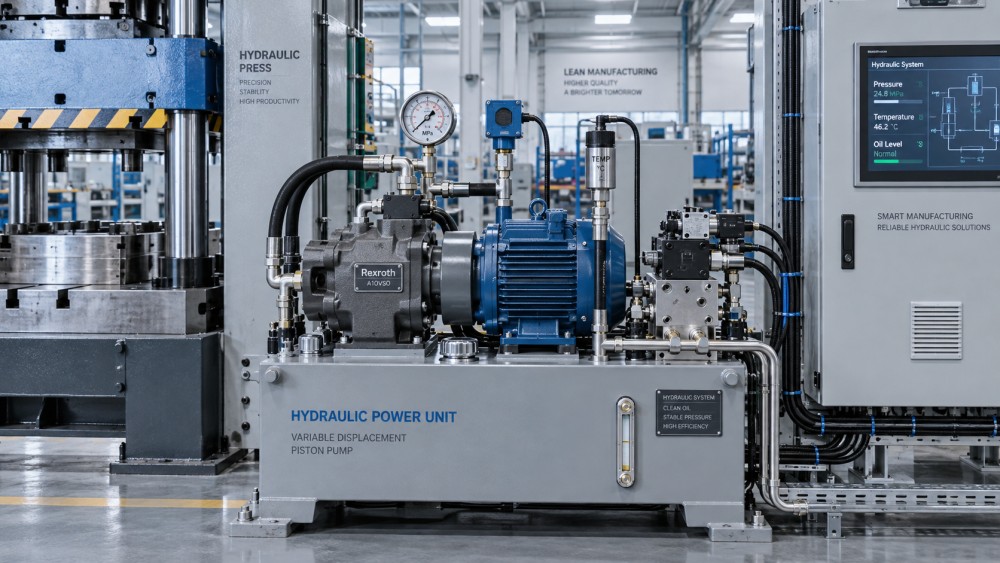
A useful monitoring arrangement links machine demand, pump operating data, and maintenance response. It should help answer practical questions: Can production continue? Does the machine need inspection during the next planned stop? Which component or operating condition should technicians investigate?
Predictive maintenance requires more than installing sensors. Reliable failure prediction depends on suitable data, validated methods, and a defined maintenance workflow. Simpler condition-based monitoring may deliver sufficient value when it consistently detects deterioration early enough to schedule service.
Suppliers compete on integration and support as well as hardware
As pump control becomes more closely connected to machine operation, supplier differentiation extends beyond mechanical specifications. Application engineering, commissioning support, diagnostic tools, documentation, and local service can influence whether an installation performs as intended.
Interface compatibility matters, but a shared communication protocol does not make two products interchangeable. Control behavior, supported data, update timing, parameter settings, and fault handling must also fit the machine. Replacing a pump or controller can require software changes and renewed validation of the process.
This creates an opportunity for suppliers offering a coordinated pump, motor, drive, and control package. A package can reduce the work needed to make components function together. It can also create dependence on proprietary tools, specialist service, or a particular replacement component.
A commercially attractive offer should explain both initial integration and long-term support. Access to operating data, parameter backups, replacement procedures, software support, and technician training affects lifecycle cost. These details become especially relevant when equipment is expected to operate longer than individual electronic components remain available.
Digital capability can support service revenue, but connected equipment does not automatically produce recurring income. Customers need a reason to keep paying, such as useful diagnostics, faster troubleshooting, or maintenance support that improves availability.
Automation also creates competitive pressure from electric actuation
Automation does not guarantee additional hydraulic demand in every application. Electric actuators can be attractive where the required force, travel, speed, and duty cycle suit their capabilities. Their integration with motion control can make them a strong option for some positioning and assembly tasks.
Hydraulics remain relevant where high force density, demanding loads, or the machine architecture favors fluid power. Piston pump suppliers therefore compete through both component improvements and the performance of the hydraulic system relative to alternative actuation methods.
Compact hydraulic power units and localized electrohydraulic arrangements offer another design path. They can place hydraulic power closer to an actuator and reduce some centralized piping requirements. Their suitability depends on heat dissipation, service access, electrical infrastructure, and load behavior.
The resulting market is segmented. Some machines may use fewer hydraulic components; others may adopt higher-value pumps, controls, and monitoring. Unit shipments alone therefore provide an incomplete view of how automation changes market value.
The business case depends on costs that quotations often omit
A digitally integrated pump may justify a higher acquisition cost, but the evaluation should include engineering, installation, commissioning, training, and maintenance. A retrofit may also require changes to filtration, cooling, electrical supply, or pipework before the expected benefits become achievable.
Reliability claims deserve particular attention. Electronic controls cannot compensate for poor inlet conditions, unsuitable fluid, contamination, excessive case pressure, or incorrect alignment. More precise control still depends on sound hydraulic and mechanical installation.
Production assumptions can change the outcome. Energy savings depend on utilization and the operating cycle. Downtime savings depend on whether earlier fault detection changes repair timing. A faster machine creates financial value only when additional capacity can be used or another production constraint is removed.
A practical evaluation can proceed through four checks:
- Define the operating baseline. Record pressure, flow demand, running hours, idle time, temperature behavior, and recurring faults.
- Identify the source of improvement. Separate reduced energy consumption, improved process consistency, shorter cycles, and maintenance benefits.
- Price the complete change. Include integration, shutdown time, service requirements, and replacement availability.
- Set acceptance criteria. Test representative production cycles against energy use, quality, response, and operating stability.
This approach makes competing proposals easier to compare because each supplier must connect technical features to an operating result.
How to assess the market opportunity
Automation should be treated as a driver of product mix and customer requirements, rather than a uniform growth multiplier. A supplier serving highly utilized production equipment faces a different opportunity from one focused on standard replacement pumps or infrequently operated machinery.
It also matters what a market estimate includes. Hydraulic axial and radial piston pumps, complete power units, and reciprocating process pumps serve different purposes. Combining them can obscure the relationship between factory automation and demand. Likewise, a pump-only revenue figure is not directly comparable with one that includes drives, controllers, and service.
Stronger commercial propositions connect application knowledge with measurable performance and dependable support. Evidence may include successful integration into machine designs, repeat orders, accessible replacement parts, and acceptance testing under realistic loads. The presence of sensors or a digital interface provides only part of that picture.
Before approving a purchase or assessing a supplier’s prospects, identify the production problem the proposed technology solves. Then ask what must be integrated, how the improvement will be measured, and who will support the system throughout its working life. Those answers reveal where industrial automation creates durable value in the piston pumps market.
Related News
- 00
0000-00
How is industrial automation shaping the piston pumps market? - 00
0000-00
How to select corrosion-resistant mechanical seals for acid pumps - 00
0000-00
How to monitor wind turbine main bearings at low rotational speeds - 00
0000-00
How sealing selection prevents leakage in hydraulic equipment - 00
0000-00
How cleanroom pneumatic design prevents particle contamination
Weekly Insights
Stay ahead with our curated technology reports delivered every Monday.