





Select an acid-pump mechanical seal by matching every exposed material to the full chemical and operating envelope, then choosing an arrangement that keeps the seal faces lubricated and controls leakage. A chemically compatible face material alone cannot compensate for an unsuitable O-ring, an exposed spring, or acid flashing between the faces.
Effective corrosion resistant mechanical seal solutions combine material compatibility, face performance, containment, and a support system the plant can maintain. The starting point is a complete service specification—not a catalog description such as “acid resistant” or “chemical duty.”
Define the service before comparing seal materials
“Sulfuric acid service” is not a sufficient specification. Concentration, temperature, impurities, and operating transitions can change which materials remain suitable. A seal that performs in a steady process may fail during dilution, cleaning, or startup because those conditions introduce a different chemical or thermal load.
Build the specification around conditions inside the seal chamber. Pump discharge pressure and bulk liquid temperature provide useful context, but they do not fully describe what the seal experiences. Face friction generates heat locally, while chamber pressure affects the liquid’s margin against vaporization.
- Chemistry: acid identity, concentration range, mixtures, dissolved gases, contaminants, and cleaning fluids.
- Temperature: normal operation, maximum excursions, startup, shutdown, and cleaning cycles.
- Pressure: seal-chamber pressure, anticipated fluctuations, vacuum conditions, and possible pressure reversals.
- Liquid behavior: viscosity, vapor pressure, lubricity, suspended solids, and crystallization or deposit formation.
- Mechanical conditions: shaft speed, movement, runout, vibration, and available installation space.
- Operating pattern: continuous duty, frequent starts, standby periods, loss of prime, and available cooling or flush utilities.
- Leakage constraints: acceptable emissions, exposure consequences, and whether another liquid may enter the process.
Record ranges rather than nominal values. During water flushing, for example, residual acid can pass through concentrations with different corrosion behavior, and dilution can generate heat. Material approval should cover that transition as well as normal production.
Check the complete wetted assembly
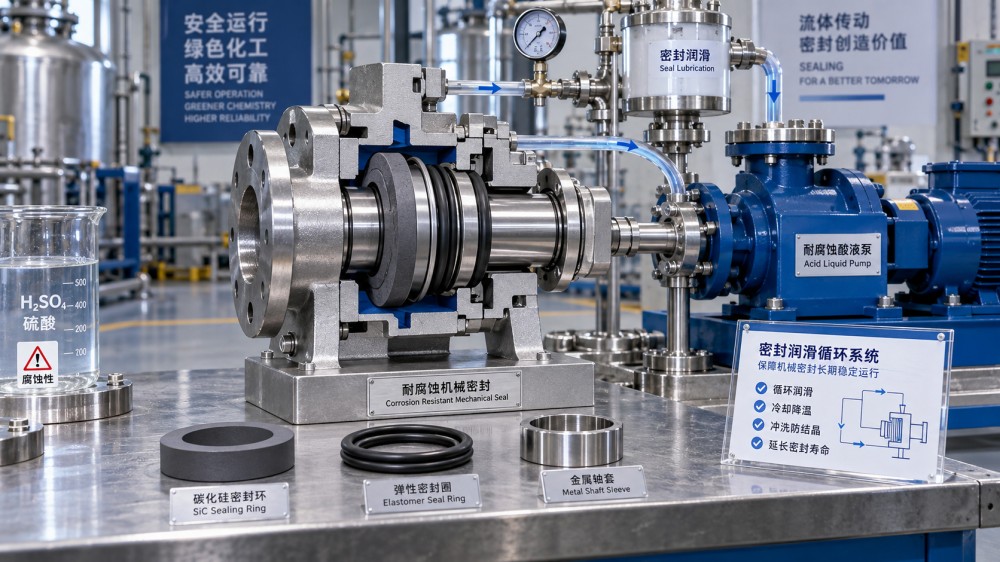
A mechanical seal includes faces, secondary seals, sleeves, glands, retainers, springs, and other hardware. Each exposed component needs its own compatibility assessment. Request a sectional drawing showing process contact, barrier-fluid contact, and components that may encounter leakage.
This drawing also reveals whether a design protects vulnerable parts. Springs positioned outside the process can reduce exposure to acid and deposits, but their actual environment still needs review. An external location does not automatically eliminate contact with corrosive leakage or vapors.
Seal faces: chemical resistance must work with lubrication
Silicon carbide is a common candidate for corrosive liquids because it combines hardness with resistance to many chemicals. However, “silicon carbide” does not identify a single interchangeable material. Sintered and reaction-bonded grades differ, including whether residual free silicon is present. That distinction can affect suitability in particular chemical environments.
Hydrofluoric acid and fluoride-containing mixtures deserve specific attention. Generic statements about silicon carbide or ceramic resistance are insufficient for these services. The assessment must address the exact grade, concentration, and temperature.
Carbon graphite can provide useful friction and lubrication characteristics, but its impregnation system matters. Resin-impregnated and metal-impregnated grades can behave differently. Strongly oxidizing media may also limit carbon suitability. A supplier should identify the proposed grade rather than list only “carbon.”
Tungsten carbide requires similar scrutiny because binder composition affects chemical performance. Hardness and abrasion resistance do not establish acid compatibility. For any face material, request the exact grade and the basis for its use in the specified chemistry.
Face pairing introduces another decision. A hard face against carbon may offer favorable friction behavior where carbon is chemically suitable. Hard-against-hard combinations may suit abrasive liquids or services that exclude carbon, but they still require adequate lubrication and heat removal. Neither pairing should be selected on an assumption that it tolerates dry running.
Secondary seals: specify the compound, not just the polymer
O-rings and other secondary seals can become the limiting components even when the faces remain intact. Swelling, hardening, loss of elasticity, or permanent deformation can cause leakage or restrict the movement needed to keep faces together.
Use this table to frame questions, not to approve a material. Compatibility charts are screening tools; they may describe immersion behavior without capturing pressure, dynamic movement, or repeated thermal cycling. Require the exact compound designation and its suitability across the specified service envelope.
For encapsulated O-rings, assess the complete construction, including jacket integrity and elastic recovery. A resistant outer layer does not make every encapsulated design suitable for a moving secondary seal.
Metal parts: avoid blanket alloy recommendations
Stainless steel is not universally suitable for acid pumps. Acid concentration, chlorides, temperature, and oxidizing or reducing conditions can alter corrosion behavior. Nickel alloys and titanium also have application boundaries; a more expensive alloy is not automatically a better choice.
Evaluate each exposed metal against the actual mixture. Include narrow crevices, spring sections, welds where present, and dissimilar-metal contacts. Thin components may lose function before obvious damage appears elsewhere in the assembly.
Choose the seal arrangement around leakage consequences
A single mechanical seal can be appropriate when the process liquid supports stable face lubrication and the expected leakage can be managed within the application’s requirements. It offers a simpler installation, but it provides no second mechanical sealing stage if the primary faces fail.
A dual unpressurized arrangement adds an outer seal and a buffer space. Depending on its design and support system, it can help collect, detect, or contain leakage from the inner seal. The process-side seal still handles the acid, so this arrangement does not remove its chemical or lubrication requirements.
A dual pressurized arrangement maintains a suitable barrier liquid above process-side seal pressure. Under the intended pressure relationship, leakage across the inner seal is directed toward the process. This can improve containment and provide a controlled lubricating environment for the faces.
That benefit introduces operating obligations. Barrier pressure, circulation, temperature, and fluid condition must remain within the design requirements. Loss of pressure can reverse the intended leakage direction. Barrier liquid can also enter the product, so its chemistry must be acceptable for process purity, downstream equipment, and any reaction with the acid.
Select the arrangement through a leakage-consequence assessment. Consider personnel exposure, environmental release, equipment damage, and process contamination alongside normal running reliability. Hazardous acid service may justify additional containment, but a dual seal succeeds only when its support system receives the necessary attention.
Make the support system part of the selection
A seal can resist corrosion and still fail because the liquid film between its faces becomes unstable. Low chamber pressure, frictional heating, entrained gas, or inadequate circulation can allow local vaporization. Faces then lose effective cooling and lubrication, leading to wear, distortion, or cracking.
Ask the supplier to explain how the proposed design maintains liquid at the faces during both steady operation and foreseeable transients. A statement that the seal meets maximum pressure and temperature ratings does not answer that question.
For crystallizing acids or contaminated streams, assess whether the arrangement prevents deposits around moving components. Deposits can obstruct secondary-seal movement, hold faces apart, or interrupt circulation. Abrasive solids may justify hard faces and a suitable flush, but particle behavior and the flow path still matter.
An external flush can supply cleaner liquid or improve cooling, provided the process accepts it. Water should never be assumed suitable simply because it is available. Acid dilution may release heat, change corrosion behavior, or disrupt product concentration. Specify flush chemistry, flow requirements, supply reliability, and the response to loss of flow.
Likewise, a barrier fluid must be compatible with the process if mixing occurs. Its viscosity, thermal stability, and cleanliness affect face performance. Cooling equipment should support the actual heat load and operating environment rather than appear as an optional accessory added after seal selection.
Check whether the seal can follow the pump
Chemical selection cannot correct excessive shaft movement, misalignment, or vibration. Review the pump’s mechanical condition before replacing a failed seal with more costly materials. Otherwise, the replacement may reproduce the same failure.
A balanced seal design can help manage hydraulic face loading and heat generation in suitable applications. Balance should be assessed with chamber pressure, speed, face geometry, and fluid behavior; the label alone does not establish performance.
Cartridge seals simplify installation by controlling important assembly settings. They can reduce fitting errors, but the cartridge still requires correct positioning, secure drive attachment, proper piping, and removal of setting devices according to its installation procedure.
Also compare pusher and bellows designs where deposits or corrosion affect moving parts. Pusher seals rely on secondary-seal movement that deposits can obstruct. Bellows designs avoid that particular sliding interface, but bellows material, fatigue loading, and deposit exposure introduce their own limits.
Compare proposals using evidence and operating cost
Send suppliers the same service specification and require explicit responses to deviations. Otherwise, a lower-priced proposal may assume cleaner liquid, lower temperature, or support utilities that the plant cannot provide.
A useful technical submission should include:
- Exact face grades, secondary-seal compounds, and exposed metal specifications.
- A drawing identifying fluid exposure and confirming dimensional fit.
- The basis for compatibility across production, cleaning, and shutdown conditions.
- Operating limits and support requirements, including abnormal-condition responses.
- Installation, inspection, repair, and spare-parts requirements.
- Relevant service references with enough operating detail to establish comparability.
Prioritize unresolved risks. A similar-service reference can support selection, but it carries limited value if concentration, impurities, temperature, or face lubrication differ substantially. Targeted material testing or engineering review is more useful than a generic claim of chemical resistance when those differences govern the decision.
Compare total operating cost through specific contributors: seal purchase, support equipment, utility consumption, instrumentation, repairability, spares, downtime, and cleanup. Include the maintenance team’s ability to manage the proposed system. Added complexity is justified when it addresses a defined failure mechanism or containment need.
The final selection should make three things clear: why every exposed material suits the acid service, how the faces remain lubricated, and what happens when operating conditions depart from normal. If a proposal leaves one of those questions unanswered, resolve it before treating the seal as technically acceptable.
Want to dive deeper into these market dynamics, or need data-driven support for your next business move? Drop a line below and let the analysts at PCTS provide customized insights.
We respect your privacy. Your information is strictly confidential.
Related News
- 00
0000-00
IndexBox Forecasts 3.8% Annual Growth for Global Radial Seals Market Through 2035 - 00
0000-00
How to assess the chemical compatibility of FFKM sealing sheets - 00
0000-00
IndexBox Forecasts 3.6% Annual Growth for Construction Bearings Market - 00
0000-00
When do hydraulic components require an export license? - 00
0000-00
How to size modular pneumatic valve systems for adequate airflow
Weekly Insights
Stay ahead with our curated technology reports delivered every Monday.