





Where Predictive Maintenance Delivers a Measurable Operational Advantage
AI predictive maintenance is most useful where a failure is both difficult to schedule and expensive to absorb. A minor conveyor bearing on a redundant line may not justify sophisticated analytics. A spindle bearing, hydraulic power unit, kiln drive, compressor train, or process pump that can stop an entire production cell often does. The difference is not the presence of a sensor. It is whether a maintenance team can detect a developing fault early enough to make a better operational decision.
That distinction matters for executives evaluating the market. Many predictive-maintenance discussions emphasize algorithms, dashboards, and connected assets. Manufacturing value usually comes from more concrete outcomes: avoiding an emergency shutdown, ordering a replacement component before lead times become critical, grouping repairs into a planned outage, or preventing a secondary failure from damaging shafts, housings, tooling, or product.
The strongest AI predictive maintenance examples do not begin with a broad promise to monitor every machine. They begin with a limited group of assets whose failure modes are understood, whose operating data can be interpreted, and whose downtime has clear commercial consequences.
1. Bearing Fault Detection on Critical Rotating Equipment
Rolling bearings remain one of the most practical starting points because bearing deterioration often creates detectable changes before a complete failure. Vibration signatures can indicate defects in the inner race, outer race, rolling elements, or cage. Temperature can show worsening friction or lubrication problems. Lubricant condition may reveal contamination, water ingress, abnormal wear particles, or loss of viscosity.
AI adds value when it evaluates these signals together and against the machine's normal operating state. A motor bearing naturally behaves differently at low load, high speed, during start-up, or after a product change. Static thresholds can produce repeated alerts during normal variation. A model that learns the asset's operating patterns can identify deviations that are more likely to represent a developing issue.
A useful example is a high-speed spindle, fan, gearbox input shaft, or production-line motor where bearing replacement requires a coordinated stoppage. Instead of responding only when vibration crosses a fixed alarm level, the maintenance system can track a rising defect frequency, compare it with load and speed, and estimate whether the condition is progressing steadily or accelerating. The alert should support a decision such as: inspect at the next planned stop, bring forward the bearing replacement, verify lubrication, or reduce load until a scheduled intervention is possible.
This is where predictive maintenance changes the economics of MRO. The team has time to confirm the correct bearing specification, obtain compatible seals and lubricant, arrange labor, and check the shaft and housing condition. It avoids the common emergency scenario in which an available substitute is installed under pressure without fully resolving the source of the failure.
However, bearing analytics are only as credible as the maintenance context around them. A vibration model cannot compensate for a poorly mounted sensor, inconsistent speed data, inadequate lubrication records, or a machine that has undergone an unrecorded mechanical modification. Organizations should also avoid treating an anomaly score as a direct statement of remaining useful life. In many facilities, the better near-term outcome is a reliable fault classification and a prioritized inspection list.
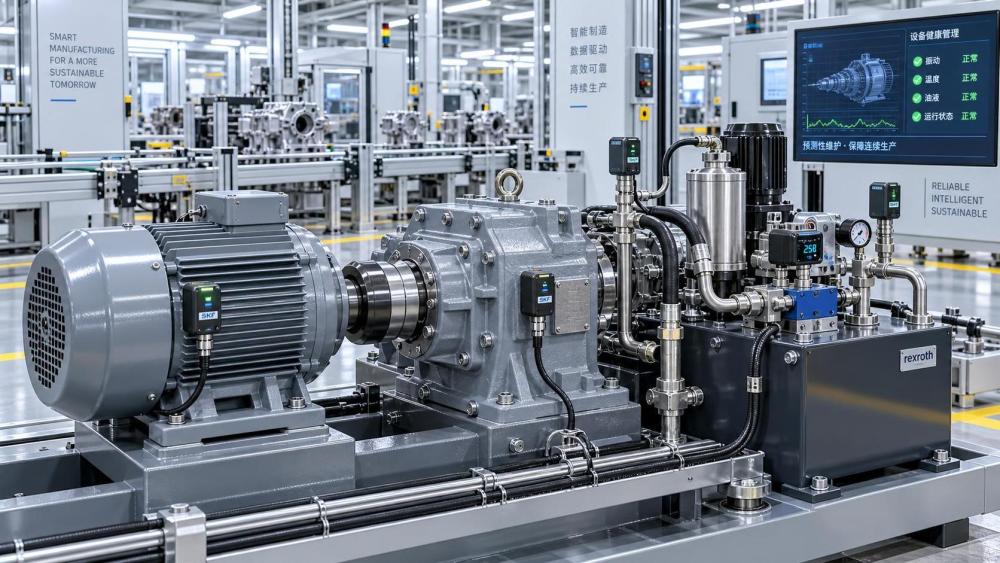
2. Hydraulic Systems: Detecting Degradation Before Pressure Is Lost
Hydraulic equipment produces a different kind of predictive-maintenance opportunity. Failures often develop through contamination, cavitation, internal leakage, hose deterioration, valve sticking, seal damage, pump wear, or overheating. The early warning may not be a single dramatic signal. It may be a gradual change in pressure stability, fluid temperature, pump current, actuator cycle time, filter differential pressure, or oil cleanliness.
Consider a hydraulic power unit supporting presses, injection systems, lifting equipment, or heavy automated machinery. A conventional preventive-maintenance program may replace filters and inspect the fluid at fixed intervals. That remains necessary, but fixed schedules do not always reveal whether a pump is losing volumetric efficiency or whether contamination is beginning to affect sensitive valves.
An AI-assisted approach can relate pressure and flow behavior to command signals, load cycles, temperature, and production mode. If the system consistently requires more motor energy to achieve the same hydraulic response, or if pressure recovery becomes slower under comparable conditions, the maintenance team has a reason to investigate. The likely action is not always pump replacement. It may be fluid sampling, a filter check, inspection for suction restrictions, verification of relief-valve behavior, or examination of cylinder seals.
For decision-makers, this example illustrates an important point: predictive maintenance is often a diagnostic workflow, not an autonomous maintenance instruction. The model narrows the search and improves timing. Engineers still need to distinguish between a changing process demand, a control-system issue, a sensor problem, and actual component degradation.
3. Conveyor Drives, Chains, and Belts: Monitoring the System Rather Than One Part
Conveying systems are frequently underestimated because individual components may appear inexpensive. Yet a stopped conveyor can starve downstream equipment, interrupt packaging, block material handling, or create safety and cleanup burdens. AI can be useful when it evaluates the drive as a connected system: motor current, gearbox vibration, belt speed, tracking behavior, chain tension, temperature, start-stop frequency, and production load.
For belts, the relevant pattern may be persistent slip rather than a sudden rupture. A model can identify a gap between commanded motor speed and actual belt movement, especially when correlated with load or moisture conditions. For chains, increasing drive torque, irregular vibration, or altered timing may point to wear, inadequate lubrication, misalignment, or sprocket deterioration. For gearboxes, rising vibration at meshing frequencies may signal conditions that should be addressed before debris or excessive backlash affects the broader drive train.
The practical benefit is coordination. Instead of replacing belts, chains, bearings, and sprockets independently according to calendar intervals, a maintenance planner can decide whether several related parts should be inspected or renewed during the same outage. This reduces repeated access work and lowers the chance that a new component is installed against a worn mating surface.
There is a limit to what data science can infer here. Conveyor performance is heavily influenced by material characteristics, contamination, alignment, cleaning practices, and operating discipline. A system that ignores these factors can confuse process variation with mechanical failure. The best programs combine sensor data with operator observations and a clear record of changes in product, load, or line configuration.
4. Motors and Electrical Assets: From Temperature Alerts to Failure Patterns
Electric motors are among the most widely monitored manufacturing assets, but simple temperature monitoring rarely provides enough lead time on its own. Motor health is connected to bearings, alignment, electrical quality, cooling, duty cycle, insulation condition, and the driven load. AI can help establish normal relationships between these variables and flag conditions that do not fit the expected pattern.
Examples include a motor drawing unusually high current for a stable production demand, a temperature rise that exceeds the expected response to ambient conditions, or vibration that increases after an alignment or coupling change. In a more mature program, motor electrical data can be combined with mechanical signals to separate likely electrical faults from load-side friction, coupling misalignment, or bearing deterioration.
This is particularly valuable for assets where a motor failure can conceal a larger issue. Replacing a failed motor without identifying excessive load, poor alignment, damaged coupling elements, or a degrading gearbox may only reset the failure clock. Predictive analysis is worthwhile when it supports root-cause discipline rather than faster component replacement alone.
Why Some Predictive-Maintenance Pilots Fail to Scale
The market case for AI maintenance is convincing only when the operating model is credible. Many pilots show that sensors can produce data and algorithms can generate alerts. Scaling across a plant or network is harder because it requires asset hierarchy, consistent naming, maintenance history, workflow ownership, cybersecurity controls, and a response process that technicians trust.
Several failure patterns recur:
- Monitoring low-consequence assets while the highest-cost failure modes remain uninstrumented.
- Installing sensors without establishing baseline conditions after commissioning, repair, or operating changes.
- Generating more alerts than the maintenance team can investigate, causing alarm fatigue.
- Expecting a model to diagnose faults where the available signals cannot distinguish among several plausible causes.
- Keeping condition data separate from work orders, spare-parts records, and failure codes.
- Measuring success by the number of connected assets rather than avoided disruption, improved planning, and reduced collateral damage.
These problems are not arguments against AI. They indicate that predictive maintenance should be introduced as a reliability program with digital tools, not as a standalone software deployment. The analytics layer needs a clear owner, but the benefits cross maintenance, production, engineering, procurement, and finance.
How to Select the First Assets
Executives often ask which machines should enter the first deployment. The answer should follow the consequences of failure, not the ease of attaching a sensor. An asset is a strong candidate when its failure stops a constraint in production, creates a meaningful safety or quality exposure, has long replacement lead times, or tends to cause damage beyond the first failed component.
Critical bearings, hydraulic pumps, gearboxes, compressors, high-duty motors, and specialized production equipment often score well because their replacement and outage planning are consequential. By contrast, an asset with cheap replacement, easy access, redundancy, and no detectable early failure pattern may be better managed through simple preventive maintenance and stocked spares.
The Procurement Question Is Broader Than Sensor Price
When evaluating condition-monitoring and AI platforms, buyers should examine the full decision chain. Sensor durability and data quality are important, particularly around heat, moisture, dust, vibration, chemical exposure, and electromagnetic interference. Yet the more consequential questions are whether the system can integrate with existing controls and maintenance systems, how it handles different operating modes, how alerts are explained, and how data remains available if a vendor relationship changes.
Component compatibility also deserves attention. A predictive program may identify a bearing issue, but the repair still depends on correct fit, internal clearance, lubrication choice, seal arrangement, installation method, and alignment. Similarly, a hydraulic alert may lead to a pump, filter, valve, or seal decision that must account for fluid compatibility, pressure rating, contamination control, and delivery lead time. Digital diagnosis should improve these choices, not disconnect maintenance planning from component engineering.
For multi-site manufacturers, standardization is often more valuable than an ambitious first deployment. Common asset criticality rules, sensor specifications, fault codes, work-order categories, and review routines make it possible to compare performance across plants and refine the model over time. A collection of isolated dashboards rarely produces the same operational leverage.
What the Market Is Moving Toward
The direction of travel is toward more targeted, explainable, and operationally connected predictive maintenance. Edge-based analysis is increasingly relevant where raw high-frequency data is costly or impractical to transmit continuously. Multimodal monitoring, combining vibration, thermal, acoustic, electrical, process, and lubricant information, can improve confidence for complex faults. The useful output will increasingly be a prioritized maintenance decision rather than another chart for specialists to interpret.
Manufacturers should remain cautious about claims that AI will eliminate unplanned downtime. Some failures are sudden, some signals are weak, and some operating environments change too frequently for stable models. The defensible objective is narrower and more valuable: detect enough developing failures early enough to schedule intervention, protect production commitments, and use labor and spare parts with more discipline.
That is why the most persuasive AI predictive maintenance examples are often unglamorous. A bearing replacement is planned before a line stoppage. A hydraulic pump is inspected before pressure instability becomes a production event. A worn chain and sprocket are changed during a coordinated shutdown. These decisions may not look like a technological revolution in isolation, but across critical assets they can materially improve manufacturing reliability and lifecycle value.
Related News
- 00
0000-00
When does a pneumatic system integrator reduce project risk? - 00
0000-00
When edge computing diagnostics reduce unplanned downtime - 00
0000-00
How precision transmission systems improve robot positioning accuracy - 00
0000-00
When welded hydraulic cylinder systems suit high-cycle equipment - 00
0000-00
How to Calculate Condition Monitoring ROI Across Critical Production Assets
Weekly Insights
Stay ahead with our curated technology reports delivered every Monday.