





A pneumatic system integrator reduces project risk when compressed-air architecture, component selection, controls, safety, and commissioning must operate as one coordinated system from the first design decision.
For project managers, the central question is not whether an integrator can supply cylinders, valves, fittings, or controls. It is whether integration prevents expensive problems before they appear during installation.
The strongest business case arises when multiple suppliers, machine modules, utilities, safety requirements, and performance targets create interfaces that no single component vendor fully owns.
In simple applications, direct component purchasing may be sufficient. In complex automation projects, however, an experienced pneumatic system integrator can reduce schedule, cost, energy, quality, and startup risk.
This article explains the situations where integration delivers measurable value, the risks that should trigger early involvement, and practical criteria for evaluating an integrator’s engineering capability.
Risk Is Reduced When System Interfaces Matter More Than Individual Components
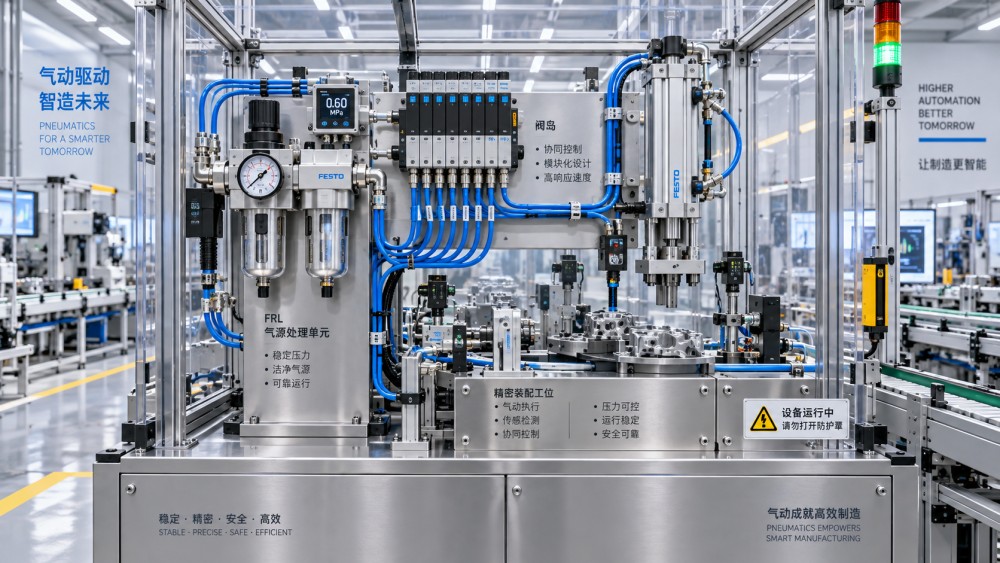
A pneumatic system rarely fails because one catalog component is inherently unsuitable. It fails because airflow, pressure, control logic, mechanical motion, installation practices, and operating conditions were not aligned.
Project risk increases when responsibility is divided among mechanical designers, electrical controls teams, plant utility engineers, machine builders, installers, and several component suppliers with separate assumptions.
A pneumatic system integrator creates a defined technical owner for those interfaces. That ownership can reduce the chance that unresolved assumptions become late-stage commissioning failures or change orders.
For example, a cylinder may meet its calculated force requirement but still perform poorly if pressure drops across undersized tubing, filters, regulators, and valve manifolds were ignored.
Likewise, a valve island can be technically compatible with a PLC yet create diagnostic limitations, wiring complexity, or unacceptable response delays when controls architecture is considered too late.
Integration adds value when the project needs a complete air-preparation strategy, distribution layout, actuator package, valve control arrangement, sensing method, safety circuit, and acceptance test plan.
Project leaders should involve an integrator early when machine performance depends on coordinated sequences, rapid cycle times, controlled clamping forces, synchronized axes, or reliable part handling.
Early involvement is particularly important where pneumatic functions interact with hydraulic equipment, servo motion, robotics, conveyors, tooling, process controls, or safety-rated machine guarding.
In these environments, isolated component specifications can create false confidence. The real engineering question is whether the combined pneumatic system achieves required performance under operating conditions.
An integrator should translate production requirements into measurable design inputs, including cycle time, payload, travel distance, duty cycle, ambient temperature, contamination exposure, available pressure, and allowed downtime.
That translation reduces ambiguity between project stakeholders. It also creates an auditable basis for selecting components, estimating air demand, sizing infrastructure, and validating final machine behavior.
The result is not merely a better pneumatic bill of materials. It is a more controlled project with fewer undocumented decisions and clearer accountability for system performance.
Situations That Justify Early Pneumatic System Integration
The first high-risk situation is a new production line or major machine build with several pneumatic stations. Shared air supply conditions can affect every downstream actuator and tool.
Without coordinated demand calculations, simultaneous cylinder movements may cause local pressure collapse. That can produce inconsistent clamping, missed sensing positions, slower cycles, and confusing intermittent faults.
An integrator can model peak and average consumption, establish allowable pressure-drop limits, and recommend receiver capacity, distribution pipe sizing, regulator zoning, and local storage where appropriate.
The second situation involves aggressive throughput targets. When a machine must complete many cycles per minute, actuator sizing alone cannot establish whether motion will remain stable and repeatable.
Stroke speed depends on available flow, valve capacity, exhaust restrictions, tubing geometry, load behavior, cushioning, and the timing of adjacent pneumatic events. These variables require system-level analysis.
A third trigger is safety-critical motion. Pneumatic systems used for clamping, lifting, guarding, pressing, or holding parts may require defined safe states during power loss, emergency stops, or maintenance.
Here, integration includes more than selecting safety valves. The design must account for residual pressure, gravity, stored energy, restart behavior, manual lockout requirements, and applicable machinery safety standards.
Projects operating in demanding environments also benefit from specialized integration. Washdown, dust, heat, corrosion, vibration, outdoor exposure, and hazardous atmospheres can change component and enclosure requirements substantially.
In food processing, pharmaceutical packaging, battery manufacturing, semiconductor support equipment, and chemical operations, material compatibility and cleanliness can be as important as force and speed.
A fourth trigger is an existing plant with unstable pneumatic performance. Repeated cylinder failures, poor repeatability, excessive air use, water contamination, or unexplained pressure variation usually indicate a system problem.
Replacing failed components one at a time can prolong the issue. A pneumatic system integrator can investigate supply quality, leakage, filtration, pressure regulation, control sequences, and mechanical loads together.
Integration is also valuable when global deployment is planned. Multi-site projects require documentation, approved alternatives, regional compliance awareness, spare-parts strategy, and consistent commissioning practices across facilities.
For project managers, the key test is straightforward: if a local design decision can create consequences for another machine function, utility system, operating team, or site, integration deserves consideration.
How an Integrator Prevents Costly Design and Commissioning Failures
Effective integration begins with a requirements review rather than a component quotation. The review should clarify process intent, operating envelope, reliability target, maintenance expectations, and site utility constraints.
That process exposes questions often missed in early designs. Is the available compressor capacity verified? Will future expansion increase demand? Are pressure specifications measured at the source or at the actuator?
A competent integrator then develops a functional architecture. This connects air generation and treatment, distribution, local regulation, valves, actuators, sensors, controls, exhaust management, and machine safety functions.
Design reviews should include pressure-drop calculations, actuator force calculations with safety margins, flow requirements, pneumatic schematic validation, electrical interface review, and accessible maintenance arrangements.
Good engineering also evaluates failure modes. A valve failure, sensor fault, line rupture, clogged filter, low-pressure event, or control communication loss should produce predictable and acceptable machine behavior.
This analysis helps prevent the common commissioning pattern where technicians adjust regulators, flow controls, and PLC timers repeatedly because the underlying design assumptions were never validated.
Controls integration is especially important for intelligent valve manifolds and sensor-rich systems. Network choice, I/O allocation, diagnostics, fault handling, cable routing, and documentation should be defined before installation.
When pneumatic diagnostics are available, they should support maintenance decisions rather than create unused data. Pressure trends, cycle counts, switching times, and fault codes need clear operational ownership.
Commissioning planning also reduces schedule uncertainty. Factory acceptance tests can verify sequences, pressure behavior, safety response, leakage, sensor operation, and performance criteria before equipment reaches the customer site.
Site acceptance criteria should be equally explicit. A project should define what constitutes successful cycle time, repeatability, leak rate, air quality, safety function, alarm behavior, and operator handover.
These practices reduce expensive field modifications. They also make supplier performance easier to assess because technical expectations are documented instead of interpreted differently by each project participant.
The integrator’s practical contribution is therefore coordination plus verification. Both matter because a finished schematic or parts list does not prove that the installation will perform reliably in production.
Evaluating a Pneumatic System Integrator Before Awarding Work
Project managers should evaluate an integrator as an engineering partner, not only as a distributor. Product availability matters, but technical process and accountability determine whether risk is actually reduced.
Begin by asking for comparable application experience. Relevant references should match the project’s operating conditions, automation complexity, industry requirements, cycle demands, and safety responsibilities.
A provider experienced only in standard air preparation assemblies may not be suitable for multi-axis automation, high-speed packaging, controlled gripping, safety-rated control circuits, or global machine deployment.
Next, review the engineering deliverables included in the scope. These may include pneumatic schematics, flow and force calculations, layout drawings, bills of materials, I/O lists, safety documentation, and test procedures.
Clear deliverables protect the project from vague expectations. They also help procurement compare proposals based on technical completeness rather than initial component price alone.
Ask how the integrator manages design changes. Projects frequently evolve after mechanical interfaces, payloads, cycle rates, layouts, and customer requirements are refined during detailed engineering.
A credible partner will explain version control, approval steps, impact assessment, alternative-component management, and how changes affect pressure demand, safety functions, delivery dates, and commissioning plans.
Supply-chain resilience should be assessed separately from engineering skill. Confirm approved component alternatives, lifecycle support, regional stock capability, lead-time visibility, and spare-parts recommendations for critical assemblies.
Quality processes also deserve scrutiny. Look for documented assembly standards, pressure testing where relevant, labeling conventions, traceability, inspection records, and procedures for handling nonconforming components.
For international equipment projects, verify knowledge of applicable standards and documentation needs. Requirements can involve machine safety, electrical interfaces, pressure equipment considerations, hygiene, materials, or customer-specific specifications.
The strongest evaluation method is a focused technical workshop. Ask the candidate to identify likely failure points, missing data, assumptions, and validation steps using a real machine module or process scenario.
This reveals whether the proposed pneumatic system integrator understands system behavior. It also shows whether its engineers ask the questions needed to protect the project before purchase orders are released.
Measuring the Business Value Beyond the Purchase Price
Integration should be justified through total project economics, not a comparison of unit prices. The lowest-cost valve, cylinder, or fitting can become expensive when it contributes to rework or production instability.
Schedule value is often the most immediate benefit. Avoiding even a few days of delayed commissioning can outweigh an integrator’s engineering fee on a machine with constrained installation windows.
Labor savings should include reduced internal coordination effort. Project teams spend significant time resolving drawing conflicts, supplier questions, control mismatches, missing parts, and field-fit issues after delivery.
Reliability value should be considered over the operating life. Better air treatment, correct component sizing, accessible layouts, diagnostics, and standardized spares can lower maintenance intervention and unplanned downtime.
Energy is another measurable category. Leak reduction, appropriate pressure settings, optimized air consumption, proper tube sizing, and avoiding unnecessary blow-off usage can reduce compressed-air operating cost.
Compressed air is frequently treated as a free utility during design. In reality, it is energy-intensive, and poorly integrated pneumatic equipment can embed avoidable operating cost for years.
Risk-adjusted value is especially relevant for high-consequence installations. Where failure threatens worker safety, customer acceptance, product quality, regulatory exposure, or contractual milestones, prevention has substantial economic value.
Project managers can create a simple value model using avoided redesign hours, reduced startup delay, lower installation rework, estimated energy savings, fewer spare-part variants, and expected downtime reduction.
The model does not need false precision. Its purpose is to compare integration cost with credible exposure, making the decision transparent to engineering, procurement, finance, and executive stakeholders.
A good integrator should support this calculation with data, assumptions, and testable performance commitments. General promises about efficiency or reliability are not sufficient for a defensible project decision.
When Direct Purchasing May Be the Better Choice
Not every pneumatic application requires a full integration scope. Direct purchasing is often reasonable for a proven replacement, a small standalone function, or an internally standardized machine design.
If the circuit is unchanged, operating conditions are well understood, interfaces are stable, and internal engineering resources own commissioning, component-level sourcing may provide adequate value.
The decision changes when modifications affect multiple interfaces. A simple cylinder replacement can become an integration project if loads, speeds, controls, safety behavior, tubing routes, or available pressure are changing.
Project managers should avoid treating integration as an all-or-nothing decision. Targeted services, such as design review, air-demand analysis, safety validation, panel assembly, or commissioning support, may be sufficient.
This modular approach can preserve internal control while bringing external expertise to the areas with the greatest technical uncertainty or operational consequence.
The practical objective is proportionality. Spend on integration where the cost of an overlooked interface is higher than the cost of resolving it through structured engineering before installation.
Conclusion: Use Integration Where Failure Has System-Level Consequences
A pneumatic system integrator reduces project risk when compressed air is no longer a simple utility connection but a performance-critical part of machine operation, safety, quality, and production availability.
The clearest triggers are complex automation, high cycle rates, shared air infrastructure, demanding environments, safety-critical functions, unstable existing equipment, and multi-site deployment requirements.
For project managers, the decision should focus on interfaces, accountability, and validation. Component quality matters, but coordinated design and commissioning determine whether the overall system performs as intended.
Evaluate integration partners through relevant application experience, defined engineering deliverables, change-control discipline, supply resilience, quality processes, and their ability to identify project-specific risks early.
When these capabilities are applied before procurement and installation, integration can reduce redesign, startup delays, energy waste, maintenance burden, and uncertainty across the full pneumatic system lifecycle.
Related News
- 00
0000-00
When does a pneumatic system integrator reduce project risk? - 00
0000-00
When edge computing diagnostics reduce unplanned downtime - 00
0000-00
How precision transmission systems improve robot positioning accuracy - 00
0000-00
When welded hydraulic cylinder systems suit high-cycle equipment - 00
0000-00
How to Calculate Condition Monitoring ROI Across Critical Production Assets
Weekly Insights
Stay ahead with our curated technology reports delivered every Monday.