





How Precision Transmission Systems Improve Robot Positioning Accuracy
Precision Transmission Systems for robotics are essential to achieving repeatable, accurate positioning in demanding automation environments. For technical evaluators, component choices such as high-precision gearboxes, couplings, bearings, belts, and motion-control assemblies directly affect backlash, stiffness, torque delivery, vibration, and long-term reliability. A robot controller can calculate an ideal path, but the mechanical system must physically reproduce it under changing loads, speeds, temperatures, and duty cycles.
This distinction matters in welding, machine tending, dispensing, electronics assembly, optical inspection, battery manufacturing, packaging, and semiconductor-related handling. In each case, a robot may appear accurate during a low-speed demonstration yet lose path quality when accelerating, carrying a payload, reversing direction, or operating continuously. The transmission system is often where that gap begins.
Robot positioning accuracy should therefore not be assessed as a motor, encoder, or software issue alone. It is a system result. The servo motor, reducer, output bearing arrangement, coupling, pulley or belt drive, mounting interfaces, arm structure, lubrication condition, and control tuning all contribute to the final position at the end effector.
Positioning Accuracy Is More Than Encoder Resolution
A high-resolution encoder reports motor position with great precision, but it does not automatically confirm where the robot flange is located. Between the encoder and the tool point, mechanical compliance and transmission error can accumulate. A gearbox may have backlash. A belt may stretch slightly under peak load. A coupling may accommodate misalignment but introduce torsional wind-up. Bearings may allow elastic deflection when a cantilevered payload changes orientation.
The practical question is not simply, “How fine is the encoder?” It is, “How closely does the output axis follow commanded motion over the full operating envelope?” This includes static positioning, repeated moves to the same point, contouring during motion, settling after a rapid stop, and behavior after direction reversal.
ISO 9283 is commonly referenced when evaluating industrial robot performance characteristics, including pose accuracy and pose repeatability. It is useful because it separates concepts that are often mixed together in specifications. Repeatability describes how consistently a robot returns to a pose; accuracy describes how close that pose is to the programmed or intended location. A robot can be highly repeatable but require calibration to correct a systematic offset. It can also show acceptable static accuracy while producing poor dynamic path performance because of transmission compliance or vibration.
For evaluators, that is why a single headline accuracy number should never replace a review of the mechanical transmission architecture.
Where Transmission Error Enters the Robot Axis
Most rotary robot joints convert motor torque into controlled output motion through a reduction stage. Harmonic, cycloidal, planetary, and precision bevel gear arrangements may be used depending on axis location, reduction ratio, payload, shock loading, size constraints, and required stiffness. Each approach involves trade-offs rather than a universally superior design.
Backlash is the most familiar source of error. It is the lost motion observed when rotational direction reverses before output torque is fully transferred through the gear train. In a robotic axis, even a small angular clearance can become noticeable at the tool center point, particularly on long arms or wrist assemblies. Backlash may also interfere with force-sensitive processes, fine insertion tasks, and contour paths requiring frequent reversals.
However, backlash is only one part of the problem. Transmission error can also result from gear tooth geometry, eccentricity, manufacturing variation, bearing runout, housing distortion, assembly preload, and local elastic deformation under load. These effects may be periodic, load-dependent, temperature-dependent, or progressive as components wear. A reducer with low nominal backlash is not automatically the best choice if its torsional stiffness, bearing support, lubrication behavior, or overload capacity does not suit the application.
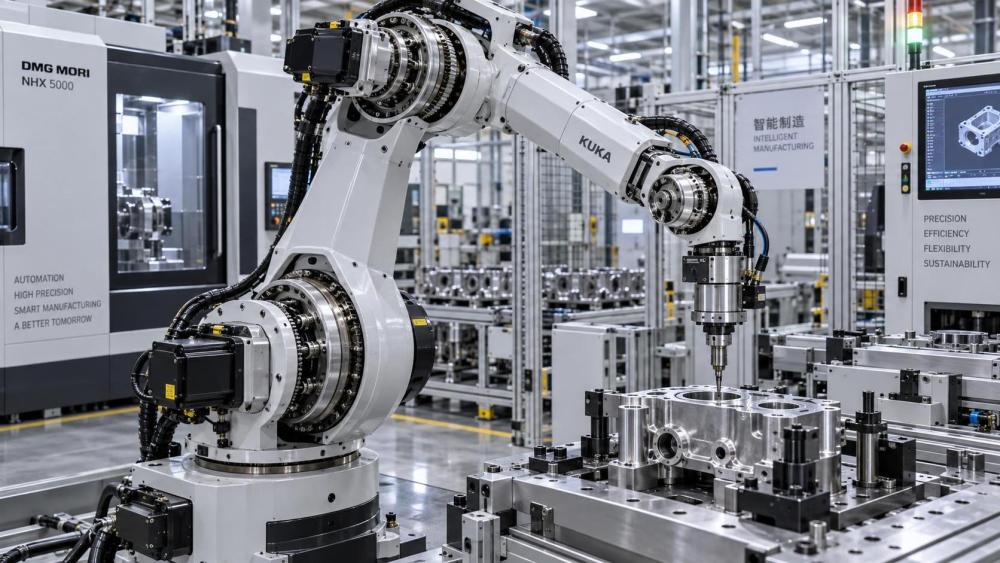
Torsional stiffness deserves particular attention. When torque rises, every mechanical element twists or deflects to some degree. In a low-stiffness drivetrain, the motor can move before the output catches up. During acceleration and deceleration, stored elastic energy can create overshoot, oscillation, and longer settling time. Controller tuning can mitigate some of this behavior, but it cannot remove a fundamentally compliant mechanical path.
Gearboxes: Matching Precision to the Actual Axis Duty
A reducer should be selected from the output-side requirements backward, not from ratio alone. Engineers need to consider continuous and peak torque, inertia ratio, emergency-stop loads, duty cycle, required angular stiffness, permissible backlash, radial and axial loads, mounting orientation, ambient temperature, and expected lubrication life. These factors become more critical on base and shoulder axes, where large moments are transmitted through the joint, but wrist axes can be equally sensitive because small errors are magnified at the tool.
Precision planetary gearboxes are often valued for compactness, torque density, and relatively straightforward servo integration. Their performance depends heavily on gear quality, carrier accuracy, bearing support, preload strategy, and assembly control. Harmonic-style strain wave reducers can provide high reduction ratios in a compact form and are widely associated with robotic joints, but their stiffness, torsional behavior, load limits, and service profile still require close review. Cycloidal designs may be attractive in applications where shock resistance and high torque capacity are priorities.
Gear accuracy classifications can be discussed in relation to standards such as ISO 1328 for cylindrical gears, but an individual gear grade does not by itself predict assembled robot-axis performance. The reducer is a mechanism, not merely a set of gears. Housing stiffness, bearing fits, preload, lubrication, sealing, and assembly alignment can influence its final behavior as much as the tooth quality.
Technical reviews should request relevant performance curves and test conditions rather than relying only on catalogue labels such as “precision” or “low backlash.” Useful questions include whether backlash is specified at no load or under a defined torque, whether torsional stiffness is measured at the output, how permissible moment loads are established, and what temperature range applies to the published values.
Bearings Determine How Well an Axis Holds Its Geometry
The bearing system around a robot joint determines whether the output remains coaxial and stable as external loads change. Cross-roller bearings, angular-contact arrangements, tapered roller bearings, and specialized integrated bearing solutions may be used depending on the geometry and loading condition. The correct arrangement must resist radial loads, axial loads, and overturning moments without excessive displacement.
Bearing clearance and preload are particularly consequential. Excess clearance can permit unwanted motion at the joint. Excessive preload can raise friction, heat generation, torque demand, and the risk of premature damage. The acceptable balance depends on speed, load spectrum, lubrication, housing material, thermal expansion, and the robot’s required motion quality.
Runout is another overlooked issue. If bearing seats, output flanges, or adjacent gears are not manufactured and assembled with appropriate geometric control, the resulting error may appear as periodic tool motion, vibration, or inconsistent process quality. This is especially relevant where robots carry cameras, precision dispensing heads, laser tools, or inspection devices that are sensitive to minor displacement.
Bearing life calculations may refer to ISO 281, but rated life is not a complete measure of robotic suitability. A bearing can meet a nominal life target while still creating unacceptable friction variation, vibration, or stiffness loss for a precision application. Evaluators should consider both fatigue life and functional precision throughout the intended maintenance interval.
Couplings, Belts, and Secondary Drives Can Undermine a Good Reducer
Not every robotic motion axis uses a reducer directly at the joint. Linear transfer units, external axes, gantries, collaborative workcells, tool changers, and auxiliary positioning equipment may rely on belts, rack-and-pinion drives, chains, couplings, and screw-driven systems. Here, transmission quality remains central to positioning performance.
A flexible coupling is often necessary to accommodate small alignment errors between motor and driven shaft. Yet excessive coupling compliance can lower torsional stiffness and complicate servo tuning. The selection process should weigh misalignment capacity against torsional rigidity, damping behavior, backlash, torque capacity, and operating temperature. In high-response axes, a coupling selected only for nominal torque can become a hidden source of settling problems.
Timing belts offer clean operation, lower inertia, long center-distance capability, and useful damping characteristics. Their limitations must still be acknowledged. Belt tension, pulley concentricity, tooth engagement, temperature, contamination, and cord creep influence positional stability. A belt-driven external axis may perform well in pick-and-place work but require more careful analysis for metrology-related positioning or high-force machining support.
Chain drives are robust in harsh transmission environments, but chain clearance and wear generally make them less suitable where fine bidirectional positioning is required. They can be appropriate for supporting, conveying, or indexing functions within an automation system, while the precision robot axis itself uses a more rigid, lower-backlash solution.
Dynamic Behavior Often Separates a Viable Design from a Stable One
Robot axes are not static structures. They accelerate rapidly, reverse direction, stop abruptly, and encounter changing payload inertia. The combination of motor inertia, gearbox stiffness, arm compliance, bearing support, and tool mass produces natural frequencies that can fall within the operating range. When this occurs, the robot may vibrate, overshoot, or require slower motion profiles to remain stable.
A common mistake is to address every path-quality problem through control settings. Better tuning may improve the result, but control gains that are too aggressive can excite a mechanical resonance. Reducing gains may suppress oscillation but extend settling time and reduce throughput. The better approach is to examine the mechanical and control system together: drivetrain stiffness, mass distribution, reduction ratio, bearing support, motor sizing, and trajectory profile.
Payload changes deserve separate validation. A robot carrying a lightweight gripper may behave very differently once a heavy fixture, welding torch package, camera enclosure, or offset workpiece is installed. The payload’s center of gravity and moment of inertia affect the transmission load more directly than mass alone. Evaluations should therefore use representative tools and operating trajectories wherever possible.
Reliability Is Part of Positioning Accuracy
A transmission system that meets accuracy requirements when new but loses consistency after extended operation creates a maintenance and quality problem. Wear changes backlash. Lubricant degradation changes friction and heat. Seal failure permits contaminants to enter bearings or gear stages. Loose mounting interfaces alter alignment. In washdown, abrasive, high-temperature, or chemically exposed environments, these risks can accelerate.
Sealing is therefore not peripheral to precision. Suitable rotary seals, O-rings, labyrinth features, grease selection, and housing protection help preserve the lubricated contact conditions on which transmission accuracy depends. The required sealing material must be evaluated against media, temperature, pressure, motion, and cleaning chemistry. A seal selected only for static compatibility may not survive the dynamic conditions of a robot joint or actuator.
Condition monitoring can provide an earlier indication of deterioration. Changes in vibration, motor current, temperature, backlash during inspection, or repeatability trends may point to developing transmission issues. Such signals require interpretation in context; a vibration increase can originate from bearings, gears, mounting structures, or an attached tool. Still, a structured monitoring plan is often more useful than waiting for visible process defects or catastrophic failure.
A Practical Evaluation Framework
When reviewing Precision Transmission Systems for robotics, technical teams should translate process needs into measurable mechanical requirements. This avoids the familiar situation in which a component meets a general specification but does not support the actual task.
- Define the required tool-center-point accuracy, repeatability, path tolerance, and settling time under real payload conditions.
- Map the complete torque path from motor to end effector, including reducers, couplings, bearings, belts, interfaces, and structural members.
- Review backlash, torsional stiffness, lost motion, runout, and permissible external loads using clearly stated test conditions.
- Check dynamic behavior across acceleration, deceleration, reversals, emergency stops, and the intended duty cycle.
- Confirm lubrication, sealing, inspection access, replacement strategy, and environmental compatibility before finalizing the architecture.
Procurement decisions should also consider consistency between production batches, documentation quality, traceability where required, spare-parts availability, and realistic service support. These factors do not replace engineering validation, but they influence whether the validated design can be maintained over its working life.
PCTS approaches these questions across the wider component system rather than treating gearboxes, bearings, seals, and monitoring devices as isolated purchase categories. For automation integrators, OEM teams, and maintenance planners, the useful starting point is often a connected review of tribology, force transmission, contamination control, assembly quality, and lifecycle serviceability.
The most reliable path to better robot positioning is not simply specifying the lowest available backlash. It is selecting a transmission architecture whose stiffness, load capacity, geometry control, lubrication, sealing, and dynamic response match the motion task. Before approving a design, confirm how each published value was measured, test representative payloads and trajectories, and assess how the system will retain its precision after real operating hours rather than only at initial commissioning.
Related News
- 00
0000-00
How precision transmission systems improve robot positioning accuracy - 00
0000-00
When welded hydraulic cylinder systems suit high-cycle equipment - 00
0000-00
Building a Conveyor Belt Predictive Maintenance Plan for Dusty Facilities - 00
0000-00
Which Chain Wear Indicators Enable Reliable Predictive Maintenance? - 00
0000-00
Predictive Maintenance for Conveyor Belts: Preventing Failures in High-Throughput Lines
Weekly Insights
Stay ahead with our curated technology reports delivered every Monday.