





Hydraulic pumps, valves, cylinders, and other fluid power parts may require an export license depending on their technical specifications, destination, end user, and intended use. A component sold for routine industrial maintenance can raise a different compliance question when it is modified for a controlled application or supplied to a restricted party. For distributors, resellers, and agents, the practical challenge is to identify those differences before an order reaches the loading dock.
Export compliance for hydraulic components is therefore a transaction-level assessment, not a label that can be attached permanently to a product family. The same pump may be eligible for shipment without a license in one transaction and require authorization, or be prohibited, in another. The applicable rules depend on the jurisdictions involved and the facts of the sale.
When can a hydraulic component require a license?
A license requirement may arise because the component itself meets the description of a controlled item, because the destination is subject to restrictions, or because the transaction involves a controlled end use or restricted party. More than one of these factors can apply at the same time.
Hydraulic equipment can be dual-use: designed for civilian machinery but also suitable for certain military or other sensitive applications. Dual-use does not mean that every high-performance valve or pump is automatically controlled. It means the technical description must be checked against the relevant control list, including its notes, exclusions, and definitions.
End-use controls may also apply to items that are not specifically described on a control list. Depending on the jurisdiction, concerns involving weapons programs, military end uses, or other restricted activities can trigger authorization requirements or prohibitions. Sanctions may impose additional restrictions independent of the item’s technical classification.
The key distinction: a product classification helps determine which controls may apply to the item; it does not, by itself, approve the customer, destination, or intended use.
Start with the exact item, not the product category
“Hydraulic pump” is a useful description for a sales quotation, but it is rarely detailed enough for an export-control assessment. A distributor needs the manufacturer’s exact part number and revision, a description of any modification, and the specifications relevant to the applicable control entry.
Depending on the item and the wording of the relevant list, useful information may include operating pressure, flow or displacement, response characteristics, construction materials, operating environment, and whether the component was specially designed or modified for a particular system. Do not assume that a parameter matters merely because it appears on a datasheet: compare it with the actual legal text and its defined measurement conditions.
A common difficulty arises with configurable assemblies. A valve body may be sold with different actuators, electronics, or feedback devices under closely related part numbers. The classification review should cover the assembly actually shipped, not an earlier configuration in the supplier’s catalogue. The same applies to replacement parts supplied for an installed hydraulic power unit.
Ask the manufacturer for its export classification and the basis for that classification. Treat it as useful evidence, not as a substitute for reviewing the transaction. The exporter may need to verify that the classification applies to the precise item, jurisdiction, and current version of the rules. Where a supplier cannot provide sufficient technical information, an unresolved classification is a reason to hold the order.
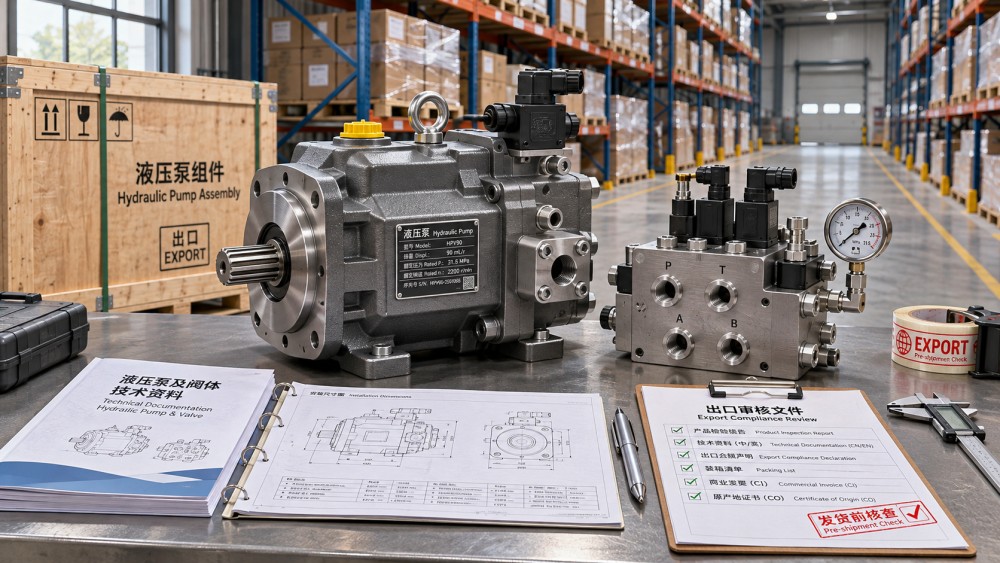
Identify which rules apply to the shipment
The country from which goods are shipped is an obvious starting point, but it is not always the only jurisdiction to consider. The origin of the item, its incorporation into another product, reexports, transit arrangements, and the involvement of controlled technology can also matter. Local legal advice may be needed where several jurisdictions overlap.
For goods subject to the United States Export Administration Regulations (EAR), classification normally involves reviewing the Commerce Control List and identifying an applicable Export Control Classification Number (ECCN), if one exists. Items subject to the EAR that are not listed on the Commerce Control List are generally designated EAR99. That designation is not a universal permission to ship: destination, end-use, end-user, and sanctions restrictions may still apply. Some items may instead fall under another U.S. regulatory regime, including military export controls.
In the European Union, Regulation (EU) 2021/821 establishes the dual-use export-control framework. Its control list and related measures should be checked in their current form, alongside applicable EU sanctions and the requirements of the competent national authority. The United Kingdom maintains its own export-control framework and licensing process. Similar-sounding classifications across jurisdictions should not be treated as interchangeable without verification.
Customs classification is a separate exercise. An HS or tariff code helps describe goods for customs purposes; it does not establish whether a hydraulic component is controlled for export. A commercial invoice showing the correct customs code is not evidence that the licensing assessment is complete.
Follow the component beyond the purchase order
The buyer on the order may be a trading company, while the component is delivered to a machine builder and ultimately installed at a different site. For a meaningful assessment, identify the parties involved and understand their roles: purchaser, consignee, intermediary, end user, and, where relevant, owner or operator. The ship-to address alone does not establish who will use the goods.
Screen relevant parties against applicable restricted-party and sanctions lists, and review potential matches rather than treating a similar name as an automatic match or clearance. Ownership and control rules can also matter even when an organization is not named directly. Screening should be repeated when material details change and close enough to shipment to reflect current restrictions.
An end-use statement can help, but a signed form is not a cure for conflicting facts. A request for a specialized hydraulic actuator, for example, deserves further questions if the stated use is generic maintenance and the buyer cannot identify the equipment or site. That is a reason to investigate, not proof of wrongdoing. If the explanation remains inconsistent, pause the transaction and escalate it under the company’s compliance procedure.
Other warning signs include an unusual routing request without a commercial explanation, a customer unwilling to identify the ultimate recipient, or specifications that do not fit the stated application. None is automatically conclusive. Together with the product and destination, however, they can change the level of diligence needed before release.
A practical release check for distributors
The most reliable workflow connects engineering, sales, and logistics rather than leaving export control to the shipping team. Before confirming a delivery date, assemble a transaction file that answers these questions:
- What is being supplied? Record the exact part number, configuration, technical datasheet, and any software or technical documentation included.
- Which controls apply? Document the relevant jurisdiction, classification, legal basis, and any unresolved technical questions.
- Where is it going? Confirm the destination, delivery route where relevant, and whether sanctions or destination-specific restrictions apply.
- Who will receive and use it? Screen the parties and record the end user, installation site, and intended application to the level warranted by the risk.
- What authorization is needed? Determine whether a license, an applicable exception or exemption, or no license is appropriate under each relevant regime. Do not assume an authorization from one jurisdiction satisfies another.
- Has anything changed? Reassess if the part, customer, destination, end use, or rules change before shipment.
If a license is required, apply to the appropriate authority before exporting and allow for the possibility that the application will be denied or returned for clarification. A license, where granted, must cover the actual item, parties, destination, and activity; its conditions should be communicated to the teams responsible for fulfilment. If an exception or exemption is used, document why its requirements are met rather than recording only the conclusion.
Keep the supporting records required by the applicable rules, including classification evidence, screening decisions, correspondence, licenses, and shipping documents. Retention periods and obligations vary by jurisdiction, so a distributor should set its policy against the rules that actually apply.
Do spare parts and technical support need a separate review?
Yes. A replacement seal kit, pump cartridge, or control valve should not automatically inherit the assessment of the original machine. Its own classification and transaction details need to be checked. Conversely, a part is not necessarily uncontrolled simply because it is described as maintenance stock.
The shipment may also include drawings, installation files, diagnostic information, or remote technical assistance. Transfers of controlled technology or software can be regulated separately from physical goods, depending on the jurisdiction and circumstances. Engineering teams should flag such transfers early, particularly when a customer requests detailed design information rather than ordinary operating instructions.
For component businesses tracking hydraulic systems and MRO demand, PCTS provides industry context that can help frame technical and procurement questions. The licensing decision itself still rests on the current rules and the facts of the individual transaction. Before releasing an uncertain order, verify the exact configuration, end user, and intended application with the supplier and, where needed, the relevant export-control authority or qualified adviser.
Want to dive deeper into these market dynamics, or need data-driven support for your next business move? Drop a line below and let the analysts at PCTS provide customized insights.
We respect your privacy. Your information is strictly confidential.
Related News
- 00
0000-00
How to assess a chain and belt drive manufacturer's quality control - 00
0000-00
How intelligent condition monitoring detects conveyor bearing faults - 00
0000-00
How misalignment affects belt drive components - 00
0000-00
Trelleborg Sealing Solutions Uses AI to Optimize Rotary Shaft Seal Design - 00
0000-00
How turbine operating speed affects precision bearing selection
Weekly Insights
Stay ahead with our curated technology reports delivered every Monday.