





Is Pneumatic Automation Cheaper to Maintain Than Hydraulic Automation?
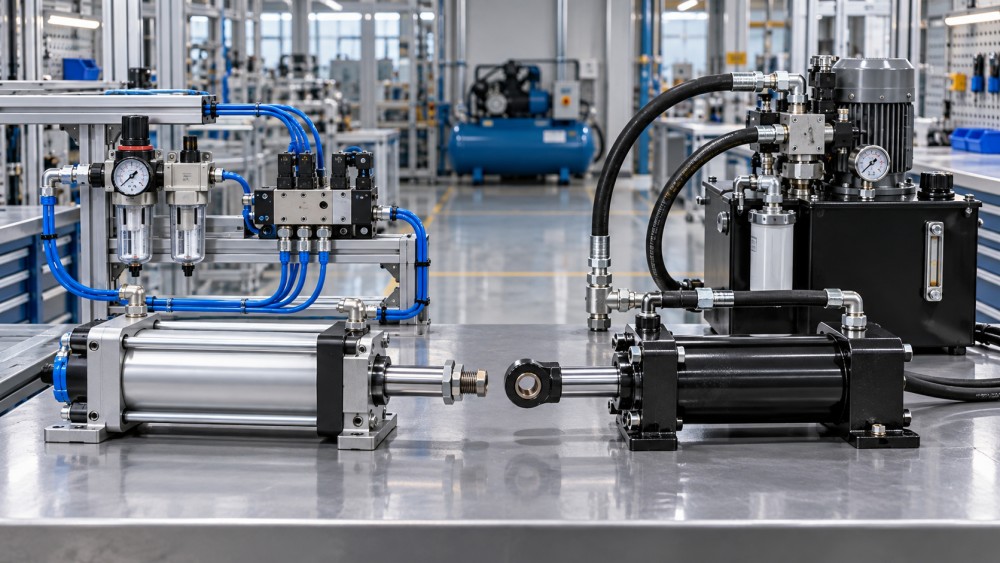
Often, yes—but simpler actuators and fewer fluid-handling requirements do not guarantee lower costs across every application. Compressed-air leaks, filtration, and compressor servicing can offset pneumatic maintenance savings, while hydraulic systems require attention to oil condition, seals, and contamination control. For maintenance teams, OEMs, and procurement managers, the right comparison depends on load requirements, duty cycle, system boundaries, and downtime risk.
The useful distinction is between maintaining an actuator and maintaining the infrastructure that makes it work. A pneumatic cylinder may be inexpensive to replace, yet depend on a poorly maintained compressed-air network. A hydraulic cylinder may cost more to overhaul, yet provide the required force with fewer compromises. Comparing component prices alone misses both situations.
Where Pneumatics Usually Has the Maintenance Advantage
For light-duty clamping, sorting, packaging, and repetitive pick-and-place movements, pneumatic automation often has a lower routine maintenance burden at the machine. Typical tasks include checking fittings and tubing, inspecting cylinder rods, servicing air preparation equipment, and replacing worn seals or valves.
There is no local hydraulic reservoir to sample, no hydraulic oil charge to replace, and generally no oil spill to contain when changing an air cylinder. Accessible, standardized components can also make repairs straightforward. Where production permits module replacement rather than workshop rebuilding, a stocked cylinder or valve manifold can shorten restoration time.
That advantage has limits. A cylinder installed out of alignment will still wear its rod bearing and seals. Excessive speed can damage cushioning arrangements, while contaminated air can make valves stick. Repeatedly replacing inexpensive parts without correcting these causes is not low-cost maintenance; it is recurring failure with a small purchase price.
Lubrication also needs a specific decision. Many pneumatic components are designed for operation without additional oil, provided the air meets the manufacturer's requirements. Adding a lubricator indiscriminately can create unnecessary servicing and process contamination. Follow the component specification rather than assuming every pneumatic circuit needs lubricated air.
The Compressed-Air System Still Needs Maintenance
A common budgeting mistake is to charge compressor maintenance to plant utilities while charging every hydraulic service task to the machine. This makes the pneumatic option look artificially inexpensive. A fair comparison includes an appropriate share of compressor, dryer, receiver, drain, filter, and distribution-system maintenance.
Air quality deserves particular attention. Moisture can promote corrosion and interfere with valve operation. Particles can damage sealing surfaces. Oil carryover may be unacceptable in some processes. The necessary treatment depends on equipment specifications and the application; excessive treatment adds expense, but inadequate treatment transfers cost into failures.
Leaks create two separate costs. Finding and repairing them consumes maintenance labor and materials. The electricity used to supply escaping air is an operating expense. Both belong in total cost of ownership, but combining them under “maintenance” makes it harder to identify whether the real problem is repair effort or wasted energy.
Higher compressor loading caused by leaks may also affect service requirements, depending on compressor design and control strategy. Raising header pressure to compensate for pressure loss is not a substitute for investigating undersized piping, clogged filters, poor regulation, or leaks.
Before expanding pneumatic automation, check pressure at the machine during peak demand—not only at the compressor display. A system that performs well during commissioning may behave differently when neighboring machines cycle simultaneously.
Why Hydraulic Maintenance Is More Demanding—and Sometimes Worth It
Hydraulic oil transmits power, lubricates components, and carries heat and contamination through the circuit. Its condition therefore affects pumps, valves, cylinders, and seals together. Maintenance must consider more than whether the reservoir level is correct.
Typical work includes checking external leakage, inspecting hoses and connections, monitoring filters, evaluating operating temperature, and assessing fluid condition. Depending on the system, oil analysis can help identify particle contamination, water, viscosity changes, or degradation. Sampling methods and acceptance limits should reflect component requirements and operating conditions, not a generic target copied from another machine.
A failed hydraulic component can also create secondary work. Pump wear debris may circulate into valves and actuators, so replacing the pump alone may not restore reliability. Cleaning, flushing, filter replacement, and investigation of the original failure mechanism may be necessary.
However, higher service complexity does not automatically mean worse economics. Hydraulic automation is often appropriate where high force, compact actuators, controlled motion under changing loads, or demanding load-holding arrangements are required. Trying to reproduce those functions with an unsuitable pneumatic design can introduce oversized cylinders, additional mechanisms, and unstable process performance.
Nor should hydraulic maintenance mean changing oil as frequently as possible. Fluid replacement decisions should follow equipment guidance, operating severity, and condition evidence. Unnecessary intervention costs money and can introduce contamination if handling practices are poor.
Match the Technology to the Work Before Comparing Costs
Pneumatic and hydraulic systems are not interchangeable simply because both use cylinders. The theoretical actuator force follows pressure multiplied by effective piston area, but usable force must also account for friction, back pressure, pressure losses, and the required engineering margin. Rod-side force differs from cap-side force because the effective areas differ.
Air compressibility matters as well. For straightforward end-to-end movement, it may be entirely acceptable. For demanding intermediate positioning or variable-load control, it can complicate performance. Advanced pneumatic controls can improve capability, but their sensors, valves, and commissioning requirements must be included in the comparison.
Consider two application patterns—not as measured case studies, but as practical selection tests:
- A packaging gate making short, repetitive strokes: If force requirements are modest and suitable compressed air is available, pneumatic actuation may keep replacement work simple. Air leakage, tubing damage, and cushioning adjustment remain relevant.
- A forming or lifting mechanism under substantial load: Hydraulic actuation may justify its fluid-maintenance burden through force density and suitable motion control. Safe load holding, hose routing, temperature management, and contamination control become central design questions.
For either technology, pressure loss must not allow a hazardous movement. Suspended loads and stored energy require engineered safeguards. Maintenance procedures must address isolation, depressurization, and mechanical restraint where necessary; compressed air is not inherently harmless, and hydraulic pressure must never be checked for leaks by hand.
Build a Comparison That Survives a Budget Review
Use the same operating hours, production duty, and accounting boundaries for both alternatives. Separate four categories: planned maintenance, corrective repairs, downtime consequences, and energy. Installation and commissioning belong in the wider lifecycle calculation, rather than being hidden in annual service costs.
Annual maintenance cost = planned labor and consumables + repair labor and parts + allocated shared-system maintenance.
Then assess downtime and energy separately. This avoids counting the same loss twice and reveals whether a low maintenance bill merely reflects deferred work. Where failure records are weak, use clearly labeled scenarios rather than presenting a single precise forecast.
The most useful inputs are usually available from maintenance records and supplier documentation:
- Actual replacement intervals, including whether failures cluster around particular shifts, loads, or environmental conditions.
- Hands-on repair time versus total production stoppage, including access, isolation, cleaning, testing, and restart.
- Spare-part availability, interchangeability, seal-kit support, and lead times for configured valves or actuators.
- Maintenance capacity: whether technicians can diagnose the system in-house or need specialist support.
- Consequences of failure, including product contamination, scrap, cleanup, and damage to adjacent equipment.
An inexpensive seal kit does not guarantee an inexpensive repair. If replacing it requires dismantling guarding, removing an actuator, and realigning the mechanism, labor and lost production may dominate. Accessibility and modular replacement can matter more than a small difference in component price.
Look Beyond Seals When Failures Repeat
Both technologies suffer when the mechanical system is wrong. Worn guides, damaged bearings, bent mounting brackets, and misaligned couplings can impose loads the actuator was not designed to carry. A recurring rod-seal failure may originate in side loading rather than seal material.
This component-level view connects fluid power with the broader reliability topics covered by Global Precision Components & Transmission Systems (PCTS): bearings, seals, transmission components, condition monitoring, and industrial MRO. A useful supplier comparison should examine how those interfaces affect service life—not just compare cylinder specifications in isolation.
Monitoring should target an identifiable failure mechanism. For pneumatics, changes in cycle time, pressure behavior, or air consumption may justify investigation. For hydraulics, temperature trends, filter differential pressure, fluid analysis, and unusual pump behavior can guide maintenance. None is a complete diagnosis by itself.
The Practical Answer
Pneumatic automation is often cheaper to maintain for suitable light-load, repetitive applications, particularly where clean compressed air and standardized spares are already available. That conclusion becomes less reliable when air infrastructure is neglected, leakage is persistent, or the application demands control beyond the proposed system's capability.
Hydraulic automation generally requires more deliberate fluid and contamination management, but can remain the more economical choice for demanding force and load requirements. Before selecting either technology, confirm the required force throughout the stroke, duty cycle, acceptable downtime, utility condition, and repair access. Then compare the complete service burden—not just the price of the next replacement cylinder.
Want to dive deeper into these market dynamics, or need data-driven support for your next business move? Drop a line below and let the analysts at PCTS provide customized insights.
We respect your privacy. Your information is strictly confidential.
Related News
- 00
0000-00
How to assess a chain and belt drive manufacturer's quality control - 00
0000-00
How intelligent condition monitoring detects conveyor bearing faults - 00
0000-00
How misalignment affects belt drive components - 00
0000-00
Trelleborg Sealing Solutions Uses AI to Optimize Rotary Shaft Seal Design - 00
0000-00
How turbine operating speed affects precision bearing selection
Weekly Insights
Stay ahead with our curated technology reports delivered every Monday.