





A shipment can be physically packed, booked with a carrier, and ready to leave, yet still stop before export because the transaction needs a compliance decision. That is how export control regulations create delays: they introduce checks that sit outside normal freight planning. The issue is not limited to obviously sensitive equipment. Industrial components, replacement parts, software, drawings, technical manuals, and information about the final user can all change the level of review required.
For cross-border purchases of bearings, hydraulic assemblies, seals, actuators, transmission components, and MRO spares, the operational consequence is straightforward. A delayed shipment can hold up a maintenance shutdown, postpone machine commissioning, force an expensive substitute purchase, or leave a production line waiting for one missing component. The practical question is therefore not simply whether goods can be exported. It is whether the supplier can identify control risks early enough to keep the delivery commitment realistic.
Why export controls interrupt an otherwise routine shipment
Export controls govern the transfer of certain goods, technologies, software, and services across borders. They may apply because of what an item is, where it is going, who will use it, or how it will be used. A standard commercial invoice and a carrier booking do not resolve those questions.
Delays normally occur when a shipment reaches a point at which the exporter, freight forwarder, bank, or customs authority needs information that was not collected during quotation or order entry. The order is then placed on hold while the parties classify the item, review the destination, screen the parties involved, or prepare an authorization request where one is required.
This is why a shipment delay often feels sudden to the buyer. The supplier may have confirmed stock and production capacity, but export clearance is a separate readiness condition. A part being available in a warehouse does not mean it is immediately releasable for international delivery.
Four control triggers that commonly affect delivery dates
1. Product classification is incomplete or too generic
Product classification determines whether an item is controlled and, if so, how it should be handled for export. The decision usually depends on technical characteristics rather than the commercial product name. Describing an item as a “bearing,” “valve,” “seal kit,” or “machine spare part” may be enough for sales purposes, but it is rarely enough for a sound export assessment.
For example, an ordinary industrial bearing used in a conveyor may be assessed differently from a high-precision bearing designed for demanding rotational accuracy, high speed, unusual temperature conditions, or specialized equipment. The same principle applies to hydraulic pumps, servo-related components, specialized seals, advanced sensing hardware, and equipment supplied with control software.
Classification becomes difficult when the supplier has only a short part description, an old data sheet, or a customer-created material code. Missing details such as material composition, accuracy class, pressure capability, operating environment, integrated electronics, or intended system can prevent a confident decision. The exporter may then need engineering input, manufacturer documentation, or a formal internal review before release.
2. The destination creates a higher review threshold
A destination can affect transit time even when the product itself is not especially unusual. Some countries, regions, ports, or transshipment routes receive closer scrutiny because of trade restrictions, diversion concerns, or local authorization requirements. A route that appears efficient on a freight quotation may introduce additional questions if goods pass through an intermediary location before reaching the final user.
Destination review is not only about the ship-to address. It may involve the billing party, consignee, freight forwarder, ultimate consignee, installation site, and any intermediary distributor. Where these parties are unclear or inconsistent across documents, the exporter may pause the shipment rather than assume that the commercial address tells the full story.
3. The end user or end use is unclear
End-use review asks what the product will do after delivery. A replacement seal for a chemical processing pump, for instance, has a different context from a similar seal purchased for an unidentified research project or for incorporation into equipment with an unclear downstream application. The component itself may not explain enough.
Questions arise when an order involves a broker, a trading company, a customer that will not identify the final installation site, or a request for unusually broad technical documentation. The concern is not that every distributor transaction is problematic. Industrial supply chains often rely on distributors. The problem is a lack of traceability when the product’s final destination or application cannot be explained in a credible, consistent way.
End-use details also matter when components are designed for high-performance machinery, automated production systems, energy infrastructure, aerospace-related equipment, laboratory systems, or controlled process environments. The right response is not to make assumptions based on the industry name alone. It is to collect enough context to determine whether the order can proceed under the exporter’s compliance process.
4. Documentation does not match the actual transaction
Documentation gaps are among the most avoidable causes of export delay. A purchase order may show one legal entity, the commercial invoice another, and the shipping instruction a third. Part numbers may differ between the packing list and invoice. Product descriptions may be so vague that a customs broker cannot connect them to the classification review. Incoterms, values, quantities, and country-of-origin information can also create questions when records conflict.
Technical documents deserve the same care. Drawings, performance data, CAD files, test reports, and configuration instructions may be supplied alongside physical goods. Sending these files to an overseas recipient can itself require a separate review, particularly where the files reveal controlled technical capability. Treating product data as harmless administrative material is a common mistake.
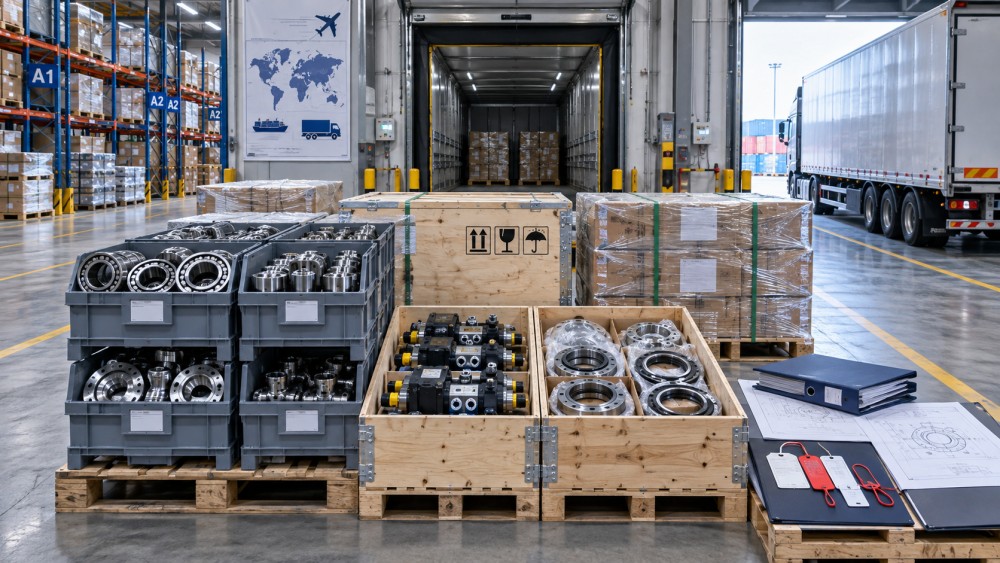
Where delays appear in the shipment timeline
Export control delays do not occur at one predictable point. They can surface before order acceptance, during production release, when the forwarder receives shipping instructions, at customs filing, or after a carrier has accepted the cargo. The later the issue appears, the more costly it becomes because inventory has been allocated, freight may be booked, and the receiving site may already be planning around the expected arrival date.
For critical spares, the practical distinction is between a normal logistics lead time and a compliance-ready lead time. A supplier that states only “in stock” has not answered the second question. A stronger commitment identifies whether classification, party screening, export documentation, and any required authorization have been considered before the shipment date is promised.
Why industrial components are often misjudged
Industrial buyers sometimes assume that small, passive, or replacement components cannot cause export complications. That assumption is unreliable. A basic O-ring or standard chain may present limited concern in many transactions, but a part’s size does not determine its export status. Precision, material, system integration, design purpose, and technical documentation can matter more than physical appearance.
A second error is assuming that a component is automatically unrestricted because it is commercially available. Availability through a catalog does not settle how a specific cross-border transaction must be reviewed. The destination, customer chain, and final use may still change the analysis.
There is also a difference between a component and the knowledge attached to it. A mechanical coupling may be simple to ship, while detailed design drawings, machine configuration files, or specialized operating instructions supplied with it deserve closer handling. Procurement teams that evaluate only the hardware line item can miss the more sensitive part of the delivery package.
For suppliers of precision mechanical and fluid-power products, this is especially relevant where one order combines standard MRO items with engineered assemblies. The order should not be treated as a single compliance category merely because it travels under one invoice. Separate lines may require different classification evidence and different release decisions.
What to ask before relying on an international delivery date
The most useful compliance questions should be asked before a purchase order is released, not after a late shipment notice arrives. They do not require the buyer to perform the supplier’s legal assessment. They establish whether the supplier has the inputs needed to complete it.
- Is the exact manufacturer part number linked to current technical specifications?
- Has the supplier reviewed the item’s export classification, or is the status still based on a generic product description?
- Who is the ultimate consignee, and where will the goods be installed or consumed?
- Is an intermediary distributor buying for stock, or for a defined downstream project?
- Will the shipment include drawings, software, calibration data, manuals, or other technical files?
- Does the planned route pass through another country or use a consolidator that changes the transaction path?
- Are the commercial invoice, packing list, purchase order, and shipping instruction aligned on entities, quantities, values, and descriptions?
- Has the delivery estimate separated manufacturing availability from export release and transit?
These questions are especially important for planned shutdowns, machine build schedules, and repair events where a delayed item has a disproportionate operational cost. In those cases, procurement should identify an approved alternative part, local inventory option, or phased shipment plan before the primary shipment becomes urgent.
Choosing suppliers with fewer compliance-related surprises
Supplier evaluation should look beyond whether a company can produce the part and quote competitive freight. Reliable export execution depends on coordination between sales, engineering, compliance, warehousing, and logistics. A supplier may be technically capable but still create delivery risk if product data is scattered, records are inconsistent, or the compliance team enters the process only after goods are packed.
Useful indicators include whether the supplier requests end-user information early, can explain what technical data is needed for classification, distinguishes a stock availability date from an export release date, and maintains consistent product descriptions across commercial and shipping documents. These are process signals, not marketing claims. They show whether a supplier has a workable path for resolving a review before it becomes a shipping exception.
For component categories such as precision bearings, hydraulic pumps, pneumatic actuators, high-performance seals, and condition-monitoring hardware, technical traceability is particularly valuable. A supplier should be able to connect the part number to the relevant specification rather than relying on broad catalog language. That reduces the chance that a shipment is stopped because the declared item cannot be adequately identified.
PCTS can be useful during this assessment because its coverage connects component function, application conditions, supplier visibility, and MRO planning. When comparing sources for industrial parts, product knowledge should support procurement risk decisions: knowing what a component does, where it is used, and what documentation normally accompanies it helps reveal which orders may need more lead-time discipline.
Build compliance time into the purchasing decision
The best way to reduce disruption is to treat export clearance as a schedule dependency, not an administrative task to be completed after the commercial deal is done. This does not mean every order needs a long buffer. Standard, repeat transactions with established parts, known customers, consistent routes, and complete records can move efficiently. The risk rises when a transaction introduces a new destination, a new intermediary, an engineered product, unfamiliar technical documentation, or an unclear final use.
For repeat purchases, maintain a controlled order record that links approved part numbers, technical descriptions, end-user details, shipping entities, and prior documentation. This avoids rebuilding the same information each time a spare part is ordered. For new projects, make compliance data part of the supplier onboarding package alongside quality documents, delivery terms, and technical approval.
When a delay has already occurred, the fastest productive response is usually to identify the exact missing decision: product classification evidence, party information, end-use confirmation, document correction, or authorization processing. Pressing for a general “release the shipment” update does not resolve the underlying hold. A precise request allows the responsible party to close the actual gap and gives the receiving operation a clearer basis for contingency planning.
International delivery performance is therefore not measured only by freight speed. It depends on whether the product, parties, documents, and use case can withstand review before the goods reach the loading dock. Building that discipline into supplier selection and order planning protects both shipment schedules and operational continuity.
Related News
- 00
0000-00
How export control regulations can delay international shipments - 00
0000-00
Which ISO standards apply to crane hydraulic systems? - 00
0000-00
How preload affects angular contact bearing stiffness and service life - 00
0000-00
Which documents are essential for seal export compliance? - 00
0000-00
When do fluid power systems need closed-loop control?
Weekly Insights
Stay ahead with our curated technology reports delivered every Monday.