





Oil mist lubrication systems lubricate rolling bearings by using compressed air to carry finely atomized oil to a bearing housing. At the outlet, a reclassifier converts part of the mist into larger droplets that deposit on bearing surfaces, supplying oil to the rolling elements, raceways, and cage.
The deposited oil forms a lubricating film as the bearing rotates, separating loaded surfaces where operating conditions allow. The mist is a delivery method, not the lubricating film itself: effective lubrication depends on producing, transporting, and depositing the right amount of suitable oil at the bearing.
How oil mist lubrication systems deliver oil to a bearing
A typical system draws oil from a reservoir into a mist generator, where a stream of clean, dry compressed air atomizes it. The resulting air-and-oil mixture travels through distribution piping to one or more bearing locations.
At each point of use, a fitting or nozzle called a reclassifier changes the flow so that fine particles collide and combine into larger droplets. These droplets are more readily deposited in the bearing housing than the fine mist used for transport.
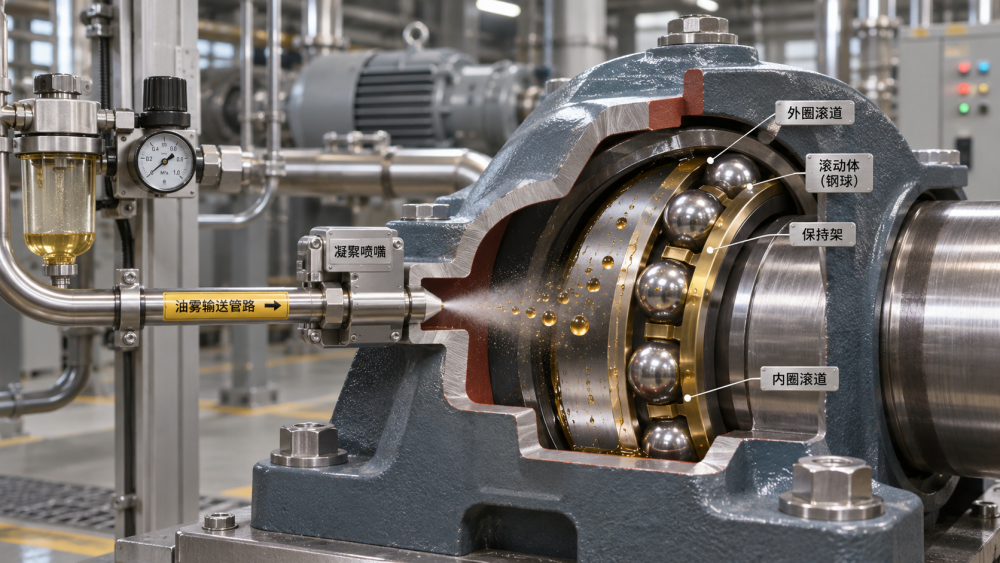
- Prepare the supply: The system provides filtered compressed air and an oil suitable for both mist generation and the bearing’s operating conditions.
- Generate the mist: The generator atomizes oil into an air stream and controls the supply to the distribution network.
- Transport it: The mixture moves through headers and branch lines toward the bearing housings.
- Reclassify and deposit it: A selected outlet fitting produces larger droplets that enter the housing and reach the bearing.
- Lubricate and drain: Deposited oil is distributed by bearing motion; excess oil and air leave through the housing’s intended drain and vent arrangements.
A mist generator can serve multiple points, but delivery to each one is not guaranteed merely because mist is visible in the main line. Branch geometry, pressure, fitting selection, and housing restrictions all affect what reaches an individual bearing.
What happens inside the rolling bearing?
A rolling bearing contains rolling elements, raceways, and often a cage. Even though the elements roll, sliding also occurs at contacts such as the rolling element ends, cage surfaces, and raceway shoulders. These contacts need a suitable supply of lubricant to control friction and wear.
Once oil enters the housing, rotating components help distribute it. At loaded rolling contacts, the combination of motion, oil viscosity, and contact pressure can create an elastohydrodynamic lubricant film. The film’s thickness depends on conditions including speed, load, temperature, and oil properties.
Oil mist does not remove the need for correct viscosity selection. If the operating oil is too thin for the contact conditions, the surfaces may experience increased metal-to-metal interaction even when the mist system is delivering oil. Excessive viscosity or oversupply can also increase resistance and heat, depending on the bearing and housing design.
The air stream can help maintain a slight positive pressure in a suitably designed housing, discouraging entry of external contaminants. This is not a substitute for effective seals, clean supply air, or an appropriate vent: an obstructed vent can create unwanted pressure and affect leakage or mist flow.
Why reclassification and housing design matter
Fine particles are useful for transport because they can remain suspended in the air stream. However, mist that passes through a housing and exits without depositing enough oil provides little benefit to the bearing. Reclassification and outlet placement help turn transported oil into usable lubrication at the point of need.
The fitting must be selected for the mist system and bearing arrangement, rather than treated as an interchangeable orifice. A housing with several bearings may require a distribution arrangement that ensures oil reaches each contact, especially where shoulders, seals, or internal passages restrict movement.
Drainage is equally important. If oil collects faster than it can leave, the bearing can churn the accumulated oil, adding drag and heat. Conversely, an open drain or vent arranged poorly can allow mist to escape before sufficient oil reaches the bearing.
Pure mist and purge mist arrangements
In a pure mist arrangement, oil mist is the primary source of bearing lubrication, and the housing is arranged to prevent unwanted oil accumulation. In a purge mist arrangement, mist supplements an oil level in the housing while the air flow also helps exclude contaminants.
The distinction affects oil-level control, startup procedures, drainage, and how an interruption is assessed. The equipment and lubrication-system instructions should determine which arrangement is intended; a housing designed for an oil bath should not be assumed suitable for pure mist without review.
Which conditions determine whether the system works?
Temperature can influence both halves of the process: oil must be handled and atomized by the supply system, then provide adequate viscosity at the bearing’s operating temperature. A change that improves flow through the generator does not automatically improve film strength at the bearing.
Startup also deserves attention. If equipment has been idle or the mist supply has been interrupted, the bearing may not have the same oil distribution as it has during steady operation. Any premisting, prelubrication, or restart procedure should follow the equipment and system manufacturers’ guidance.
How does oil mist compare with other lubrication methods?
Oil mist is one way to supply oil; it is not inherently the best choice for every rolling bearing. The comparison depends on how much lubricant the bearing needs, whether the system must remove heat, and how the housing is designed.
- Grease: Retains lubricant within the bearing area and can simplify arrangements without a continuous oil supply. Relubrication access, grease compatibility, speed, and heat removal remain important constraints.
- Oil bath: Uses an oil level in the housing to supply the bearing. It requires correct level control and can experience churning losses if the level is excessive.
- Circulating oil: Pumps oil through the bearing and returns it to a reservoir, where it can be filtered and cooled. It can support higher heat-removal needs but requires pumps, return lines, and related controls.
- Oil mist: Distributes oil through air lines to multiple points with limited oil accumulation in a properly designed pure-mist housing. It depends on compressed air, correct deposition, vent management, and monitoring of the distribution network.
- Oil-air lubrication: Delivers metered quantities of oil along a line with an air stream. Its metering and transport mechanism differs from conventional atomized mist, so components and settings should not be assumed interchangeable.
Oil mist is not generally a replacement for a circulating system when substantial heat must be carried away by oil. Bearing losses, external heat, ambient conditions, and allowable temperatures must be assessed before changing lubrication methods.
What are the common signs of a delivery problem?
A bearing can receive too little oil even when the central reservoir contains oil and compressed air is available. A blocked reclassifier, damaged branch line, incorrect fitting, air leak, or restriction at the housing can affect one point while others continue to operate.
Possible warning signs include rising bearing temperature, abnormal noise or vibration, unexpected wear, and a change in oil deposition or drain behavior. These are not exclusive to lubrication faults: alignment, load, contamination, bearing damage, and measurement conditions should also be considered.
Excess mist escaping around a housing can indicate a venting, sealing, pressure, or delivery issue, but visible mist alone does not establish that the bearing is receiving the correct oil quantity. Similarly, oil collecting in a drain can show that oil has reached the housing without proving that every bearing contact is adequately lubricated.
Practical checks
- Confirm the correct oil is in the reservoir and that the generator is operating within its specified conditions.
- Check compressed-air pressure, filtration, and moisture control at the relevant operating load.
- Inspect headers and branches for leaks, damage, restrictions, and accumulated liquid where the system design requires it to be removed.
- Verify that each reclassifier is the specified type and is installed at the intended location.
- Check housing vents, drains, and seals for blockage, leakage, or unintended modifications.
- Review bearing temperature and condition trends alongside delivery checks rather than relying on a single indicator.
Inspection and maintenance should follow site safety procedures. Pressurized components, rotating equipment, hot surfaces, and collected oil all require appropriate isolation and handling.
Environmental and operating considerations
Escaping oil mist can create housekeeping and exposure concerns. Housings and vents should be designed with suitable mist collection or filtration where required by the application and applicable local rules. The arrangement must still provide the intended air flow; sealing every exit without an engineered vent path can impair system operation.
The central trade-off is straightforward: mist can distribute small quantities of oil to multiple bearings, but the system works only when each bearing receives and retains enough lubricant under its actual duty. A sound assessment therefore covers the complete path from air and oil supply to deposition, venting, drainage, and bearing condition—not just the mist generator.
Want to dive deeper into these market dynamics, or need data-driven support for your next business move? Drop a line below and let the analysts at PCTS provide customized insights.
We respect your privacy. Your information is strictly confidential.
Related News
- 00
0000-00
How do oil mist lubrication systems lubricate rolling bearings? - 00
0000-00
How to assess a metallurgy equipment components supplier's traceability - 00
0000-00
How to assess a chain and belt drive manufacturer's quality control - 00
0000-00
How intelligent condition monitoring detects conveyor bearing faults - 00
0000-00
How misalignment affects belt drive components
Weekly Insights
Stay ahead with our curated technology reports delivered every Monday.