





On July 4, 2026, U.S. Customs and Border Protection, together with the ITC, began a 90-day surprise verification campaign focused on the declared origin of imported bearings under HS codes 8482.10 and 8482.20, with wind turbine main shaft bearings receiving particular scrutiny. For exporters, overseas wind project buyers, and distribution channels, the development matters because compliance is no longer limited to basic shipment documents: response speed, traceability depth, and technical production records now sit directly alongside delivery risk and cost exposure.
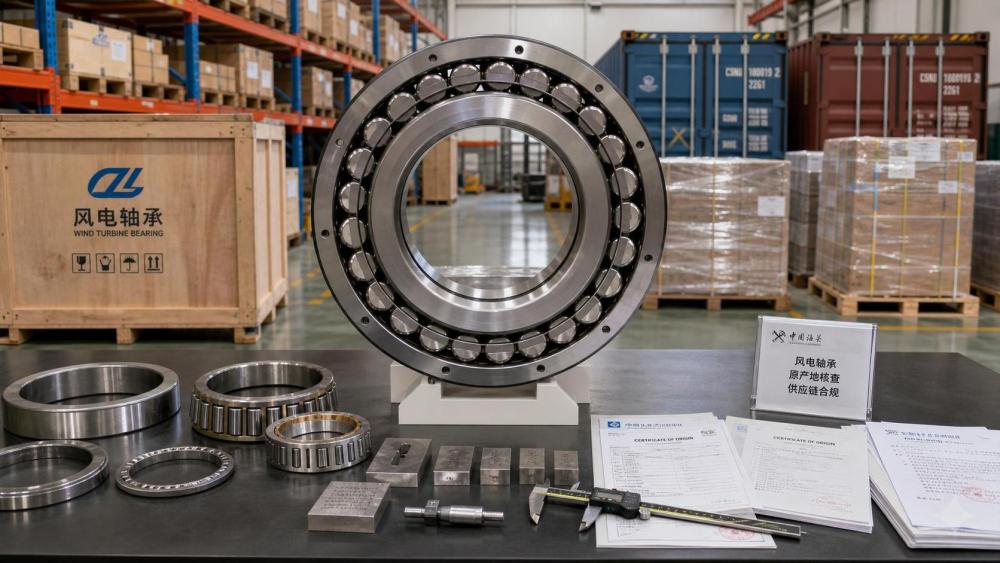
What the Current Check Covers
According to the provided information, the U.S. action applies to imported bearings classified under HS 8482.10 and 8482.20 and runs for 90 days starting July 4, 2026. The review is described as a special authenticity inspection of origin, and wind turbine main shaft bearings are a key focus within the campaign.
The inspection requires submission of a complete BOM traceability chain, heat treatment process records, and third-party material reports. The provided information also states that if a Chinese exporter cannot respond to an electronic traceability request within 48 hours, the goods will be detained and a 25% anti-circumvention cash deposit will be imposed.
Where the Pressure Is Likely to Appear First
Export transactions face a documentation-speed test
From an industry perspective, direct trading companies are likely to feel the first impact because the stated trigger is not only product classification but also the ability to provide origin-related proof quickly. The pressure point is the 48-hour response window for electronic traceability requests. What deserves closer attention is whether export teams can assemble BOM records, process documentation, and material evidence in a form that can be submitted without delay.
Manufacturing links move closer to customs compliance
Analysis shows that manufacturers involved in bearing processing, especially those connected to wind turbine main shaft bearing supply, may face increased operational pressure in recordkeeping. The required heat treatment records and third-party material reports suggest that production-stage files are now part of trade-risk control. The practical issue is not only whether records exist, but whether they can be matched clearly to the shipped goods and presented in a traceable chain.
Project buyers and channels may see timetable disruption
Observably, overseas wind project procurement teams and distribution businesses are exposed through delivery schedules and compliance-related cost changes. The provided information explicitly indicates that lead times and compliance costs will rise significantly for these parties. In business terms, the effect is likely to appear in purchasing timelines, buffer stock decisions, and supplier communication rather than in customs handling alone.
Supply chain service providers may be pulled into verification workflows
For logistics, customs support, and related supply chain service providers, the main concern is coordination speed across documents and counterparties. Even though the action is aimed at imported bearings, the operational burden can spread across shipment preparation, document retrieval, and importer-exporter communication. What deserves closer attention is whether service providers are prepared to support traceability requests that require production and material evidence rather than standard commercial paperwork only.
What Companies Should Watch Now
Whether supporting records are complete and connected
Companies dealing in the affected bearing categories should focus on whether BOM traceability, heat treatment records, and third-party material reports are complete and mutually consistent. The immediate issue is chain integrity: isolated files may not be enough if they cannot be linked clearly to the shipped product.
The operational meaning of the 48-hour response window
Analysis shows that the 48-hour requirement is not just a procedural detail. It changes the threshold for day-to-day compliance readiness. Firms should pay close attention to who holds the documents, how quickly they can be retrieved, and whether the response process depends on multiple entities across trading and manufacturing functions.
Contracts, delivery promises, and customer communication
For suppliers and channel partners, the stated risk of detention and added cash deposit means customer-facing commitments may need closer review. What deserves closer attention is how delivery schedules, quotation validity, and exception handling are discussed with overseas buyers when an origin verification request can interrupt shipment release.
Further official clarification during the 90-day period
Observably, the current information establishes the inspection framework, the document demands, and the stated consequence of non-response. Companies should continue watching for any further official wording, procedural clarification, or scope detail issued during the 90-day period, because the gap between policy language and operational enforcement often determines where the real burden falls.
Why This Matters Beyond a Single Shipment
Analysis shows that this development is more than a routine customs filing issue. It signals that origin claims for affected bearings, especially those tied to wind turbine main shaft applications, are being tested through deeper production and material traceability. That does not by itself prove a permanent structural shift in all bearing trade, but it does indicate a sharper enforcement posture around origin verification in this product range.
It is more appropriate to understand this as both an immediate compliance event and an industry signal that documentation quality, document accessibility, and manufacturing traceability are becoming central to shipment reliability. Continued observation is still necessary because the current information describes the start of a 90-day action, not its final enforcement outcomes across the market.
How to Read the Current Signal
At this stage, the most balanced reading is that the inspection creates near-term pressure on exporters, manufacturers, project buyers, and channels connected to the covered bearing categories, while also pointing to a wider compliance expectation around origin substantiation. The confirmed facts already indicate higher operational sensitivity for wind-related bearing supply, but the broader market effect still needs to be assessed through how the 90-day campaign is implemented in practice.
For that reason, this is best understood as a live enforcement development with immediate transaction impact and longer-term signaling value, rather than as a settled conclusion about future trade conditions for the entire bearing sector.
Basis of This Article
This article is based on the user-provided news title, event date, and event summary. The specific official source link was not provided in the input and should therefore be verified on an ongoing basis. For this type of development, commonly relevant source categories may include official notices, company disclosures, industry association updates, authoritative media reporting, and standard or technical documentation related to the products concerned.
Further attention should remain on any subsequent official clarification regarding enforcement scope, documentation expectations, response procedures, and how the 90-day inspection period is carried out in actual trade operations.
Related News
- 00
0000-00
How FFKM O-rings reduce seal failure in corrosive media - 00
0000-00
What global equipment manufacturing in the USA means for supply chain risk - 00
0000-00
How FFKM outgassing performance affects vacuum seal selection - 00
0000-00
When should heat resistant metallurgy belts be replaced? - 00
0000-00
When does a fluid power maintenance service reduce unplanned downtime?
Weekly Insights
Stay ahead with our curated technology reports delivered every Monday.