





On July 3, 2026, TUV Rheinland announced the full adoption of the revised EN 15804+A2:2026 standard for environmental product declarations, and the immediate industry relevance lies in one change: wind turbine main shaft bearings are now brought into mandatory carbon footprint verification. With major OEMs including Vestas and Siemens Gamesa updating their tender documents for the second half of 2026 to require a TUV-certified EPD, the issue moves beyond sustainability positioning and into technical bid qualification, procurement access, and delivery readiness for bearing suppliers and related service providers.
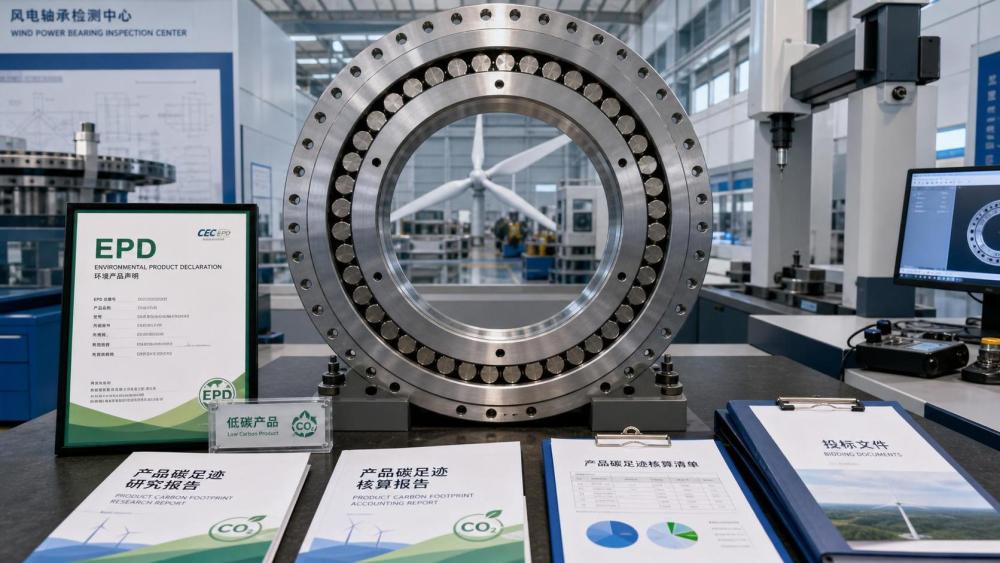
What has already changed in the tender rulebook
The confirmed facts are limited but commercially significant. TUV Rheinland stated on July 3, 2026 that it is fully enabling the revised EN 15804+A2:2026 standard. According to the event summary, this is the first time wind turbine main shaft bearings have been included within a mandatory carbon footprint verification scope. At the same time, major European wind turbine manufacturers, including Vestas and Siemens Gamesa, have updated tender documents for the second half of 2026. Under those updated bid conditions, bearing suppliers must provide a TUV-certified EPD, and failure to do so results in automatic rejection at the technical evaluation stage.
Where the pressure is likely to appear first
Bid access now depends on certification readiness
From an industry perspective, the most immediate impact is on suppliers seeking to participate in OEM tenders. The stated requirement does not merely add another supporting document; it places the certified EPD directly into the technical screening process. That means bid preparation, document completeness, and certification timing may become as important as price and product specification alignment in the early stage of supplier participation.
Procurement teams will need tighter document control
Purchasing functions at OEMs and tiered sourcing organizations are also likely to feel the change quickly. Analysis shows that once a tender file names a TUV-certified EPD as a mandatory condition, procurement workflows must verify whether supplier submissions meet that form requirement before commercial comparison can proceed. What deserves closer attention is the practical link between tender issuance, supplier onboarding, and compliance file review.
Testing and certification support may become part of delivery planning
Certification-related service providers and internal compliance teams may face increased workload because the requirement is tied to market access rather than optional disclosure. Observably, suppliers that do not already have an accepted EPD process in place may need to align technical files, verification materials, and submission schedules more closely with customer bid calendars. For exporters and manufacturers, this may affect quotation timing, contract preparation, and delivery commitments if certification evidence is requested upfront.
What companies should watch now
Check whether current bid files match the new requirement
Companies involved in supplying wind turbine main shaft bearings should review active and upcoming tender documents for the second half of 2026 and confirm whether a TUV-certified EPD is explicitly listed as a mandatory qualification item. The practical issue is not only whether an EPD exists, but whether it matches the certification form now being requested in the tender process.
Review certification and technical document readiness together
Analysis shows that compliance review should not be separated from technical bid preparation. Teams handling product data, quality files, tender responses, and customer documentation should confirm whether existing materials can support EPD verification under EN 15804+A2:2026 as referenced in the event summary. Where execution details are still not provided, it is more appropriate to treat this as a document readiness issue requiring close follow-up rather than to assume a settled operating routine.
Pay attention to timing risk in procurement and delivery
Because the event summary links certification directly to technical bid eligibility, companies should watch for timing risks between tender release, certification completion, and shipment planning. This is especially relevant where customer approval, supplier qualification, and production scheduling depend on the same document package. The current information does not confirm how different buyers will sequence these checks, so continued monitoring of bid wording and customer communication remains necessary.
Track any clarification in execution language
What deserves closer attention is whether further clarification emerges on verification scope, acceptance criteria, or supporting documentation. The confirmed information establishes the requirement and the tender consequence, but it does not yet provide detailed implementation language. For that reason, companies should continue tracking formal wording from certification bodies and updates in customer procurement documents.
Why this looks like an execution signal, not just a policy reference
Observably, this development is more than a general sustainability statement because the event summary ties the standard revision to a concrete tender outcome: no TUV-certified EPD, no passage through technical evaluation. That makes it more appropriate to understand the news as an execution signal already entering commercial practice. At the same time, analysis should remain cautious. The available facts confirm the requirement and its immediate procurement relevance, but they do not yet establish how broadly or uniformly the rule will be applied across all buyers, suppliers, and contract cycles.
How this development is best understood at this stage
The most balanced reading is that a standards and certification change has begun to translate into a hard procurement condition for a specific wind component category. For the industry, the significance lies in the shift from general environmental disclosure to bid-gating compliance documentation. It is more appropriate to understand this as a live market-entry and tender-execution signal, while continuing to watch how certification practice, buyer language, and supplier response develop in the next round of implementation.
Basis of this article and what still needs verification
This article is based on the user-provided news title, event date, and event summary. For developments of this type, commonly relevant source categories may include official announcements, regulatory publications, standards organization documents, industry association notices, tender documentation, and reporting by authoritative trade media. A specific official source link was not provided in the input, so further verification is still required. What should continue to be monitored includes detailed implementation language, certification interpretation, changes in tender documents, industry feedback, and how companies are handling the requirement in actual bidding and delivery processes.
Want to dive deeper into these market dynamics, or need data-driven support for your next business move? Drop a line below and let the analysts at PCTS provide customized insights.
We respect your privacy. Your information is strictly confidential.
Related News
- 00
0000-00
How sealing technology reduces contamination in semiconductor manufacturing - 00
0000-00
Where to install vibration sensors on rotating machinery - 00
0000-00
NTSB Probe Finds Boeing Warned of MD-11 Engine Bearing Risk Years Earlier - 00
0000-00
How to size pneumatic grippers for packaging system integration - 00
0000-00
How to size alloy steel power transmission chains for heavy loads
Weekly Insights
Stay ahead with our curated technology reports delivered every Monday.