





Why MRO Spare Parts Forecasting Changes from One Plant Reality to Another
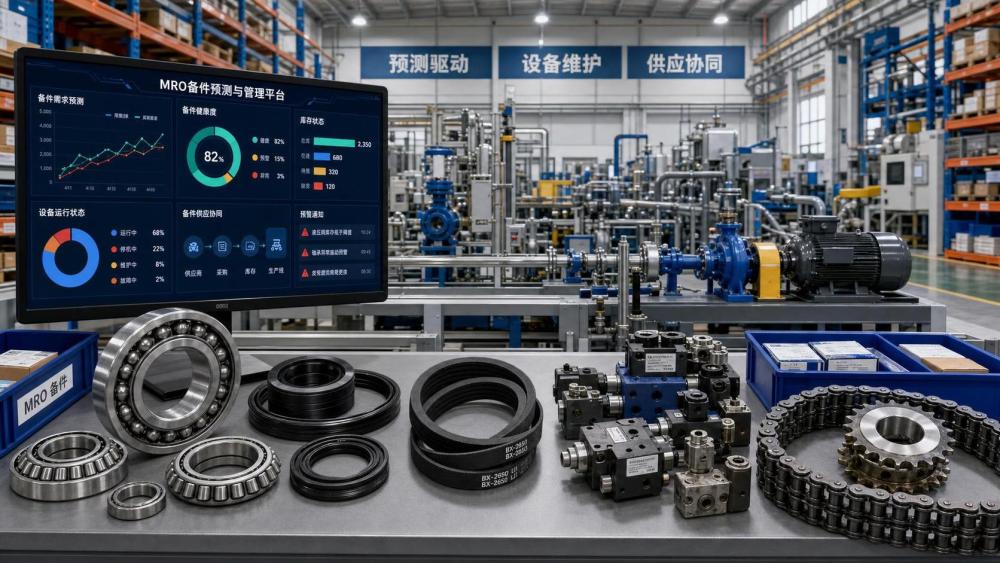
Accurate MRO spare parts forecasting protects uptime, controls working capital, and reduces avoidable emergency purchasing.
That sounds straightforward until mixed equipment fleets, uneven maintenance records, and supplier volatility enter the picture.
In practice, MRO spare parts forecasting is rarely a single math problem. It is a context problem.
A spindle bearing for a high-speed machine, a hydraulic seal in a contaminated circuit, and a chain in abrasive service fail for different reasons.
Their replacement patterns also differ, even when annual consumption looks similar on paper.
This is why better MRO spare parts forecasting starts with application logic, not only historical usage.
Within precision components, transmission systems, hydraulics, pneumatics, and sealing, forecasting accuracy improves when demand signals are tied to equipment function, failure mode, and maintenance strategy.
That broader view matters in industrial environments where bearings, pumps, belts, couplings, O-rings, and condition monitoring parts interact with load, contamination, heat, lubrication, and operator routines.
Start by Separating Stable Consumption from Failure-Driven Demand
One common mistake is treating every spare part as if it follows the same demand pattern.
It does not. Some items are consumed predictably. Others move only when equipment condition changes suddenly.
Filters, standard seals, common belts, and routine lubrication accessories often fit a scheduled replacement pattern.
Large bearings, servo-coupled transmission parts, hydraulic motors, and specialty FFKM seals usually behave differently.
For these items, usage history alone can distort MRO spare parts forecasting because a single breakdown event can reshape annual demand.
A more reliable approach is to classify parts into at least three groups before building forecasts.
- Routine consumption items with stable replacement intervals.
- Condition-based items linked to vibration, leakage, heat, or wear trends.
- Critical event items reserved for low-frequency but high-impact failures.
This step improves MRO spare parts forecasting because each category needs different data and different safety stock logic.
High-Speed and High-Precision Equipment Need More Than Consumption History
In high-speed machining, semiconductor handling, or automated assembly, failure is often driven by tolerance loss rather than visible breakage.
That changes the forecasting question.
Instead of asking how many bearings or seals were used last year, it is better to ask what operating conditions are shortening life now.
Spindle bearings may be affected by lubrication quality, preload drift, thermal growth, or contamination during installation.
Mechanical seals may fail earlier because of media chemistry, pressure cycling, or shaft misalignment.
In these environments, MRO spare parts forecasting becomes more accurate when service records are combined with condition signals.
Useful inputs include vibration alerts, temperature deviations, lubricant analysis, leakage rates, and mean time between intervention.
PCTS-style component intelligence is helpful here because part performance is tied to engineering details, not only to stock codes.
What deserves closer attention in this setting
- Specification changes hidden behind similar part descriptions.
- Long lead times for precision bearings, special elastomers, or imported assemblies.
- Replacement events caused by installation quality rather than natural wear.
- Asset criticality that justifies insurance stock despite low annual usage.
Harsh-Environment Assets Create a Different Forecasting Pattern
Conveying, bulk handling, mining support systems, outdoor drives, and heavy hydraulic applications usually produce noisier demand.
Dust, shock loads, moisture, corrosive media, and variable duty cycles accelerate wear unevenly.
A chain, belt, coupling insert, rod seal, or bearing housing may perform well in one line and fail early in another line nearby.
This is where MRO spare parts forecasting often fails because similar assets are assumed to have identical consumption patterns.
A stronger method is to segment demand by operating severity.
That means separating clean indoor duty from washdown duty, steady loads from shock loads, and normal temperature service from high-temperature exposure.
When severity bands are applied, MRO spare parts forecasting starts to reflect field reality instead of average assumptions.
When Supplier Behavior Matters as Much as Machine Behavior
Some forecast errors do not come from maintenance demand at all.
They come from lead-time drift, inconsistent substitutions, packaging constraints, or changing export availability.
For standard pneumatic components, supply may be flexible but specification mismatch can be a hidden risk.
For specialized bearings, seal materials, or power transmission assemblies, availability risk may dominate the forecast decision.
This is why MRO spare parts forecasting should use two clocks: demand timing and replenishment timing.
If one clock is uncertain, historical consumption becomes less useful by itself.
Platforms that track supplier visibility, market changes, and component alternatives can support better judgment here.
The practical value is not promotional. It is operational.
Knowing which items face long qualification cycles or unstable sourcing directly improves MRO spare parts forecasting accuracy.
The Most Useful Data Usually Sits Across Several Systems
Forecasting problems often persist because maintenance logs, purchase history, failure reports, and sensor data remain disconnected.
That separation hides the reason behind demand.
A part number may show irregular demand, yet the pattern becomes logical once downtime events and line conditions are added.
To improve MRO spare parts forecasting, the most effective data model is often simple rather than elaborate.
- Link each spare part to asset type and function.
- Record whether demand came from planned work or breakdown work.
- Capture the actual failure mode, not just the replaced item.
- Track approved alternates and qualification limits.
- Review lead-time volatility every quarter.
This structure supports better MRO spare parts forecasting because it explains demand behavior instead of merely counting transactions.
Where Forecasts Commonly Go Wrong
Several misjudgments appear repeatedly across industrial spare parts planning.
One is assuming that low annual usage means low importance.
A rarely used hydraulic cartridge or special seal can still be production-critical if downtime exposure is high.
Another is grouping visually similar components together despite different operating loads, media, or compliance requirements.
There is also a cost trap.
Focusing only on purchase price may reduce stock value while increasing emergency freight, rushed labor, and repeat failures.
In MRO spare parts forecasting, total cost of ownership is often the better guide.
A final blind spot is failing to update forecasts after maintenance strategy changes.
Once predictive monitoring, lubrication upgrades, or alignment improvements are introduced, part demand should be recalibrated quickly.
A Practical Way to Improve MRO Spare Parts Forecasting Now
The fastest improvement usually comes from better segmentation, not from chasing a perfect algorithm.
Start with the parts that create the largest downtime or supply exposure.
Then build a review process around real application differences.
- Map critical bearings, seals, chains, belts, hydraulic parts, and pneumatic items to equipment severity.
- Separate planned replacement demand from breakdown demand.
- Adjust stock policy for long-lead or qualification-sensitive parts.
- Use condition data where failure progression is measurable.
- Review forecast error by asset group, not only by warehouse total.
That approach keeps MRO spare parts forecasting tied to operating reality.
It also fits the way industrial component decisions are actually made, where tribology, fluid power, sealing performance, transmission wear, and sourcing risk influence one another.
The next useful step is to sort current spare parts demand by scenario, compare the conditions behind each pattern, and tighten the rules for critical stock, lead-time risk, and replacement triggers.
Related News
- 00
0000-00
How FFKM O-rings reduce seal failure in corrosive media - 00
0000-00
What global equipment manufacturing in the USA means for supply chain risk - 00
0000-00
How FFKM outgassing performance affects vacuum seal selection - 00
0000-00
When should heat resistant metallurgy belts be replaced? - 00
0000-00
When does a fluid power maintenance service reduce unplanned downtime?
Weekly Insights
Stay ahead with our curated technology reports delivered every Monday.