





As of June 1, 2026, Russia has begun enforcing a new mandatory GOST R standard, GOST R ISO 22894:2026, for fluid-control components used in sanitary ware and daily-use supporting applications. The change matters not only to product manufacturers, but also to exporters, buyers, certification-related service providers, and supply chain operators linked to pneumatic actuators and sealing products, because market access now turns more directly on certification, labeling, and clearance readiness rather than shipment alone.
What the June 1 rule change clearly covers
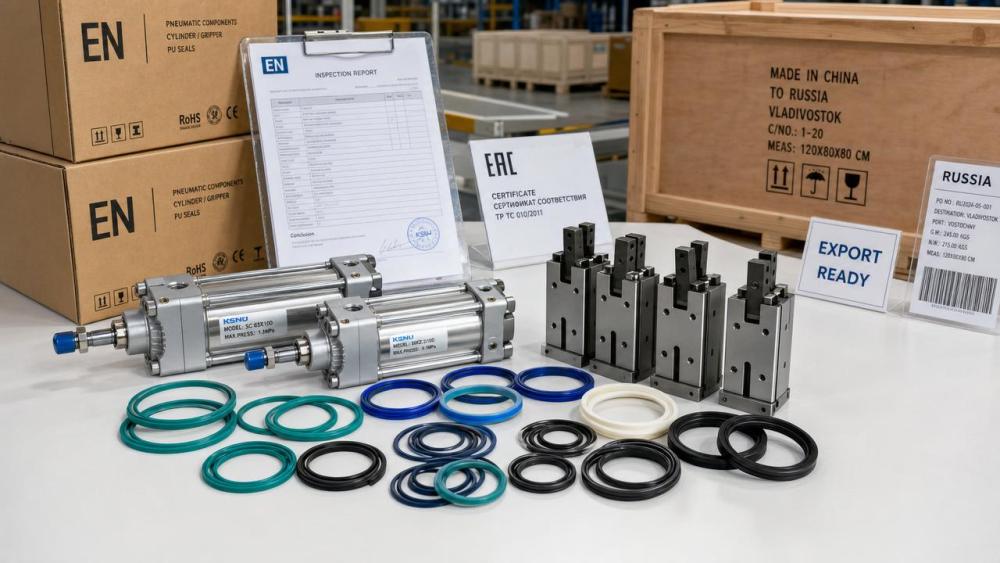
The confirmed information shows that Russia is mandatorily applying the revised GOST R standard, GOST R ISO 22894:2026, from June 1, 2026 to fluid-control components used with sanitary equipment and daily chemical supporting applications. The newly added requirements include corrosion resistance for stainless steel cylinders, pneumatic grippers, and PU seals, as well as food-contact certification and Russian-language labeling and coding requirements. The information also states that products from Chinese suppliers that have not obtained RST certification or have not been connected to the Honest Sign labeling system will be unable to clear customs, affecting the export chain for pneumatic actuators and sealing components to Russia.
Where the pressure is likely to appear first in the supply chain
Export shipments now face a stricter customs access threshold
From an industry perspective, exporters are likely to feel the change first because the summary directly links non-compliance to an inability to clear customs. For companies shipping stainless steel cylinders, pneumatic grippers, PU seals, or related actuator and sealing products into Russia, the practical issue is no longer only whether the goods meet buyer specifications, but whether certification status and labeling system access are in place before shipment.
Procurement and specification teams may need earlier document alignment
Buyers and sourcing teams may also be affected because the new requirements touch corrosion resistance, food-contact certification, and Russian-language coding. Analysis shows that this can shift procurement attention toward technical document review, supplier qualification checks, and consistency between product specifications, compliance documents, and delivery planning.
Certification and compliance service links become more operationally important
For certification-related firms, testing support providers, and compliance coordinators, the rule change raises the importance of document completeness and execution timing. What deserves closer attention is whether suppliers can align RST certification, product scope, and labeling readiness with actual export batches, since any mismatch may affect release and handover schedules.
Channel and after-sales participants may need clearer traceability support
Distributors and after-sales participants may not be the first point of regulatory impact, but they can still be affected if product coding, Russian-language labeling, or clearance status creates downstream traceability or delivery issues. Observably, this makes product identity management and document retention more relevant across the later stages of the trade chain.
What companies should review now
Check whether the affected product scope touches current Russia-bound orders
Companies should first review whether their current or planned Russia-related business includes stainless steel cylinders, pneumatic grippers, PU seals, or other fluid-control components used in the covered sanitary ware and daily-use support scenarios. This is the most direct starting point for assessing exposure.
Verify certification status and labeling readiness before shipment planning
Analysis shows that RST certification status and connection to the Honest Sign system should be treated as pre-shipment compliance checkpoints where relevant, because the provided information ties both items to customs clearance capability. Where execution details are not yet provided in the input, companies should avoid assuming that existing files or prior shipment practice remain sufficient.
Recheck technical files, test materials, and Russian-language marking content
Because the new standard adds requirements tied to corrosion resistance, food-contact certification, and Russian-language labeling and coding, exporters and suppliers should pay closer attention to whether technical files, test-related materials, product descriptions, and packaging information remain aligned with the new rule set for the affected goods.
Watch for changes in delivery timing and order acceptance conditions
It is more appropriate to understand this as a compliance-linked delivery issue as well as a product standard issue. Companies involved in order confirmation, scheduling, and customer communication should therefore watch for possible changes in document lead times, shipment release conditions, and buyer-side acceptance requirements.
Why this looks like an execution signal, not just a standards update
Analysis shows that this development is more than a technical standards revision in name. The key reason is that the provided information connects the new requirements directly to customs clearance outcomes and to access to the Honest Sign system. From an industry perspective, that makes this easier to read as an execution-stage compliance signal with immediate trade relevance, while some practical details of implementation may still require further observation.
Observably, the market will need to continue watching how certification interpretation, labeling expectations, and buyer documentation demands are applied in real transactions. At this stage, it would be premature to turn that observation into a fixed conclusion beyond the confirmed rule change itself.
How this update is best understood at this stage
At present, this event is best understood as a concrete market-access change affecting Russia-bound trade in certain sanitary ware and daily-use supporting fluid-control components, especially where pneumatic actuators and sealing products are involved. The confirmed message is clear: compliance items such as RST certification and labeling-system connection are becoming directly relevant to shipment feasibility. The broader operational effect still depends on how the requirements are applied in procurement practice, documentation review, and customs execution, so continued monitoring remains necessary.
Basis of this article and what still needs verification
This article is generated based on the user-provided news title, event date, and event summary. For developments of this type, commonly relevant source categories may include official notices, regulator releases, customs or trade authority information, industry association updates, standard-setting documents, and reporting by authoritative trade media. No specific official source link was provided in the input, so the exact official reference path still requires ongoing verification. What still needs continued observation includes detailed implementation language, certification interpretation, tender or specification document changes, market feedback, and how companies actually execute the requirements in shipments and supply arrangements.
Want to dive deeper into these market dynamics, or need data-driven support for your next business move? Drop a line below and let the analysts at PCTS provide customized insights.
We respect your privacy. Your information is strictly confidential.
Related News
- 00
0000-00
How sealing technology reduces contamination in semiconductor manufacturing - 00
0000-00
Where to install vibration sensors on rotating machinery - 00
0000-00
NTSB Probe Finds Boeing Warned of MD-11 Engine Bearing Risk Years Earlier - 00
0000-00
How to size pneumatic grippers for packaging system integration - 00
0000-00
How to size alloy steel power transmission chains for heavy loads
Weekly Insights
Stay ahead with our curated technology reports delivered every Monday.