





From June 1, 2026, Russia begins mandatory enforcement of revised requirements under TR CU 010/2011 for imported stainless steel cylinders, PU hydraulic sealing components, and FFKM O-rings. The change matters not only as a technical compliance update, but as a direct trade and delivery issue for exporters, distributors, procurement teams, and certification-related service providers working across the hydraulic and sealing supply chain.
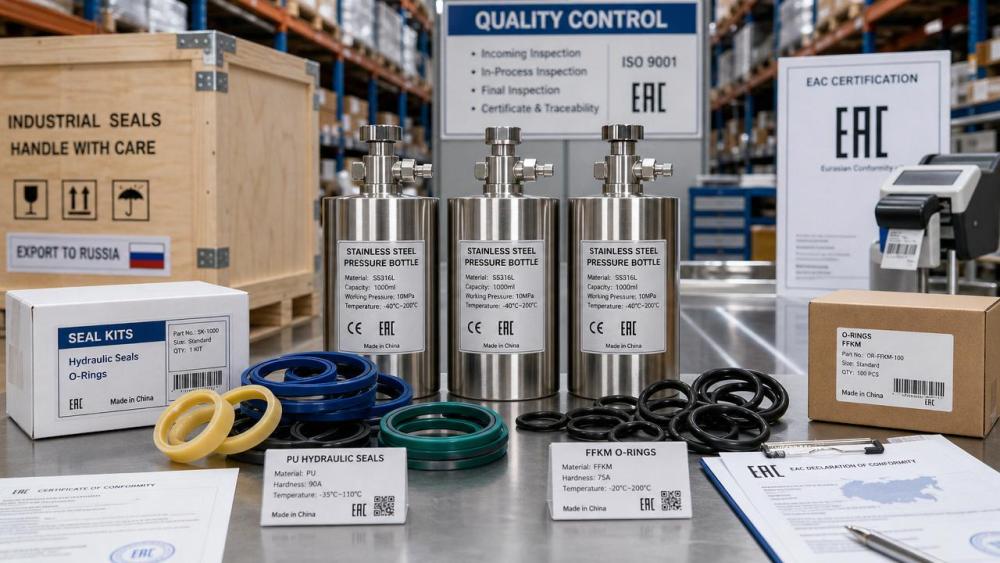
What the rule now requires at the border and sales-unit level
The confirmed change is tied to the revised version of Russia’s Technical Regulation on Industrial Equipment and Sealing Materials, identified in the input as TR CU 010/2011. It becomes mandatory on June 1, 2026.
According to the provided event summary, all imported stainless steel cylinders, PU hydraulic seals, and FFKM O-rings covered by this change must complete EAC certification before entry into the market.
The same summary states that the minimum sales unit must carry a Russian-language label. The label content must include the manufacturer, batch number, pressure rating, and applicable medium.
Products that do not meet these requirements may be detained by customs or destroyed. The input also indicates that this directly affects the supply rhythm of Chinese hydraulic and sealing exporters shipping into Russian distribution channels, while pushing overseas local distributors to start certification filing and label reprinting earlier.
Where the pressure is likely to appear across the supply chain
Export shipments face a tighter compliance checkpoint
For export-oriented manufacturers and trading companies, the most immediate exposure is at the customs and market-entry stage. Because certification and Russian-language labeling are both treated as mandatory conditions, the impact is not limited to product quality alone; it extends to shipment release, documentation readiness, and packaging completion before delivery.
From an industry perspective, what deserves closer attention is whether current export batches, SKU structures, and packaging formats can support minimum-unit Russian labeling without disrupting dispatch schedules.
Distributors must align inventory and relabeling plans earlier
Local distributors and channel operators may be affected in inventory turnover and product presentation at the point of sale. The provided information already suggests that overseas distributors are being pushed to begin certification filing and label reprinting in advance.
Analysis shows that this raises a practical issue for stocked goods and newly arriving lots: channel participants need to review whether product units, labels, and traceability information remain consistent with the new mandatory format before goods move further downstream.
Procurement and sourcing teams need to recheck supplier readiness
For buyers and sourcing teams, the rule change may alter supplier screening criteria. Certification status, label compliance capability, and traceable batch information become more relevant in purchase confirmation and delivery planning.
Observably, procurement risk under this type of rule change is not only about price or lead time, but also about whether the selected supplier can provide goods that are market-ready under the revised compliance threshold.
Certification and support services may see earlier coordination requests
Companies involved in certification support, testing coordination, document handling, and after-sales traceability may also see changes in demand. The reason is straightforward: once customs detention or destruction becomes a stated consequence, upstream and downstream parties have stronger incentives to resolve paperwork, labeling, and product-identification gaps before shipment.
That said, the input does not provide a detailed execution procedure, so this should be understood as a practical compliance implication rather than a confirmed change in service volumes or regulatory workflow.
What companies should review now in day-to-day operations
Check whether covered products have a complete certification path
Companies handling stainless steel cylinders, PU hydraulic seals, and FFKM O-rings should first review whether the relevant product lines already have a valid EAC certification path in place for the Russian market. Analysis shows that this is the most basic gating item because the reported consequence for non-compliance is customs detention or destruction.
Rework label control at the smallest sales-unit level
The rule described in the input does not stop at product approval; it also reaches the minimum sales unit. This means companies should pay close attention to packaging design control, translation accuracy, batch traceability, and whether manufacturer identity, batch number, pressure rating, and applicable medium are consistently shown in Russian.
Reassess shipment timing and inventory sequencing
Because the reported effect already includes pressure on supply rhythm into Russian distribution channels, exporters and distributors may need to review handover timing between production, labeling, certification readiness, and customs clearance. It is more appropriate to understand this as an operational coordination issue, not only a legal one.
Keep watching how the rule is reflected in market documents
The input confirms the mandatory rule change, but it does not provide further detail on implementation wording beyond the main requirements and consequences. For that reason, companies should continue watching for how the requirement is reflected in trade documents, technical files, procurement specifications, and downstream commercial paperwork.
Why this looks more like an execution signal than a distant policy trend
Analysis shows that this development is better understood as an implemented compliance threshold rather than a broad policy discussion. The presence of a defined effective date, mandatory certification, mandatory Russian-language labeling, and stated customs consequences gives the change immediate operational relevance.
At the same time, observably, the market still needs to watch how the rule is applied in practice. The input does not provide further details on interpretive standards, enforcement rhythm across transactions, or how downstream buyers may adjust tender and purchasing documents. That makes continued monitoring necessary even though the rule itself is described as mandatory from June 1, 2026.
How the industry may best read this change for now
In practical terms, this event signals that compliance for certain hydraulic and sealing products entering Russia is moving closer to the point of shipment, packaging, and customs review. The industry significance lies less in abstract regulation and more in the fact that certification status and Russian-language label content now sit directly alongside delivery continuity and channel supply planning.
It is more appropriate to understand this as a rule that has already moved into the implementation stage, while some execution details and market responses still deserve observation. A cautious and neutral reading is that affected companies should treat this as a current compliance and trade-preparation issue, not as a distant policy headline.
Basis of this article and what still needs verification
This article is generated based on the user-provided news title, event date, and event summary. The analysis is limited to the confirmed information supplied in the input and does not rely on additional unverified data, company examples, market figures, or external links.
For this type of regulatory development, relevant source categories would typically include official regulatory notices, customs or trade authority information, industry association releases, standards-related documents, and reporting from established industry media. However, no specific official source link was provided in the input, so the exact official publication path still needs to be verified on an ongoing basis.
What still requires continued attention includes the detailed enforcement approach, certification interpretation, wording used in procurement or tender documents, downstream channel feedback, and how affected companies adjust labeling, filing, and shipment arrangements in practice.
Want to dive deeper into these market dynamics, or need data-driven support for your next business move? Drop a line below and let the analysts at PCTS provide customized insights.
We respect your privacy. Your information is strictly confidential.
Related News
- 00
0000-00
IndexBox Forecasts 3.8% Annual Growth for Global Radial Seals Market Through 2035 - 00
0000-00
How to assess the chemical compatibility of FFKM sealing sheets - 00
0000-00
IndexBox Forecasts 3.6% Annual Growth for Construction Bearings Market - 00
0000-00
When do hydraulic components require an export license? - 00
0000-00
How to size modular pneumatic valve systems for adequate airflow
Weekly Insights
Stay ahead with our curated technology reports delivered every Monday.