





Pneumatic Automation Solutions for Assembly Lines: When Guided Cylinders Beat Standard Setups
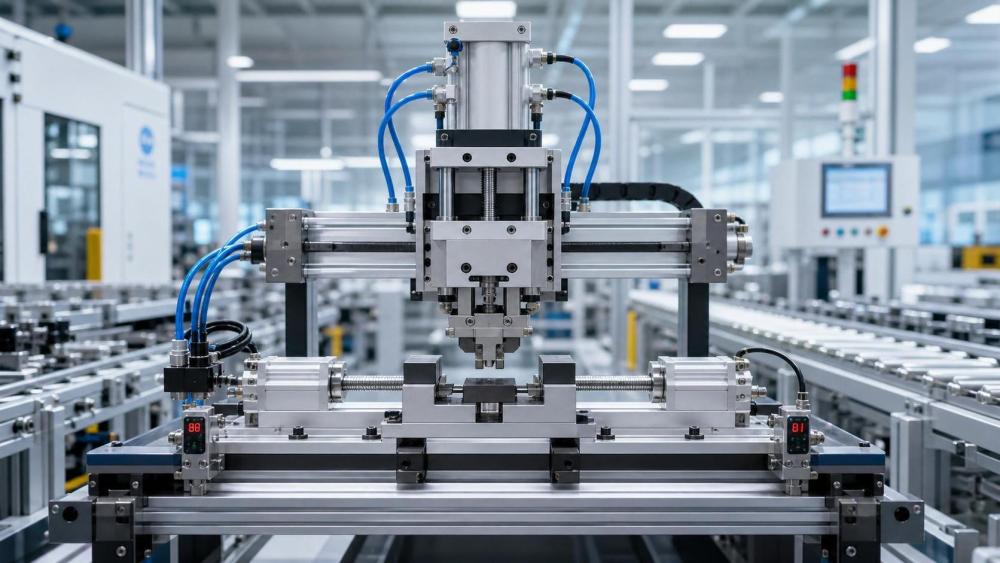
In modern manufacturing, motion control choices shape output quality, uptime, and labor efficiency.
That is why Pneumatic Automation Solutions for assembly lines now go far beyond simple extend-and-retract functions.
Standard air cylinders still fit many tasks.
But once side load, offset tooling, or strict repeatability enter the picture, their limits show quickly.
Guided cylinders answer that gap by combining linear actuation with built-in guidance and stronger load control.
For assembly lines, that means fewer alignment errors, smoother motion, and more stable tooling support.
The practical question is not whether guided cylinders are better in theory.
It is whether they solve specific production risks better than standard setups.
That is the real basis for choosing Pneumatic Automation Solutions for assembly lines with confidence.
Why Standard Cylinder Layouts Start to Struggle
A standard pneumatic cylinder works well when the load is centered and the movement is simple.
That model suits pushing, lifting, ejecting, or stopping in clean and predictable cycles.
Problems begin when the tooling sits away from the rod centerline.
The same happens when a part enters the station with slight variation.
In those cases, the cylinder rod is forced to manage side load it was not designed to carry.
That extra stress can create rod deflection, seal wear, uneven contact, and short service intervals.
On high-speed lines, small mechanical instability turns into visible quality loss.
Press-fit depth may vary.
Labels may land off position.
A gripper may close squarely one cycle and drag the next.
This is where many retrofit decisions begin.
Teams often discover that the issue is not air pressure, valve timing, or sensor response.
The root issue is unsupported motion.
In practical terms, Pneumatic Automation Solutions for assembly lines fail when mechanical guidance is treated as optional.
Where Guided Cylinders Change the Result
A guided cylinder integrates the actuator with guide rods, bearings, or a slide structure.
That design gives the load a controlled path instead of asking the piston rod to absorb every force.
The benefit is immediate in applications with moments, side loads, or off-center tooling.
More importantly, guided cylinders make station behavior more repeatable over time.
That matters because assembly performance is rarely judged on day one.
It is judged after thousands or millions of cycles.
When evaluating Pneumatic Automation Solutions for assembly lines, guided cylinders usually win in these situations:
- Pick-and-place units carrying offset grippers or vacuum tooling
- Part clamping stations needing parallel contact and even force
- Pressing or seating steps with tight position repeatability
- Transfer slides exposed to vibration or light shock loads
- Compact fixtures where external rails add complexity and alignment time
This does not mean every station needs a guided design.
It means the mechanical load path must be matched to the real task, not the simplified drawing.
Typical Performance Gains
In many plants, the strongest gains are not headline speed increases.
They are consistency gains that protect yield and maintenance budgets.
- Lower rod bending risk
- Better alignment at end-of-stroke contact
- Reduced seal and bearing wear
- Improved repeatability across long production runs
- Simpler fixture design in compact automation cells
How to Decide: Guided Cylinder or Standard Setup
A useful selection process starts with failure modes, not catalog pages.
Ask what the actuator must resist, not only what force it must deliver.
That shift makes Pneumatic Automation Solutions for assembly lines much easier to evaluate.
Five Practical Questions
- Is the load centered on the rod throughout the stroke?
- Will the tooling create pitch, yaw, or roll moments?
- Does the process require precise parallel motion or contact squareness?
- How costly is drift, misalignment, or maintenance downtime?
- Can external guides fit the available space without adding alignment risk?
If most answers point toward offset loading and repeatability risk, a guided cylinder is usually the stronger choice.
If the task is light, centered, and forgiving, a standard cylinder remains cost-effective.
Comparison Snapshot
Application Scenarios That Justify the Upgrade
Some assembly tasks make the value of guided cylinders obvious.
Others reveal the benefit only after repeated downtime or scrap events.
The following scenarios commonly push Pneumatic Automation Solutions for assembly lines toward guided designs.
Electronic and Precision Component Assembly
Small parts often demand exact approach angles and controlled contact.
A guided cylinder helps maintain stroke straightness during insertion, seating, or test contact.
Automotive Subassembly Stations
Fixtures may hold clips, bushings, connectors, or lightweight housings with offset tooling.
Guided actuation reduces tilt and supports consistent force delivery across long cycle counts.
Packaging and Transfer Systems
Fast handling equipment creates vibration, changing loads, and frequent starts and stops.
Guided cylinders bring more stable travel and reduce alignment loss in compact motion modules.
Clamping and Inspection Fixtures
Inspection accuracy depends on part position staying repeatable from cycle to cycle.
A guided cylinder supports parallel clamping and lowers the chance of uneven contact points.
What to Check Before Specifying Pneumatic Automation Solutions for Assembly Lines
Selecting the right actuator is only part of the job.
The final result depends on sizing, mounting, air quality, and maintenance logic.
A solid specification review should include these points:
- Load mass, center of gravity, and moment direction
- Stroke length, cycle rate, and required end position accuracy
- Shock loads during contact, release, or emergency stop
- Mounting stiffness and tolerance stack-up in the fixture
- Sensor integration for stroke confirmation or part presence
- Air preparation, lubrication policy, and contamination exposure
- Replacement access and service interval targets
This is where lifecycle thinking matters.
A cheaper actuator can become expensive when line stoppages, fixture resets, and scrap accumulation are added in.
For PCTS audiences, that broader view is central to component selection and MRO planning.
A Practical Way to Move Forward
The best Pneumatic Automation Solutions for assembly lines come from matching actuator architecture to production reality.
If a station handles centered loads and generous tolerances, standard cylinders still make sense.
If the task involves side load, offset tooling, compact mounting, or repeatability pressure, guided cylinders usually deliver better long-term value.
The decision should be grounded in actual failure risk, not only initial price.
Review the motion path, map the moments, and test the fixture under realistic cycle conditions.
That approach leads to Pneumatic Automation Solutions for assembly lines that stay stable, maintainable, and commercially sound over time.
Want to dive deeper into these market dynamics, or need data-driven support for your next business move? Drop a line below and let the analysts at PCTS provide customized insights.
We respect your privacy. Your information is strictly confidential.
Related News
- 00
0000-00
How to check vibration analysis software for sensor compatibility - 00
0000-00
IndexBox Forecasts 3.8% Annual Growth for Global Radial Seals Market Through 2035 - 00
0000-00
How to assess the chemical compatibility of FFKM sealing sheets - 00
0000-00
IndexBox Forecasts 3.6% Annual Growth for Construction Bearings Market - 00
0000-00
When do hydraulic components require an export license?
Weekly Insights
Stay ahead with our curated technology reports delivered every Monday.