





Why does Electronics Assembly Pneumatics ISO matter beyond audit paperwork?
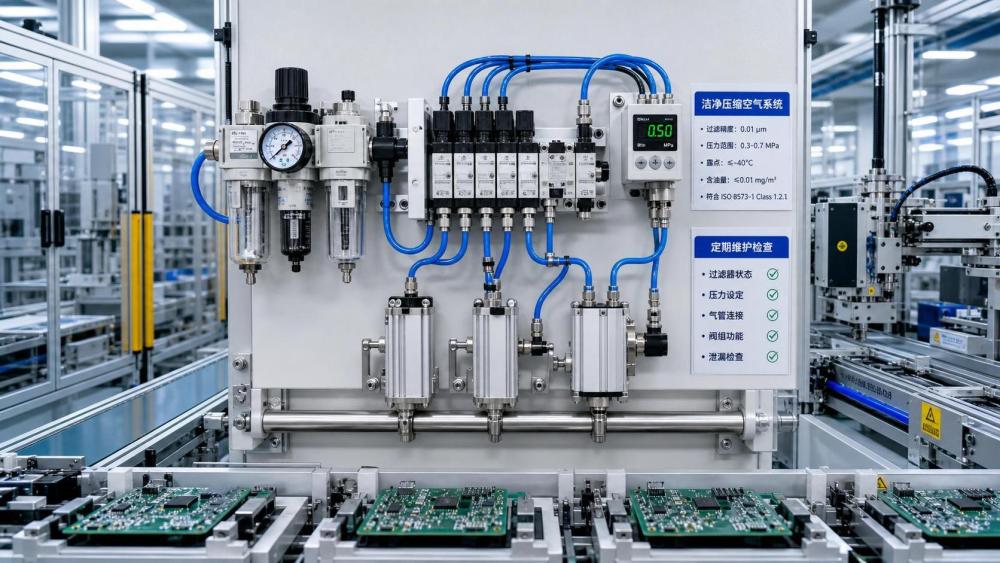
In electronics assembly, compressed air touches more than motion control. It affects soldering consistency, pick-and-place stability, clean handling, and operator exposure.
That is why Electronics Assembly Pneumatics ISO compliance is rarely just a file review. It is a practical reliability issue.
When air quality, pressure stability, and component traceability drift, the result is often hidden at first. Defects appear later as rejects, leakage, stoppages, or failed audits.
A common mistake is treating pneumatic compliance as separate from maintenance and process control. In reality, these systems sit inside a larger mechanical and MRO chain.
That broader view is increasingly visible across industrial intelligence platforms such as PCTS, where fluid power, sealing, wear, lifecycle cost, and uptime are analyzed together.
So the useful question is not whether Electronics Assembly Pneumatics ISO applies. The better question is where nonconformity usually starts, and how to fix it early.
Where do most Electronics Assembly Pneumatics ISO compliance gaps actually appear?
The biggest gaps are rarely dramatic. More often, they come from small mismatches between design intent, shop-floor conditions, and maintenance reality.
In actual production, several weak points show up again and again:
- Unverified air quality, including moisture, oil carryover, and particles near sensitive assembly stations.
- Incorrect pneumatic component selection for cleanroom, ESD-sensitive, or high-cycle electronics processes.
- Missing records for regulator calibration, leak checks, hose replacement, and valve service history.
- Pressure settings adjusted informally during troubleshooting, without revision control.
- Seal materials that degrade under chemical cleaning agents or elevated temperature.
- No clear link between recurring downtime and the actual pneumatic root cause.
These gaps look small on paper. On a live electronics line, they can affect gripping force, placement accuracy, and contamination risk within one shift.
A useful way to judge exposure is to ask whether every critical air-driven function has a defined control limit, inspection method, and service interval.
If one of those three is missing, Electronics Assembly Pneumatics ISO readiness is already weaker than it appears.
How can you tell if the issue is documentation, hardware, or maintenance?
This is where many reviews become too general. A faster method is to separate findings into three buckets and test each one differently.
This kind of table works well because Electronics Assembly Pneumatics ISO failures often overlap. A leak may start as a seal issue, then become a documentation issue.
The more reliable approach is to check evidence in sequence: system design, current machine condition, then recorded maintenance behavior.
Which technical mistakes create the highest audit and quality risk?
Some nonconformities are minor housekeeping issues. Others directly undermine process capability. Those deserve faster attention.
One major problem is unstable air pressure at the point of use. Even when the compressor room looks fine, long distribution runs can create local variation.
That matters in electronics assembly because small pneumatic grippers and cylinders are sensitive to pressure drop. Force changes may not trigger alarms, but they still affect handling accuracy.
Another frequent issue is poor material compatibility. O-rings, seals, and tubing may pass initial installation, then deteriorate under cleaners, heat, or repeated cycling.
In many plants, this is treated as a spare parts problem. More often, it is a specification problem.
There is also the contamination question. Electronics Assembly Pneumatics ISO compliance depends on air cleanliness suitable for the process, not just general factory standards.
If filters are selected for convenience rather than application sensitivity, particles and oil mist can migrate toward critical stations.
Needless valve overrides are another warning sign. Temporary manual changes often stay in place long after the original issue disappears.
- Check pressure at the actuator, not only at the main regulator.
- Match seal and hose materials to chemicals, heat, and cycle count.
- Define air cleanliness limits for each sensitive process station.
- Record temporary parameter changes and close them formally.
These actions are not complicated, but they close many of the common Electronics Assembly Pneumatics ISO gaps before an auditor or failure event exposes them.
What is the most practical way to fix recurring gaps without slowing production?
A full system rebuild is rarely necessary. Most sites improve faster by targeting the few points where compliance, quality, and downtime intersect.
Start with a line-by-line criticality map. Mark every pneumatic function that can influence product handling, contamination control, or operator safety.
Then compare each function against actual field evidence. The key question is simple: does the current machine state match the approved standard?
In practice, a focused correction plan usually includes the following:
- Standardize air preparation units by contamination risk and maintenance interval.
- Replace vague component descriptions with exact part, material, and rating data.
- Set leak testing routes for joints, valves, manifolds, and quick-connect points.
- Tie maintenance records to failure codes, not only work orders.
- Use change control for regulator settings, tubing reroutes, and substitute parts.
This is also where broader industrial knowledge helps. PCTS often frames pneumatic reliability together with sealing behavior, wear patterns, and spare cycle planning.
That cross-functional view makes fixes more durable. It reduces the chance of solving today's leak while creating tomorrow's contamination or lifecycle cost issue.
How should Electronics Assembly Pneumatics ISO be reviewed before the next audit?
Pre-audit reviews work best when they are evidence-based, not presentation-based. Auditors usually look for consistency between documentation, machine condition, and operator practice.
A short internal review can be more useful than a large meeting if it answers the right questions.
Ask these questions on the floor
- Are all critical pneumatic settings documented and physically verifiable?
- Do replacement parts match approved materials and pressure ratings?
- Is there evidence of filter service, drainage, and leak correction?
- Have recurring line stops been traced to pneumatic root causes?
- Do safety devices and lockout points match the latest equipment condition?
If the answer is uncertain, the issue should be treated as open. Assumptions are exactly what weaken Electronics Assembly Pneumatics ISO readiness.
It also helps to review trend data, not just snapshots. Repeated seal failures, pressure dips, or valve sticking often reveal deeper control gaps.
When those trends are linked to maintenance intervals and part specifications, corrective action becomes much easier to defend during an audit.
A practical closing view: what should be done next?
Electronics Assembly Pneumatics ISO compliance improves when pneumatic systems are treated as controlled production assets, not background utilities.
The recurring gaps are usually familiar: unstable air quality, unsuitable materials, weak records, and reactive maintenance.
The fix is just as practical. Map critical functions, verify actual machine conditions, tighten document control, and align spare parts with process risk.
For teams comparing components, maintenance strategies, or compliance priorities, it helps to use a reference base that connects pneumatics with sealing, MRO economics, and reliability behavior.
That kind of structured review supports better decisions before defects, downtime, or certification issues become expensive.
The next step is straightforward: identify the highest-risk pneumatic points, confirm their standards, and close the gaps with evidence rather than assumptions.
Related News
- 00
0000-00
Where are axial piston pumps used in mining equipment? - 00
0000-00
Embodied AI Robotics and Drive Control Forum Held in Shanghai - 00
0000-00
How does seal service life affect the total cost of ownership? - 00
0000-00
Schaeffler to Cut 3,460 Jobs and Close Five European Plants - 00
0000-00
How does system size affect the price of a belt drive system?
Weekly Insights
Stay ahead with our curated technology reports delivered every Monday.