





How to assess capacity expansions in pneumatic actuator factory news
A new production hall or assembly line can signal growth, but does it translate into dependable supply? For business evaluators tracking pneumatic actuator factory news, expansion announcements deserve scrutiny beyond headline investment figures. The central distinction is between planned capacity and qualified, commercially available output.
That distinction matters because an expansion can mean very different things: additional machining capacity, assembly transferred from another site, more automated testing, or simply space reserved for future equipment. Each has a different effect on delivery reliability, supplier economics, and procurement risk. A useful assessment follows the product through the factory—and then asks whether the resulting output is available to the market being evaluated.
Establish what is actually expanding
Start with the product boundary. “Pneumatic actuators” may refer to linear air cylinders, compact guided actuators, rotary units, or valve actuators using rack-and-pinion or scotch-yoke mechanisms. These products do not share identical manufacturing constraints. Additional capacity for standard cylinders says little about the availability of spring-return valve actuators or specialized corrosion-resistant configurations.
Next, distinguish gross additions from net additions. A new facility may replace an older plant rather than add to its output. Relocating assembly can improve logistics while temporarily reducing productive hours through equipment transfers, training, and process requalification. Unless the announcement explains what happens to existing operations, the net capacity gain remains uncertain.
Capacity claims also need a denominator. Annual unit output depends on product mix, shift patterns, changeovers, and the definition of a finished unit. A line assembling small standard cylinders cannot be compared directly with one building large customized rotary actuators. Revenue capacity is even less transparent because selling prices and configuration mix can change without any increase in physical throughput.
The practical question is: which saleable product families will gain output, relative to which operating baseline?
Read the timeline as a series of evidence gates
Groundbreaking, equipment installation, commissioning, and commercial release are separate milestones. News coverage often compresses them into a single “opening” date. Business forecasts should not.
A useful evidence sequence runs from funded construction to installed machinery, trial production, process validation, customer approval where required, and repeat shipments. Each stage removes a different uncertainty. Installed equipment supports confidence that the project is progressing; it does not demonstrate stable yield or delivery performance.
- Before commissioning: look for equipment delivery, utility readiness, recruitment, and a defined product scope.
- During ramp-up: seek evidence of accepted trial batches, calibrated inspection equipment, trained operators, and resolved process issues.
- After commercial release: examine repeat-order lead times, schedule adherence, returns, and whether output remains stable across configurations.
Sources have different evidentiary value. A company release establishes what management has announced. Equipment commissioning records, a suitably scoped site audit, and customer-approved production records can support narrower operational conclusions. Where evidence is unavailable, label capacity as announced or commissioning-stage rather than treating it as dependable supply.
Find the constraint that the investment removes
Factory floor area is rarely the most useful capacity measure. The stronger question is whether the investment removes the operation that limits finished output.
For linear cylinders, relevant constraints may include tube preparation, bore finishing, rod machining, surface treatment, cleaning, assembly, or leak testing. For rotary valve actuators, housing machining, gear production, spring handling, and torque verification may be more relevant. Some processes may be outsourced, meaning the apparent factory expansion still depends on external capacity.
Follow the route from incoming material to dispatch. If additional assembly stations feed an unchanged test department, work-in-progress may increase without a comparable rise in shipments. Likewise, faster machining may have little commercial value if outsourced coating or anodizing remains constrained.
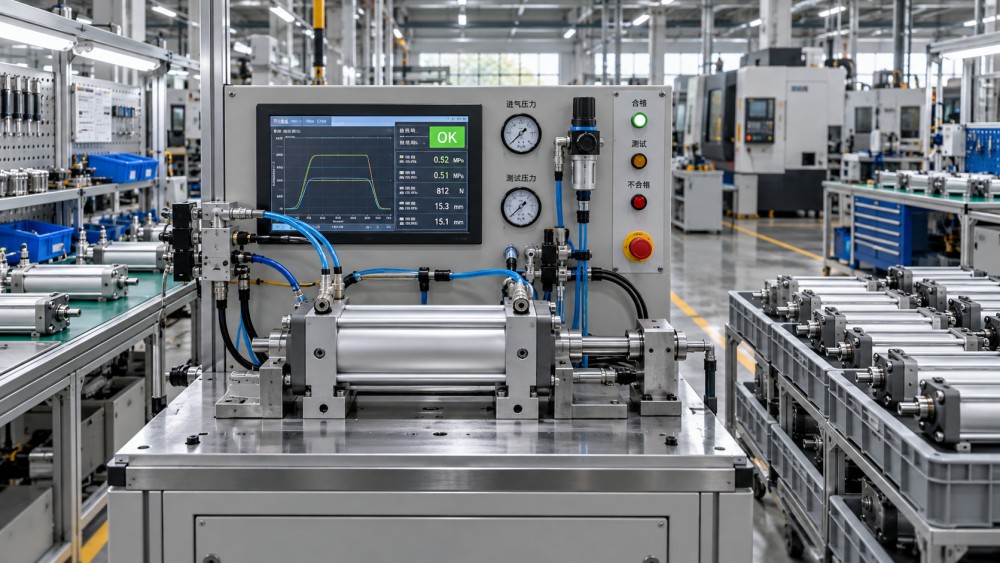
Testing deserves particular attention. Depending on the actuator and application, production checks may cover leakage, movement, stroke, or torque at specified conditions. Endurance testing generally serves a different purpose from routine production acceptance. An announcement about a new laboratory should therefore be examined for what it adds: development capability, qualification capacity, or higher end-of-line throughput.
For a high-mix operation, ask about throughput under the expected order mix—not just the shortest cycle demonstrated on one standard model. Fixture changes, seal selection, spring configurations, and documentation can materially affect available capacity.
Check whether people, components, and quality systems can keep pace
Automation does not eliminate workforce constraints; it changes them. A new line may need fewer manual assembly hours but more maintenance, programming, calibration, and process-engineering support. Hiring announcements are encouraging, but they do not establish that all shifts can operate independently.
Ask whether trained supervisors, quality technicians, and maintenance personnel are available for the intended operating schedule. Capacity based on additional shifts is fragile if experienced staff are spread too thinly or if equipment faults require support available only during daytime hours.
Purchased components require equally close attention. Seals, tubes, castings, springs, bearings, position sensors, and mounting accessories can constrain complete actuator shipments. Elastomer availability is not simply a matter of finding an O-ring with matching dimensions: material compatibility, temperature capability, friction behavior, and customer approval may restrict substitution.
New sites also introduce change-control questions. Confirm how drawings, approved suppliers, inspection plans, traceability, and nonconformance handling transfer to the expanded operation. Existing certifications should not automatically be assumed to cover every new location or process; their scope and any application-specific requirements need verification.
A useful early warning is finished-unit growth accompanied by rising rework or delayed release. More assemblies entering production do not necessarily mean more conforming products leaving it.
Separate the supplier’s growth story from the market signal
An expansion is evidence of a supplier’s investment decision, not proof that the entire pneumatic actuator market is accelerating. The project may support localization, replace aging assets, internalize outsourced work, or serve a single large customer. Several announcements can also reflect investment decisions made under earlier demand conditions.
To assess the trend, compare the stated purpose with order commentary, distributor inventory conditions, quoted lead times, and developments among comparable suppliers. These indicators need consistent dates and product definitions. Falling lead times may reflect added capacity, weaker demand, improved component availability, or a combination of all three.
Commercial access matters as much as technical output. A plant dedicated to an OEM program may add little availability for independent distributors. A regional assembly center may shorten local configuration and delivery times without materially increasing global machining capacity. Its value is real, but different from a fully integrated production expansion.
Nor should added capacity automatically imply lower prices. Depreciation, financing, training, and initial scrap can weigh on economics during ramp-up. Pricing will also depend on utilization, competition, contracts, and product mix. Claims of imminent price pressure need more support than a larger building.
This is where cross-component intelligence helps. Global Precision Components & Transmission Systems (PCTS) covers pneumatic components alongside bearings, seals, hydraulic systems, transmission parts, and industrial MRO. Reading actuator expansion news alongside developments in these related supply chains can help evaluators identify whether the real constraint sits inside the announced factory or upstream.
Translate the evidence into a supply decision
Avoid reducing the assessment to a single confidence score that hides unresolved assumptions. Record what is established, what remains conditional, and which business decision depends on the answer.
For critical machinery or MRO demand, retain a distinction between supplier qualification and supply substitution. A promising new line may justify evaluation without justifying immediate reductions in safety stock or removal of an established alternative source. Those decisions should reflect the consequences of interruption, not enthusiasm about the project.
The most useful follow-up to pneumatic actuator factory news is a short evidence request: identify the models being released, the remaining qualification steps, the capacity available to your channel, and delivery performance after ramp-up. Until those answers are credible, treat the announcement as future potential—not committed supply.
Want to dive deeper into these market dynamics, or need data-driven support for your next business move? Drop a line below and let the analysts at PCTS provide customized insights.
We respect your privacy. Your information is strictly confidential.
Related News
- 00
0000-00
How to check vibration analysis software for sensor compatibility - 00
0000-00
IndexBox Forecasts 3.8% Annual Growth for Global Radial Seals Market Through 2035 - 00
0000-00
How to assess the chemical compatibility of FFKM sealing sheets - 00
0000-00
IndexBox Forecasts 3.6% Annual Growth for Construction Bearings Market - 00
0000-00
When do hydraulic components require an export license?
Weekly Insights
Stay ahead with our curated technology reports delivered every Monday.