





How Centralized Industrial Lubrication Cuts Downtime in High-Load Lines
In high-load production lines, small lubrication gaps often trigger big operational losses.
A bearing runs dry for minutes, heat rises, vibration follows, and the line stops.
That pattern is common in conveyors, forming lines, presses, rolling systems, and automated transfer equipment.
Centralized industrial lubrication changes that pattern by delivering the right lubricant, at the right point, in the right amount.
For operations under constant load, that consistency matters more than many teams first expect.
It supports bearing life, chain stability, seal protection, and cleaner maintenance planning across the whole line.
This is why centralized industrial lubrication is now treated as a reliability tool, not just a maintenance accessory.
Why high-load lines fail so easily without lubrication control
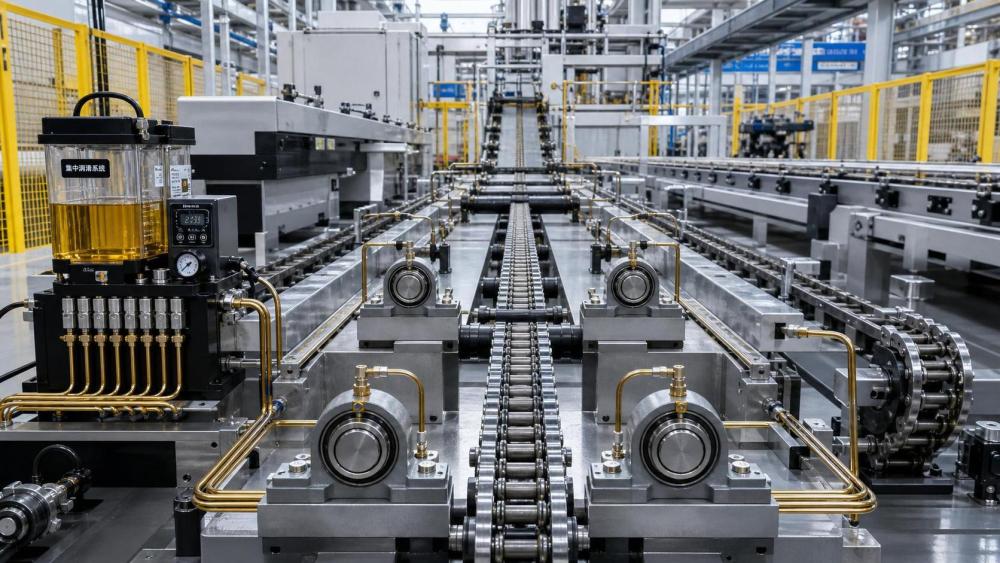
High-load systems operate with narrow margins.
Loads are higher, speeds vary, temperatures swing, and contamination can enter from dust, moisture, or process debris.
Under those conditions, manual greasing often becomes inconsistent.
Some points get too much lubricant, others get too little, and many are serviced later than planned.
That creates several hidden costs before a visible failure appears.
- Bearing surfaces lose film protection and wear accelerates.
- Chains and pins stretch faster under shock loads.
- Seals harden or leak when friction heat increases.
- Lubricant contamination spreads across connected components.
- Maintenance windows become reactive instead of planned.
The bigger issue is not only component damage.
It is the loss of production rhythm.
Once one lubrication-sensitive point fails, upstream and downstream assets often sit idle.
That is exactly where centralized industrial lubrication delivers measurable value.
How centralized industrial lubrication reduces downtime at the source
Centralized industrial lubrication works by automating lubricant delivery from a controlled source to multiple lubrication points.
Instead of waiting for manual service, the system feeds lubricant in small, timed, repeatable doses.
That sounds simple, but the operational impact is significant.
It stabilizes lubrication intervals
Regular micro-dosing helps maintain a stable lubricant film.
That lowers friction spikes during startup, peak load, and continuous cycling.
It reduces human access risks
Many high-load lines have lubrication points in guarded, elevated, or hot zones.
A centralized industrial lubrication setup moves service access away from hazardous positions.
It prevents over-lubrication
Too much grease can be almost as damaging as too little.
Excess grease raises heat, damages seals, and attracts contamination.
Controlled metering keeps the dose closer to actual operating needs.
It supports predictive maintenance
When lubrication becomes consistent, condition data becomes easier to interpret.
Vibration, temperature, and wear trends are less distorted by irregular greasing practices.
That improves fault diagnosis and replacement timing.
Where centralized industrial lubrication creates the fastest payoff
Not every asset needs the same lubrication strategy.
The best returns usually come from components that are heavily loaded, hard to access, or failure-critical.
In practical terms, these areas often rise to the top:
- Conveyor bearings exposed to dust, washdown, or long duty cycles.
- Chain drives in packaging, mining, steel, and bulk handling systems.
- Rolling equipment with repeated shock loads and thermal variation.
- Presses and forming machines with frequent start-stop movement.
- Automated cells where downtime disrupts multiple linked stations.
From a lifecycle perspective, centralized industrial lubrication also protects connected parts.
Better lubrication on bearings can reduce shaft wear, seal failures, motor load variation, and spare parts consumption.
That broader system effect is often underestimated during project scoping.
What to evaluate before selecting a centralized industrial lubrication system
A good lubrication solution is not chosen by pump size alone.
System design should match equipment behavior, lubricant properties, and maintenance realities.
Several checkpoints matter early in the decision process.
Lubrication point mapping
List every bearing, chain, guide, and moving interface that depends on regular lubrication.
Then rank each point by load, accessibility, and failure consequence.
Lubricant compatibility
Grease viscosity, oil separation, base oil type, and additive package affect system performance.
The lubricant must match both the components and the delivery method.
Environmental conditions
Heat, moisture, washdown, chemicals, and airborne particles change lubrication behavior.
They also influence tubing, seals, fittings, and reservoir design.
Monitoring and alarms
Low-level alarms, blockage detection, and cycle confirmation are worth including.
Without feedback, an automated system can still fail silently.
Service simplicity
The best centralized industrial lubrication design is easy to refill, inspect, and troubleshoot.
If it adds maintenance complexity, adoption will suffer.
A practical implementation path for high-load operations
The strongest projects usually start small and scale with evidence.
That approach lowers risk and makes ROI easier to prove internally.
- Identify one line with frequent lubrication-related stoppages or high manual service effort.
- Measure baseline data, including downtime, bearing failures, grease use, and labor hours.
- Select the correct centralized industrial lubrication architecture for that asset group.
- Install alarms and confirm all delivery points receive lubricant as planned.
- Track condition, maintenance intervals, and production stability for several operating cycles.
- Expand only after the pilot shows reduced downtime and clearer maintenance control.
This phased method also helps standardize spare parts, lubricant selection, and technician training.
Over time, lubrication becomes part of a broader reliability program, not a separate maintenance task.
Common mistakes that reduce the value of centralized industrial lubrication
Even well-funded projects can underperform when setup details are missed.
Several mistakes appear again and again in high-load environments.
- Using one lubrication schedule for points with different loads and speeds.
- Choosing a lubricant that does not flow well in the delivery network.
- Ignoring contamination ingress around fittings, reservoirs, or damaged lines.
- Skipping operator and technician training after installation.
- Treating the system as fit-and-forget instead of a monitored asset.
The fix is usually straightforward.
Match delivery frequency to duty cycle, confirm lubricant behavior in real conditions, and review alarm data regularly.
That discipline is what turns centralized industrial lubrication into a long-term downtime reduction tool.
Why this matters for cost, reliability, and future line upgrades
The clearest benefit is fewer unplanned stops.
But the longer-term value reaches further than downtime alone.
Centralized industrial lubrication can lower grease waste, reduce premature parts replacement, and improve maintenance labor allocation.
It also supports cleaner reliability data for future automation and condition monitoring projects.
In other words, it helps create a more stable base for digital maintenance strategies.
For operations under heavy mechanical stress, that is not a minor upgrade.
It is a practical way to protect critical assets while improving throughput confidence.
When lubrication becomes controlled, repeatable, and visible, fewer failures stay hidden until it is too late.
That is why centralized industrial lubrication remains one of the most effective reliability upgrades for high-load lines.
A focused pilot, clear performance baseline, and component-specific design review are usually the best next steps.
Related News
- 00
0000-00
Where are axial piston pumps used in mining equipment? - 00
0000-00
Embodied AI Robotics and Drive Control Forum Held in Shanghai - 00
0000-00
How does seal service life affect the total cost of ownership? - 00
0000-00
Schaeffler to Cut 3,460 Jobs and Close Five European Plants - 00
0000-00
How does system size affect the price of a belt drive system?
Weekly Insights
Stay ahead with our curated technology reports delivered every Monday.