





When Motor Downtime Starts as a Small Signal
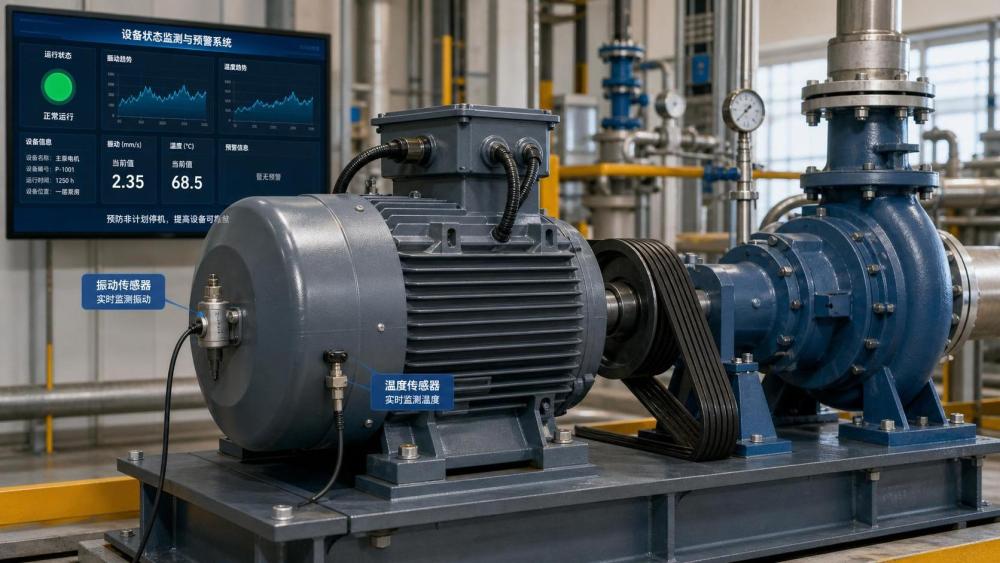
Unplanned motor stops rarely begin with one dramatic failure. In most plants, they start with weak vibration shifts, unstable temperature patterns, or lubrication changes.
That is why Condition Monitoring Solutions for motors matter across precision components, transmission systems, and industrial MRO environments. They turn early symptoms into usable maintenance decisions.
In practical use, the value is not only fault detection. The larger benefit is deciding which motors need attention now, which can wait, and which repeated alarms point to deeper mechanical issues.
This matters in facilities where motors interact with bearings, couplings, belts, chains, pumps, fans, and sealed rotating assemblies. A motor alarm often reflects a system problem, not only a motor problem.
For a platform centered on reliability, transmission efficiency, sealing performance, and lifecycle cost, Condition Monitoring Solutions for motors fit naturally into broader asset intelligence.
Actual Operating Context Changes What Needs Monitoring
Different sites ask different questions because motor duty is different. A lightly loaded conveyor motor does not fail in the same way as a high-speed spindle motor or a pump drive.
More importantly, the consequence of failure changes the monitoring logic. Some motors stop production immediately. Others can be serviced during planned windows without major disruption.
The better approach is to sort applications by operating stress, criticality, and access conditions. That makes Condition Monitoring Solutions for motors easier to size and easier to justify.
In rotating equipment, the same sensor data can mean different things. A temperature rise may indicate overload, poor cooling, bearing friction, misalignment, or contamination from a failing seal.
This is where integrated thinking helps. Vibration, lubrication, transmission parts, and sealing behavior should be read together rather than as isolated maintenance signals.
What usually changes from one application to another
In Conveyor and Transmission Lines, Minor Drift Often Matters More Than Extreme Failure
In belt, chain, and coupling driven systems, motors often run for long hours under repetitive load. Failures are not always sudden. Efficiency loss appears first.
Here, Condition Monitoring Solutions for motors should not focus only on catastrophic bearing damage. They should also capture imbalance, belt tension effects, shaft misalignment, and coupling wear.
A useful judgment point is whether the motor symptom changes after transmission adjustments. If vibration drops after belt alignment, the root cause was likely outside the motor housing.
This type of application benefits from trend-based monitoring. Stable but slowly rising current, temperature, or vibration can reveal friction growth before throughput is affected.
Pump and Hydraulic Drive Systems Need Cross-Component Interpretation
Motor condition in hydraulic units is closely tied to pump behavior, fluid cleanliness, and load pulses. Electrical readings alone can miss the full picture.
When a motor drives a hydraulic pump, repeated stress may come from cavitation, pressure instability, or contamination. The motor shows symptoms, while the initiating fault sits elsewhere.
In these cases, Condition Monitoring Solutions for motors should be linked with pressure, flow, and temperature context. That avoids replacing healthy motors while the pump train remains unstable.
Another common issue is heat concentration around couplings and seals. If cooling airflow is restricted or fluid temperature is already elevated, motor alarms may appear earlier than expected.
The practical recommendation is to review the whole drive path. Check shaft alignment, coupling stiffness, lubrication intervals, fluid condition, and seal integrity before declaring a motor defect.
High-Speed or Precision Equipment Leaves Less Room for Delay
Spindle systems, automated handling modules, and precision rotating assemblies behave differently. Small deviations can damage product quality before they stop the machine.
In these environments, Condition Monitoring Solutions for motors are often used to protect accuracy as much as uptime. Surface finish, repeatability, and thermal drift become part of the maintenance decision.
The monitoring threshold usually needs tighter tuning. A vibration level considered acceptable on a general conveyor may be unacceptable on a high-speed positioning axis.
Sensor placement also matters more. Data taken too far from the bearing zone can hide early changes, especially when the machine frame absorbs part of the signal.
A common mistake is copying alarm limits from a different asset class. Precision applications need machine-specific baselines built from stable operating cycles.
Remote, Continuous, or Hazardous Areas Favor Simpler Service Logic
Some motors are installed in elevated structures, outdoor units, or enclosed process areas where inspection is expensive or infrequent. In these places, response speed depends on signal clarity.
Condition Monitoring Solutions for motors should be easy to interpret under limited access conditions. Too many low-value alarms create noise and delay action.
A better setup uses layered alerts. One level flags abnormal drift, another requests inspection, and the highest level supports shutdown or urgent intervention.
Battery life, wireless reliability, enclosure sealing, and data transmission stability become selection criteria here. Advanced analytics have little value if data continuity is weak.
- Continuous process lines need early warning that supports planned intervention windows.
- Precision equipment needs tighter thresholds to protect output quality.
- Outdoor or remote installations need rugged hardware and stable communication.
- Hydraulic and transmission systems need data interpretation across connected components.
What Often Gets Misjudged Before Deployment
One frequent misjudgment is choosing Condition Monitoring Solutions for motors by sensor specification alone. On paper, the device looks capable. On site, the data may be difficult to trust.
Another mistake is treating similar motors as identical assets. The same frame size can behave very differently under different mounting, load, lubrication, and environmental conditions.
Some projects also underestimate implementation cost. The sensor itself may be affordable, while integration, alarm tuning, cable protection, and maintenance workflow changes drive the real effort.
There is also a recurring gap between monitoring and action. If alarm ownership, inspection steps, and replacement criteria are unclear, even accurate data will not prevent unplanned stops.
Useful checks before standardizing a solution
- Confirm whether the main risk is mechanical wear, electrical instability, lubrication loss, or system interaction.
- Define which assets justify continuous monitoring and which only need periodic measurement.
- Set alarm logic according to process consequence, not generic catalog values.
- Review compatibility with existing maintenance records, CMMS routines, and spare parts decisions.
- Check enclosure, connector, and mounting suitability for dust, vibration, washdown, or chemical exposure.
How to Match Condition Monitoring Solutions for Motors to Real Service Priorities
The strongest results usually come from phased deployment. Start with motors linked to bottleneck assets, difficult access points, or repeated failure history.
Then compare the data against known issues in bearings, couplings, belts, seals, and pump trains. That step is important because motors often transmit evidence from nearby components.
In a broader industrial intelligence framework, Condition Monitoring Solutions for motors should support both maintenance action and component evaluation. They help reveal which design choices reduce recurring stress.
The next step is practical rather than theoretical. Map each motor group by duty cycle, failure impact, environment, and service access. Then set monitoring depth accordingly.
That approach creates clearer baselines, fewer false alarms, and better replacement timing. More importantly, it reduces unplanned stops by connecting data to the conditions that actually cause them.
Want to dive deeper into these market dynamics, or need data-driven support for your next business move? Drop a line below and let the analysts at PCTS provide customized insights.
We respect your privacy. Your information is strictly confidential.
Related News
- 00
0000-00
How sealing technology reduces contamination in semiconductor manufacturing - 00
0000-00
Where to install vibration sensors on rotating machinery - 00
0000-00
NTSB Probe Finds Boeing Warned of MD-11 Engine Bearing Risk Years Earlier - 00
0000-00
How to size pneumatic grippers for packaging system integration - 00
0000-00
How to size alloy steel power transmission chains for heavy loads
Weekly Insights
Stay ahead with our curated technology reports delivered every Monday.