





On April 1, 2026, the market focus shifted from a sharp rise in China’s tungsten hexafluoride export price to its downstream effects on semiconductor equipment consumables. The reported April 2026 average export price reached USD 149.79 per kilogram, up 203.83% year on year. Because tungsten hexafluoride is a key precursor in semiconductor CVD processes, the supply strain is now drawing attention from wafer fabs, equipment service teams, spare-parts buyers, and suppliers of high-reliability sealing products such as PU hydraulic seals and FFKM O-rings, where purity, fluorine corrosion resistance, and qualification lead times directly affect delivery expectations.
What the confirmed update shows
The confirmed information indicates that China’s average export price for tungsten hexafluoride in April 2026 was USD 149.79 per kilogram, representing a year-on-year increase of 203.83%.
The stated drivers were China’s export controls on tungsten powder shipments to Japan and production cuts by manufacturers in Japan and South Korea.
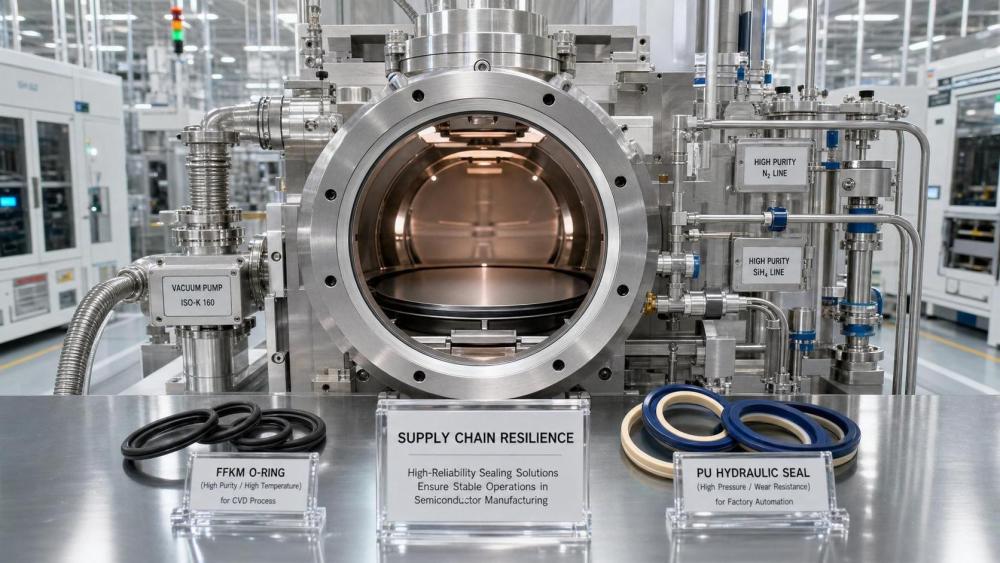
The same information also confirms that tungsten hexafluoride is a critical precursor for semiconductor CVD processes, and that the current tightness is transmitting into the supply of high-reliability sealing materials, including PU hydraulic seals and FFKM O-rings.
These sealing components are used in semiconductor equipment chambers, vacuum pumps, and clean fluid systems. The input further confirms that they require very high purity and fluorine corrosion resistance, that qualification cycles are long, that substitute supply is tight, and that overseas wafer fabs have already seen effects on spare-parts procurement rhythm and lead-time expectations.
Where pressure is appearing across the chain
Semiconductor equipment spare-parts purchasing faces timing risk
From an industry perspective, spare-parts buyers are likely to feel the impact first through planning and replenishment. When a critical CVD precursor becomes tight and that pressure spreads to specialized sealing parts, procurement is affected not only by price signals but also by uncertainty around qualified availability and replacement timing.
Seal suppliers are exposed to qualification and substitution constraints
Suppliers of PU hydraulic seals and FFKM O-rings may face pressure because these products are tied to demanding application environments such as equipment chambers, vacuum pumps, and clean fluid systems. The impact is likely to concentrate in qualification schedules, delivery commitments, and discussions around alternative supply, since the confirmed information already points to long certification cycles and limited substitute sources.
Overseas wafer fabs must watch spare-parts continuity
Observably, overseas wafer fabs are affected through spare-parts procurement pace and lead-time expectations. The issue is not limited to a single material input; it extends to whether maintenance, replacement, and inventory decisions for high-spec sealing components can remain aligned with tool uptime requirements.
Service and supply-chain coordinators may see more communication load
For service providers and supply-chain teams, the likely impact is operational rather than purely transactional. What deserves closer attention is how quickly delivery expectations, qualification status, and substitution feasibility can be communicated across procurement, maintenance, and customer-facing functions.
What companies should monitor now
Separate confirmed supply status from market interpretation
Analysis shows that companies should distinguish between the confirmed facts in this update and broader market assumptions. The verified information covers price movement, stated causes, affected product categories, and procurement impact on overseas wafer fabs; businesses should avoid treating unverified extension scenarios as settled outcomes.
Keep a close watch on qualification-sensitive categories
For teams handling semiconductor equipment consumables, the more immediate focus is on categories with high purity and fluorine corrosion resistance requirements. In practical terms, products such as PU hydraulic seals and FFKM O-rings deserve closer review because long certification cycles can limit response speed even when alternative supply discussions begin early.
Review lead-time commitments and customer communication
Companies involved in procurement, supply, or after-sales support should pay attention to how current lead-time expectations are being stated and updated. The input already indicates that overseas wafer fabs have seen changes in spare-parts purchasing rhythm, so communication discipline around availability, documentation, and delivery windows becomes more important.
Track rule signals separately from shipment execution
Analysis shows that policy-related signals and actual business execution should not be treated as identical. The stated cause includes export controls on tungsten powder to Japan, but the operational effect for many companies will depend on how supply tightness translates into qualified parts availability, replacement planning, and order fulfillment timing.
Why this matters beyond a single price jump
Observably, this development says more than a one-month export price increase. It highlights how a constraint in a semiconductor process material can move into adjacent categories that are less visible in headline market tracking but highly sensitive in day-to-day fab operations.
It is more appropriate to understand this as a supply-chain transmission signal rather than a fully settled long-term outcome. The confirmed facts already show impact on procurement rhythm and lead-time expectations, but the durability and extent of that impact still require continued observation.
What deserves closer attention is the interaction between material tightness and qualification-dependent components. In sectors where replacement is not immediate and substitute supply is limited, small upstream disruptions can carry disproportionate operational weight.
How the market should read the development
At this stage, the update is best read as a meaningful industry warning sign for semiconductor-related supply chains, especially where high-reliability sealing materials are involved. It does not by itself confirm a broad structural outcome, but it does indicate that upstream material stress is already influencing downstream spare-parts planning.
A neutral reading is that the situation combines a confirmed short-term shock with potential longer-tail implications. For companies exposed to equipment maintenance, consumables sourcing, or qualified seal supply, the immediate task is not broad speculation but closer monitoring of availability, certification timing, and delivery commitments.
Basis of this article
This article is generated based on the user-provided news title, event date, and event summary. The confirmed basis includes the reported April 1, 2026 timing, the April 2026 average export price of tungsten hexafluoride, the stated year-on-year increase, the cited causes, and the described transmission of supply pressure into PU hydraulic seals and FFKM O-rings.
For this type of industry update, commonly relevant source categories may include official announcements, company statements, industry association information, authoritative media reporting, and standard-setting or technical documentation. No specific official source link was provided in the input, so the underlying source chain still needs continued verification.
Further observation should focus on whether subsequent official wording, supplier qualification developments, and spare-parts delivery conditions materially change the current interpretation of supply pressure across semiconductor equipment-related sealing products.
Want to dive deeper into these market dynamics, or need data-driven support for your next business move? Drop a line below and let the analysts at PCTS provide customized insights.
We respect your privacy. Your information is strictly confidential.
Related News
- 00
0000-00
How sealing technology reduces contamination in semiconductor manufacturing - 00
0000-00
Where to install vibration sensors on rotating machinery - 00
0000-00
NTSB Probe Finds Boeing Warned of MD-11 Engine Bearing Risk Years Earlier - 00
0000-00
How to size pneumatic grippers for packaging system integration - 00
0000-00
How to size alloy steel power transmission chains for heavy loads
Weekly Insights
Stay ahead with our curated technology reports delivered every Monday.