





On April 28, 2026, Pakistan’s Ministry of Commerce issued S.R.O. 704(I)/2026, requiring written proof that imported goods were not produced with forced labor. For industrial components such as PU hydraulic seals, FFKM O-rings, and heavy roller chains, the development matters because import clearance risk is now tied not only to product delivery, but also to labor-compliance documentation across the supply chain. Importers, upstream manufacturers, and export-facing suppliers are therefore watching the rule closely.
A new document requirement at the border
The confirmed fact is that Pakistan’s Ministry of Commerce released S.R.O. 704(I)/2026 on April 28, 2026 and required all imported goods to be accompanied by written proof stating that they were not made using forced labor.
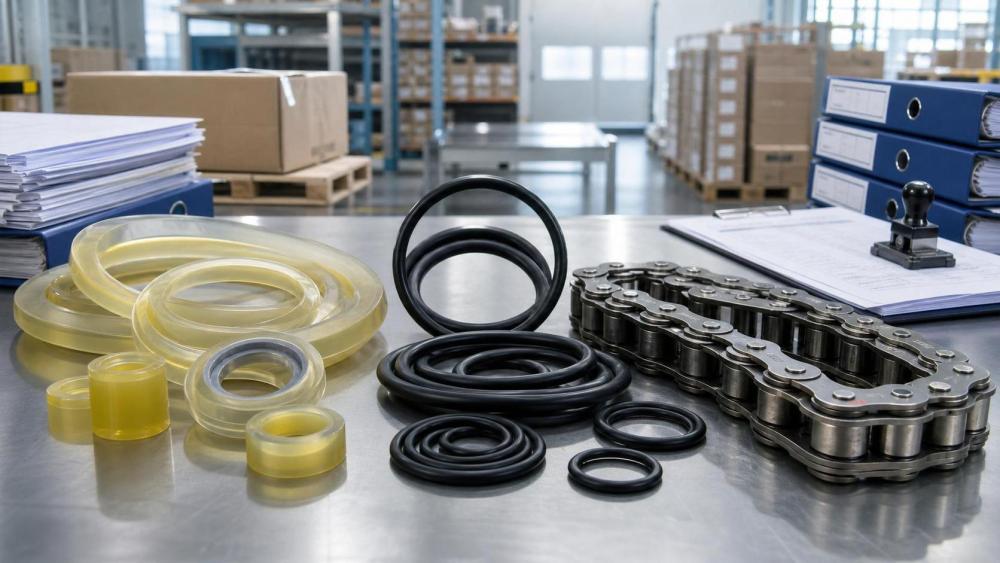
The information provided also indicates that industrial sealing and power transmission parts, including PU hydraulic seals, FFKM O-rings, and heavy roller chains, may face refusal of customs clearance if they are produced by contract factories located in high-risk areas.
Another confirmed point is that importers are urgently asking upstream Chinese suppliers to provide ILO compliance statements and factory audit reports.
Why sealing and chain supply lines are now exposed
Importers face immediate documentation pressure
From an industry perspective, the first impact falls on importers because the rule applies at the point of entry. Their exposure is concentrated in customs filing, document review, and supplier communication. What deserves closer attention is whether existing purchase files already contain the written declarations now being requested.
Upstream manufacturers are pulled into compliance review
For manufacturers supplying industrial seals and chains, the issue is not limited to production capacity or price. Analysis shows that buyers are now asking for ILO-related declarations and factory audit materials, which pushes labor-compliance evidence into routine export documentation. Suppliers using contract manufacturing arrangements may face more questions about where goods are actually made.
Trade execution and delivery schedules may become more fragile
For companies involved in order coordination, shipping, and cross-border execution, the main concern is that a missing or disputed document can affect customs release. Observably, this creates a new risk point between production completion and final import clearance, especially for parts sourced through layered supply arrangements.
What companies should review now
Check whether current declarations match customer requests
Companies serving the Pakistan market should verify whether they can provide the written proof now being requested by importers, and whether that proof is aligned with the ILO compliance statements and audit reports buyers are asking for.
Identify products linked to higher review sensitivity
What deserves closer attention is not every product in the same way, but the categories already mentioned in the market reaction: PU hydraulic seals, FFKM O-rings, and heavy roller chains. Where these goods involve contract factories in higher-risk areas, document scrutiny may become more intense.
Separate policy wording from operational readiness
Analysis shows that the rule itself is a legal requirement, while the ability to pass clearance depends on operational follow-through. Companies should therefore distinguish between understanding the regulation and being ready with supplier files, audit records, and customer-facing statements.
Prepare for tighter customer communication cycles
Because importers are already requesting documentation from upstream Chinese suppliers, response speed and document consistency are likely to become practical issues. Businesses should pay attention to who prepares the statement, how factory audit materials are organized, and how quickly they can answer customer compliance queries.
How this development is best interpreted
This section is an editorial observation. At this stage, it is more appropriate to understand the development as a concrete compliance signal rather than as a fully measurable market outcome. The rule is already clear in its documentary requirement, but the broader commercial impact will depend on how strictly documentation is checked in actual transactions and how suppliers adapt their paperwork.
Observably, the immediate significance lies in shifting forced-labor compliance from a reputational issue into an import-document issue for affected shipments. For the sealing and chain supply chain, that makes traceability and factory-level proof more commercially relevant than before.
A short-term customs issue with longer-term implications
In summary, the latest development is not just about one more form at the border. It signals that labor-compliance statements are becoming part of practical trade execution for industrial components entering Pakistan. At present, it is more appropriate to read this as both an immediate documentation change and a longer-term warning for suppliers whose production structures are harder to verify.
A neutral reading is that the rule has already created a real compliance task, while the full scale of its business impact still requires continued observation.
Basis of this article and what still needs verification
This article is generated from the user-provided news title, event date, and event summary. The confirmed basis includes the April 28, 2026 timing, Pakistan Ministry of Commerce S.R.O. 704(I)/2026, the written proof requirement for imports, the cited product categories, and the reported request for ILO compliance statements and factory audit reports.
For this type of industry update, commonly relevant source categories may include official government notices, company announcements, industry association releases, authoritative media coverage, and standards or compliance-related documents. A specific official source link was not provided in the input, so continued verification remains necessary.
Further observation should focus on whether additional official wording, implementation clarification, or market-side document practice changes emerge after the initial announcement.
Want to dive deeper into these market dynamics, or need data-driven support for your next business move? Drop a line below and let the analysts at PCTS provide customized insights.
We respect your privacy. Your information is strictly confidential.
Related News
- 00
0000-00
How sealing technology reduces contamination in semiconductor manufacturing - 00
0000-00
Where to install vibration sensors on rotating machinery - 00
0000-00
NTSB Probe Finds Boeing Warned of MD-11 Engine Bearing Risk Years Earlier - 00
0000-00
How to size pneumatic grippers for packaging system integration - 00
0000-00
How to size alloy steel power transmission chains for heavy loads
Weekly Insights
Stay ahead with our curated technology reports delivered every Monday.