





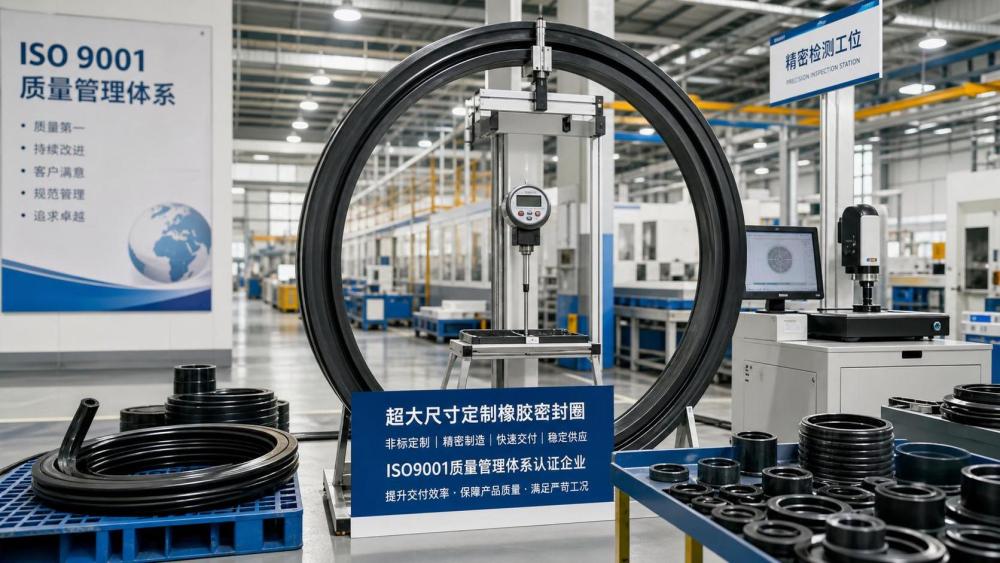
The timing of the underlying event is not specified in the source input, but as of June 13, 2026, Xingtai Longmeng Machinery had obtained ISO9001 quality management system certification and reported a 22% improvement in delivery efficiency for large custom sealing products. For export-oriented supply chains serving hydraulic system integrators, heavy-equipment OEMs and MRO providers, this is worth attention not simply as a company update, but as a practical signal that certification status, process consistency and delivery performance are becoming more relevant in supplier qualification, procurement review and project execution for oversized sealing applications.
What Has Been Confirmed So Far
According to the provided information, Xingtai Longmeng Machinery had passed ISO9001 certification by June 13, 2026. The same input states that its hot-splicing process for large rubber seals achieves joint strength consistent with the base material, that response time for non-standard orders has been reduced by 30%, and that its order delivery completion rate over the past three years reached 99.2%.
The confirmed information also indicates that this capability has clear supply-chain stability value for buyers in Europe, the United States and the Middle East that depend on long-cycle custom sealing products. The applications specifically mentioned in the input include export projects involving wind power yaw systems and main hydraulic cylinders for construction machinery, both of which require very large sealing components.
Why Supplier Qualification May Carry More Weight
For buyers managing export project timelines
From an industry perspective, purchasers of oversized custom seals may be affected because certification and delivery metrics often influence supplier screening, technical review and scheduling decisions. In this context, what deserves closer attention is whether procurement teams begin placing greater emphasis on documented quality-system status, responsiveness for non-standard requirements and evidence of delivery consistency when evaluating vendors for long-cycle projects.
For manufacturers integrating hydraulic assemblies
Hydraulic system integrators and heavy-equipment OEMs may feel the impact primarily in technical specification alignment and project execution. Where very large seals are tied to critical assemblies, the combination of certified quality management and a process described as maintaining joint strength consistency may become more relevant in internal compliance review, supplier approval files and bid-related technical documentation.
For aftermarket and maintenance service providers
MRO service providers may be affected in spare-parts planning and service continuity. Analysis shows that where maintenance projects rely on non-standard or oversized seals, shorter response cycles can matter for downtime control, but buyers still need to watch how supplier credentials, technical records and traceability documents are requested in contracts or maintenance procurement procedures.
For certification and supply-chain support functions
Certification-related service providers, sourcing teams and trade support functions may need to pay closer attention to how ISO9001 status is referenced in qualification files, tender submissions, audit checklists and delivery assurance reviews. The practical impact is less about a new law being announced in the input and more about how recognized certification can shape compliance expectations in cross-border industrial purchasing.
What Companies Should Watch in Current Practice
Review how certification is used in vendor approval
Analysis shows that companies purchasing custom sealing products should verify how ISO9001 certification is being treated in supplier onboarding, tender evaluation and approved-vendor management. The current input confirms certification status, but it does not provide the detailed execution criteria that individual buyers, projects or markets may apply.
Check technical files for oversized custom applications
For projects involving wind power yaw systems, construction machinery main hydraulic cylinders or similar oversized sealing requirements, companies should pay close attention to technical documentation, specification matching and any testing or process records requested during procurement. The supplied information supports attention to process consistency, but it does not establish a universal technical acceptance standard across all projects.
Reassess lead-time assumptions for non-standard orders
Observably, a reported 30% reduction in response time for non-standard orders can affect procurement planning and inventory assumptions. Even so, companies should treat this as a supplier capability signal rather than a guaranteed project outcome, and continue checking contract terms, delivery commitments and order-specific documentation before adjusting sourcing strategies.
Keep traceability and after-sales records aligned
Exporters, OEMs and service providers should also watch whether customer requirements increasingly call for clearer quality traceability, delivery records and supporting documentation for custom seals used in critical equipment. The input does not define any new mandatory rule, so the practical focus should remain on document readiness and consistency with customer-side compliance expectations.
How This Signal Should Be Read
It is more appropriate to understand this as an execution-level market signal rather than as a fully defined new regulatory regime. Analysis shows that the combination of ISO9001 certification, process consistency claims and improved delivery performance can matter where buyers are tightening supplier qualification standards or placing more weight on dependable fulfillment for custom industrial components.
At the same time, this remains an area that still requires observation. The input does not provide new policy text, enforcement guidance or formal changes in tender rules. For that reason, industry participants should keep watching how certification language, technical qualification requirements and delivery-assurance expectations appear in actual procurement documents and project feedback.
A Practical Reading for the Market
In practical terms, this development is best read as a sign that certified process control and delivery reliability may be gaining importance in the commercial evaluation of large custom sealing suppliers, especially for export projects with long lead times and oversized component requirements. It should not be overstated as a blanket market shift, but it does provide a concrete reference point for companies reviewing sourcing resilience, supplier compliance files and project delivery risk.
Basis of This Article
This article is generated from the user-provided news title, event timing and event summary. No specific official source link was provided in the input, so any official confirmation path still requires further verification. For this type of development, commonly relevant source categories may include official company disclosures, regulator releases, trade or customs authority information, industry association updates, standard-setting organization documents and reporting by established business or industrial media.
Further observation is still needed on any later clarification concerning certification application in procurement, evolving tender documentation, market-side qualification language, industry feedback and actual execution by buyers and suppliers.
Related News
- 00
0000-00
Where are axial piston pumps used in mining equipment? - 00
0000-00
Embodied AI Robotics and Drive Control Forum Held in Shanghai - 00
0000-00
How does seal service life affect the total cost of ownership? - 00
0000-00
Schaeffler to Cut 3,460 Jobs and Close Five European Plants - 00
0000-00
How does system size affect the price of a belt drive system?
Weekly Insights
Stay ahead with our curated technology reports delivered every Monday.