





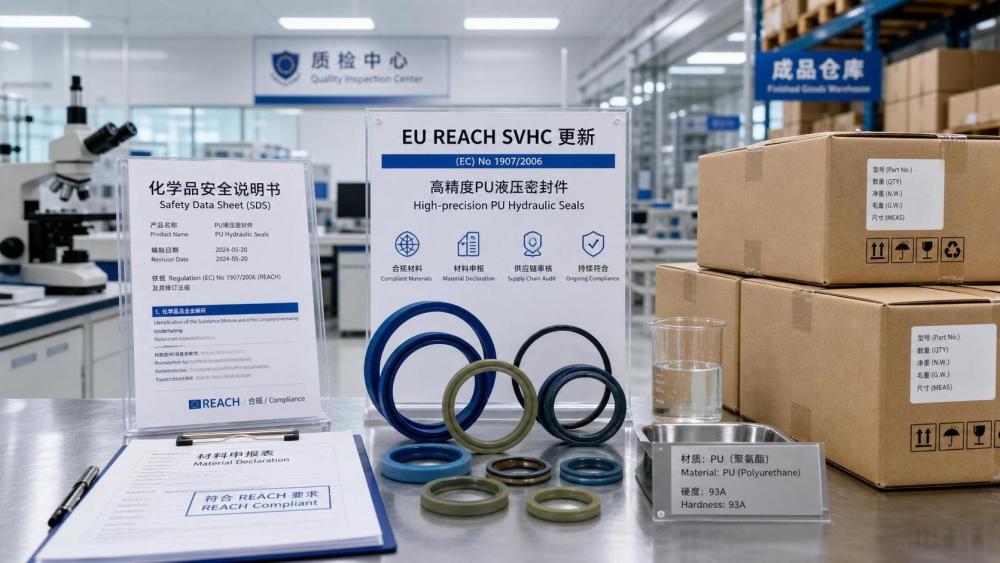
On July 5, 2026, the European Chemicals Agency (ECHA) added three fluoropolymer degradation intermediates to the SVHC Candidate List, creating an immediate compliance issue for some chemical-resistant PU hydraulic seal formulations shipped to Europe. For exporters, importers, OEM buyers, and distributors, the development is worth close attention because it does not stop at a regulatory listing: it also changes what must now be declared in Section 15 of the SDS and in accompanying documents, pushing supply-chain review and technical file updates into current business operations.
What changed on July 5
According to the provided event information, ECHA formally placed three fluoropolymer degradation intermediates on the SVHC Candidate List on July 5, 2026. The stated direct effect is on the compliance status of certain chemical-resistant PU hydraulic seal formulations. From the same date, all PU hydraulic seal products exported to the EU must declare the presence status of the substances and the relevant concentration threshold in SDS Section 15 and in accompanying documentation.
The provided information also states that this change will trigger renewed supply-chain review and upgrades to technical documentation for seal importers, OEM procurement teams, and distributors.
Where the pressure will appear in the supply chain
Export and trade-facing suppliers
From an industry perspective, companies directly shipping PU hydraulic seals to the EU are likely to feel the first operational impact because declaration requirements now apply immediately. The main pressure point is document readiness: product files, SDS content, and supporting shipment documents must be aligned with the new substance-status and concentration-threshold disclosure requirement.
Procurement teams buying for OEM programs
For OEM purchasing functions, the issue is not limited to a regulatory check-box. Analysis shows that procurement teams may need to re-verify whether affected PU hydraulic seal formulations remain acceptable for current sourcing arrangements, especially where chemical resistance requirements previously guided material selection. What deserves closer attention is whether supplier disclosures are complete, current, and consistent across technical and transactional documents.
Importers and distribution channels
Importers and distributors are specifically named in the provided information, which indicates that they will need to revisit supply-chain controls. In practice, their exposure is likely to center on inbound document review, product traceability within stocked lines, and communication with upstream suppliers and downstream customers regarding declaration status.
Manufacturing and formulation management
For manufacturers using PU hydraulic seal compounds with chemical-resistant positioning, the immediate relevance lies in formulation compliance assessment. Observably, the key business link is whether the materials used in export-bound products require updated declaration handling under the revised SVHC context, and whether the technical documentation attached to those products reflects that status clearly.
What companies should check now
Documentation consistency across SDS and annex files
Analysis shows that the most immediate task is not broad strategy but document accuracy. Companies involved in EU-bound shipments should focus on whether SDS Section 15 and accompanying files express substance presence status and concentration-threshold information in a consistent way.
Supplier confirmation and formulation visibility
What deserves closer attention is upstream confirmation. Businesses relying on external compounders or component suppliers will need clear visibility into whether the relevant substances are present in affected PU hydraulic seal formulations and how that status is documented for export use.
Customer communication and order execution risk
For sales, account, and delivery teams, the practical concern is execution continuity. Analysis shows that any mismatch between product status and supporting declarations could affect customer review, order release, or acceptance procedures, particularly where EU buyers require complete technical files before shipment or intake.
Further wording changes still need monitoring
The confirmed fact is that the listing and declaration requirement are now in effect. At the same time, observably, businesses should continue watching for any further official wording, interpretive clarification, or downstream customer-specific compliance requests that may affect how the requirement is implemented in routine transactions.
Why this matters beyond a single document update
This section is an editorial observation based on the provided facts. It is more appropriate to understand this development as both an immediate compliance adjustment and a broader signal for materials governance in EU-bound industrial components. The listing itself is already a confirmed regulatory event, but the full business effect depends on how deeply the affected substances are embedded in current PU hydraulic seal formulations and how quickly supply chains can produce reliable declarations.
Analysis also suggests that the issue should not be read as a general disruption across all PU hydraulic seals. The provided information points specifically to some chemical-resistant formulations, which means the near-term impact may be concentrated in certain product configurations, customer programs, or documentation workflows rather than uniformly across every seal category.
How the market should read this update
At this stage, the most balanced reading is that the REACH SVHC update has already created a concrete compliance action point for PU hydraulic seals exported to Europe, while its broader commercial effect still requires continued observation. The confirmed takeaway is clear: declaration obligations have moved from a background compliance topic into an immediate operational requirement for affected products. The wider industry significance lies in how quickly suppliers, buyers, and channel partners can align technical files, supplier confirmations, and shipment documentation.
Basis of this article
This article is based on the user-provided news title, event date, and event summary. For developments of this type, commonly relevant source categories may include official regulatory notices, company statements, industry association updates, authoritative media reporting, and standard-setting or technical compliance documents. No specific official source link was provided in the input, so the precise official source path still needs ongoing verification. Follow-up attention should remain on any additional official clarification and on how declaration requirements are applied in actual EU-bound business documentation.
Want to dive deeper into these market dynamics, or need data-driven support for your next business move? Drop a line below and let the analysts at PCTS provide customized insights.
We respect your privacy. Your information is strictly confidential.
Related News
- 00
0000-00
How to check vibration analysis software for sensor compatibility - 00
0000-00
IndexBox Forecasts 3.8% Annual Growth for Global Radial Seals Market Through 2035 - 00
0000-00
How to assess the chemical compatibility of FFKM sealing sheets - 00
0000-00
IndexBox Forecasts 3.6% Annual Growth for Construction Bearings Market - 00
0000-00
When do hydraulic components require an export license?
Weekly Insights
Stay ahead with our curated technology reports delivered every Monday.