





On July 10, 2026, the European Chemicals Agency issued a notice that changes the compliance basis for PU hydraulic seals entering the EU market. The update brings specified PFAS substances in PU hydraulic seals into the REACH Annex XVII restriction list, and from October 1, 2026, imported products under HS code 3926.90.90 must be accompanied by a PFAS test report showing a result of no more than 25 ppb from an ISO/IEC 17025 accredited laboratory. For exporters, importers, testing providers, and supply chain teams handling these products, this is not only a product compliance issue but also a documentation, lead-time, and customs-readiness issue that requires near-term attention.
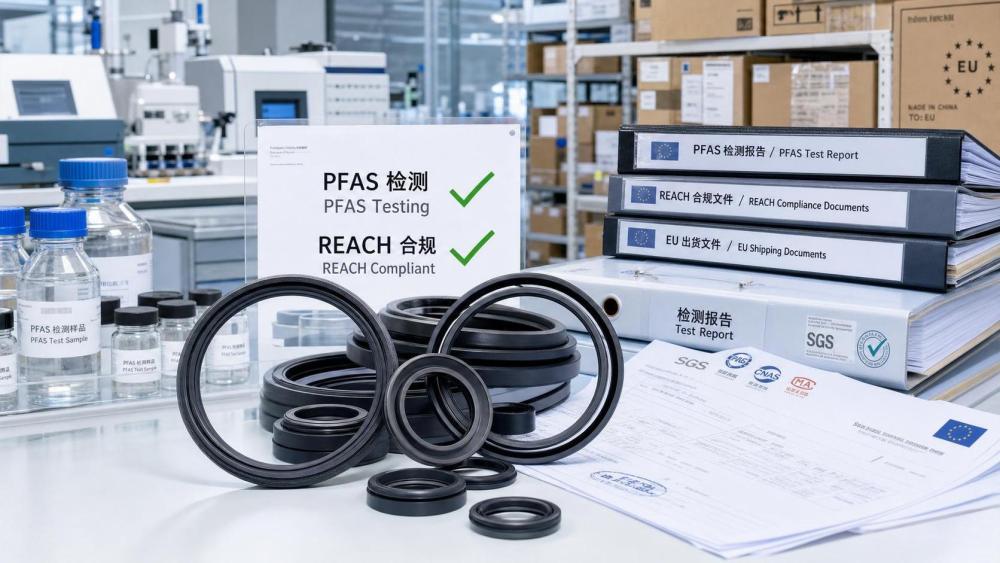
What the notice changes for EU-bound shipments
According to the information provided, the ECHA notice was released on July 10, 2026 and adds specified per- and polyfluoroalkyl substances (PFAS) in PU hydraulic seals to the REACH Annex XVII restriction list.
The requirement applies from October 1, 2026 to all PU hydraulic seals imported into the EU under HS code 3926.90.90.
The products must be accompanied by a test report showing PFAS content at or below 25 ppb.
The test report must be issued by a laboratory accredited to ISO/IEC 17025.
The information provided also states that the change directly affects compliance preparation by Chinese exporters, testing lead times, and customs clearance timing, while importers need to coordinate with suppliers in advance on pre-testing and document filing.
Where the pressure will appear across the business chain
Export preparation moves closer to shipment readiness
From an industry perspective, exporters of PU hydraulic seals may be affected first because the rule ties market access to a specific test document rather than to a general compliance statement. The practical impact is likely to appear in sample preparation, test scheduling, shipment release planning, and the completeness of export documentation for EU-bound orders.
What deserves closer attention is that the compliance step now sits closer to the shipping window. If testing is not arranged early enough, the issue is not limited to product review; it can extend to dispatch timing and customs documentation readiness.
Import-side coordination becomes a file-control task
EU importers may be affected because they need incoming goods to arrive with documentation that matches the new rule. The information provided already points to the need for advance coordination with suppliers on pre-testing and document filing.
In practice, the impact is likely to fall on supplier onboarding, order confirmation, document collection, and customs-facing compliance files. Buyers and import compliance teams will need to pay close attention to whether the required report is available before shipment rather than after arrival.
Testing capacity becomes part of delivery planning
Testing service providers and compliance support teams may also see direct effects because the rule specifies ISO/IEC 17025 accredited laboratory reports and a defined threshold of 25 ppb. Analysis shows that this makes laboratory selection and report timing part of the delivery schedule, not just a background quality step.
For manufacturers and traders, this means lead-time management may now depend partly on laboratory turnaround and document completeness. For supply chain service providers, the main concern is whether testing, filing, and shipping milestones are aligned well enough to avoid clearance delays.
What companies should review now
Check whether product files match the new threshold requirement
Analysis shows that companies handling PU hydraulic seals for the EU market should first review whether their current technical and compliance files can support the PFAS threshold now referenced in the notice. The immediate point is not to assume existing files are sufficient, but to confirm whether new testing will be needed for EU shipments after October 1, 2026.
Build testing time into order and shipment schedules
Observably, the notice turns testing lead time into a commercial planning issue. Exporters and importers should pay attention to whether purchase orders, shipment plans, and customer delivery commitments leave enough time for pre-testing and report issuance by an ISO/IEC 17025 accredited laboratory.
Review document control for customs and customer files
What deserves closer attention is the document path around the shipment. The provided information states that importers need to coordinate pre-testing and document filing in advance, so companies should review how reports are collected, checked, stored, and attached to transaction records for EU-bound goods.
Follow execution language as the rule moves into practice
The information provided confirms the notice and the effective date, but it does not provide further implementation detail beyond the testing and filing requirement. For that reason, companies should continue watching for execution language, documentary expectations, and any changes in how customers, importers, or downstream procurement documents reflect the new requirement.
How this should be read at this stage
Analysis shows that this development is best understood as a concrete compliance signal rather than a distant policy discussion. The effective date is already defined, the covered product category is identified, and the required testing format is specified. That makes the issue operational for companies shipping PU hydraulic seals into the EU.
At the same time, it is also more appropriate to understand this as a rule change that still requires close observation in execution. The current information does not establish how all market participants will apply document checks in practice, so industry attention should remain on implementation wording, procurement-side adoption, and feedback from actual shipment handling.
A rule change with immediate workflow consequences
The significance of this notice lies less in headline value and more in how directly it touches trade execution. For EU-bound PU hydraulic seals, PFAS compliance is moving into a document-backed entry requirement tied to accredited testing and a defined limit. That affects exporters, importers, and service providers through preparation time, file completeness, and shipment planning.
From an industry perspective, the most balanced reading for now is that this is an implemented rule signal with practical near-term consequences, while some execution details still need to be observed through market practice and follow-up compliance handling.
Basis of this article and what still needs verification
This article is based on the user-provided news title, event date, and event summary. The confirmed facts used here come from the provided description of the July 10, 2026 ECHA notice, the REACH Annex XVII restriction change, the October 1, 2026 effective date, the covered HS code 3926.90.90, and the requirement for an ISO/IEC 17025 accredited laboratory report showing PFAS content of no more than 25 ppb.
For events of this type, relevant source categories usually include official notices, publications by regulatory authorities, customs or trade administration updates, industry association releases, standards-related documents, and reporting by authoritative trade media. No specific official source link was provided in the input, so the exact official link remains to be verified on an ongoing basis.
Further observation is still needed on implementation details, certification and document review practice, changes in procurement or tender documentation, market feedback, and how companies execute testing and filing requirements in actual trade flows.
Related News
- 00
0000-00
Where are axial piston pumps used in mining equipment? - 00
0000-00
Embodied AI Robotics and Drive Control Forum Held in Shanghai - 00
0000-00
How does seal service life affect the total cost of ownership? - 00
0000-00
Schaeffler to Cut 3,460 Jobs and Close Five European Plants - 00
0000-00
How does system size affect the price of a belt drive system?
Weekly Insights
Stay ahead with our curated technology reports delivered every Monday.