





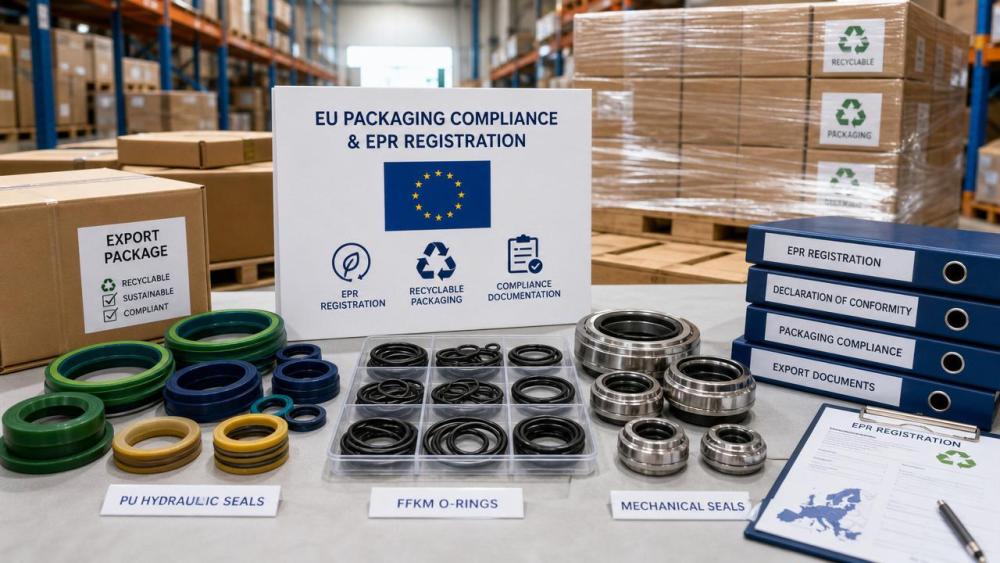
On August 12, 2026, the EU’s Packaging and Packaging Waste Regulation (PPWR) is set to take effect, bringing immediate compliance implications for industrial sealing products sold in Europe. Manufacturers and importers handling items such as PU hydraulic seals, FFKM O-rings, and mechanical seals must complete Extended Producer Responsibility (EPR) registration in each relevant member state and fulfill related recycling obligations. For exporters, importers, distributors, and supply chain teams, this is not just a regulatory update; it directly affects market access, customs clearance, online sales continuity, and the cost structure tied to cross-border delivery.
What the regulation changes for sealing products
According to the provided information, the EU PPWR will be formally implemented on August 12, 2026. The requirement applies to industrial sealing products sold in the European market, including PU hydraulic seals, FFKM O-rings, and mechanical seals.
The confirmed compliance requirement is that manufacturers and importers must complete EPR registration in the relevant EU member states and carry out recycling-related obligations. The stated compliance risks for companies that fail to meet these requirements include refusal of customs entry, removal from online platforms, and substantial fines.
The information also makes clear that the regulation has a direct impact on export access for sealing components and on supply chain compliance costs.
Where the pressure is likely to appear first
Export-facing manufacturers may face a market access checkpoint
From an industry perspective, manufacturers that ship sealing products into Europe are likely to feel the impact first because the requirement is tied to whether products can continue to enter and remain in the EU market. The main pressure point is no longer limited to product delivery itself, but extends to packaging-related compliance preparation before shipment.
What deserves closer attention is whether internal export processes, customer onboarding, and shipment documentation are aligned with EPR registration obligations across member states.
Importers in Europe sit at the center of execution risk
Analysis shows that importers are directly exposed because the confirmed requirement explicitly covers them alongside manufacturers. Their operational risk may concentrate in customs clearance, platform compliance, and local recycling obligation handling.
For this group, the key issue is not only whether goods are ordered and received, but whether the registration and follow-up obligations have been completed in the markets where the products are sold.
Distributors and platform-based sellers may need tighter compliance screening
Observably, channel operators and sellers using online platforms may need to pay closer attention because the stated consequences include platform delisting. Even where they are not the original manufacturer, their business continuity can still be affected if upstream compliance is incomplete.
The main business impact is likely to appear in supplier qualification checks, listing maintenance, and transaction continuity for EU-bound products.
Supply chain and service teams may see cost and timing effects
For logistics, documentation, and trade support teams, the immediate concern is that packaging compliance now becomes part of export readiness. Analysis shows this can affect delivery schedules, handover timing, and coordination between factories, exporters, and importers.
The information provided also points directly to a rise in compliance-related supply chain costs, making coordination quality a practical issue rather than a secondary administrative task.
What companies should watch now
Track member-state registration execution
The confirmed requirement refers to completing EPR registration in each relevant member state. What deserves closer attention is the practical scope of where products are sold and which entities are responsible for registration in each market.
Review which sealing product lines are exposed
Companies should focus on the product categories explicitly covered in the provided information, including PU hydraulic seals, FFKM O-rings, and mechanical seals. In practice, this means identifying which EU-bound product lines may be affected first in sales, shipment, and after-sales support workflows.
Separate policy language from operational readiness
Analysis shows that a formal rule taking effect does not automatically mean every company is operationally prepared. The practical question is whether internal teams, import partners, and channel operators can provide the required registration status and supporting compliance materials when goods move or listings are reviewed.
Prepare customer and supplier communication early
For exporters and buyers, it is more appropriate to focus early on supplier qualifications, document readiness, responsibility allocation, and delivery planning. The immediate risk described in the provided information suggests that communication gaps between manufacturers, importers, and sales channels could translate into shipment disruption or listing interruptions.
Why this looks like more than a short-term compliance notice
Observably, this development is not best understood as a narrow packaging formality. It signals that packaging-related producer responsibility is becoming a practical entry condition for industrial components, including sealing products. That matters because these parts are often treated as technical items first, while packaging compliance may previously have been handled as a secondary issue.
Analysis shows that the current significance lies in the combination of access risk and execution detail: customs rejection, platform delisting, and fines make the issue immediate, while member-state registration and recycling obligations make implementation operationally complex. For that reason, this is more appropriately understood as a concrete compliance shift with longer-term supply chain implications, while some execution details may still require continued monitoring.
How the sector may best interpret this update
At this stage, the most balanced reading is that the PPWR implementation date creates a clear compliance threshold for industrial sealing products entering the EU market. The confirmed facts already indicate direct consequences for exporters and importers, especially where packaging responsibility has not yet been built into routine trade processes.
Rather than viewing this only as a short-term regulatory change, it is more appropriate to understand it as a structural compliance signal for market access and supply chain management. The near-term priority is readiness; the longer-term issue is how consistently companies can integrate EPR obligations into ongoing EU business.
Basis of this article and points for continued verification
This article is based on the user-provided news title, event date, and event summary. The factual core used here includes the stated August 12, 2026 implementation date for the EU PPWR, the requirement for manufacturers and importers of industrial sealing products sold in Europe to complete EPR registration in relevant member states and fulfill recycling obligations, and the stated risks of customs refusal, platform delisting, and fines for non-compliance.
For this type of development, commonly relevant source categories may include official regulatory notices, company compliance disclosures, industry association updates, authoritative media reporting, and standards-related documentation. A specific official source link was not provided in the input, so further verification remains necessary. Continued attention should be paid to any later official wording, member-state implementation details, and operational guidance affecting registration and obligation fulfillment.
Want to dive deeper into these market dynamics, or need data-driven support for your next business move? Drop a line below and let the analysts at PCTS provide customized insights.
We respect your privacy. Your information is strictly confidential.
Related News
- 00
0000-00
How to check vibration analysis software for sensor compatibility - 00
0000-00
IndexBox Forecasts 3.8% Annual Growth for Global Radial Seals Market Through 2035 - 00
0000-00
How to assess the chemical compatibility of FFKM sealing sheets - 00
0000-00
IndexBox Forecasts 3.6% Annual Growth for Construction Bearings Market - 00
0000-00
When do hydraulic components require an export license?
Weekly Insights
Stay ahead with our curated technology reports delivered every Monday.