





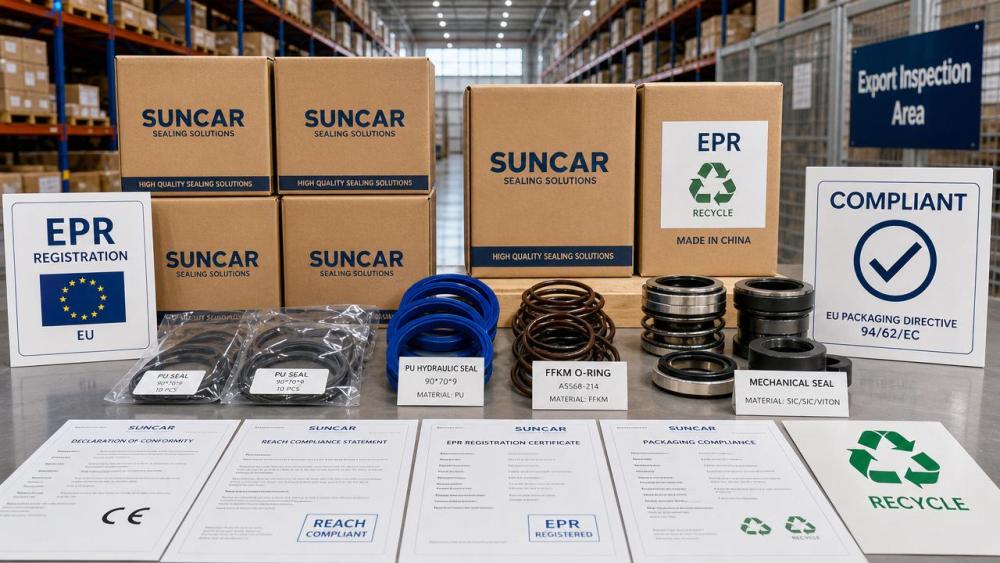
On August 12, 2026, the EU Packaging and Packaging Waste Regulation (PPWR) is set to take effect, turning packaging compliance into a direct export requirement for industrial products shipped to Europe. For suppliers of PU hydraulic seals, FFKM O-rings, mechanical seals, and other packaged components, the immediate issue is no longer only product performance or delivery capacity, but whether EPR registration and related recycling obligations have been completed in the destination market. This matters to exporters, procurement teams, channel operators, and supply chain service providers because the rule change can now affect customs clearance, platform access, and fulfillment continuity for high-value B2B components.
What the Rule Change Confirms
The confirmed development is that the EU's PPWR will formally take effect on August 12, 2026. According to the provided event summary, suppliers exporting packaged industrial products to the EU must complete registration with a producer responsibility organization in the target country and fulfill related recycling obligations.
The scope described in the input includes industrial products shipped with packaging, with examples such as PU hydraulic seals, FFKM O-rings, and mechanical seals. The summary also states that non-compliant companies may face refusal at customs, removal from platforms, and significant fines.
The rule change is described as having a direct impact on the B2B export fulfillment path for high-value-added components such as seals, bearings, and hydraulic system parts.
Where the Pressure Appears in the Export Chain
Export suppliers now face a packaging compliance checkpoint
For manufacturers and exporters selling packaged industrial components into the EU, the impact is tied to market access rather than only packaging design. If EPR registration in the destination country is a required condition for shipment, compliance becomes part of the export readiness review before goods move, especially for orders involving seals, O-rings, and related mechanical components.
From an industry perspective, the business stages most likely to be affected are shipment preparation, export documentation review, customer onboarding, and delivery execution. What deserves closer attention is whether the supplier's compliance file is complete enough to support smooth customs handling and continued order fulfillment.
Procurement and sourcing teams may need to reassess supplier readiness
For buyers and sourcing teams purchasing for the EU market, the change can alter how supplier qualification is evaluated. Analysis shows that packaging-related compliance may become part of routine supplier checks for industrial parts, especially where delivery reliability matters as much as technical specification alignment.
This does not change the confirmed facts of the rule itself, but it does suggest a practical shift: procurement teams may need to verify whether exporters have completed the required EPR registration in the relevant target market before confirming sourcing plans or delivery schedules.
Channels and supply chain operators may bear execution risk
Distributors, platform operators, and supply chain service providers may also be exposed because non-compliance is described as carrying risks such as customs rejection and platform removal. Observably, that places operational pressure on the handoff points between seller, logistics coordination, platform listing, and final market entry.
For these participants, the most relevant changes are likely to involve documentation checks, onboarding standards, and transaction risk screening around packaged industrial goods moving into the EU.
What Companies Should Watch Closely Now
Treat EPR status as a market-entry prerequisite
Analysis shows that companies exporting packaged industrial products to the EU should treat destination-country EPR registration as a precondition that needs to be reviewed early, not after shipment arrangements are already in place. For affected product lines, compliance review now sits closer to the front end of export planning.
Review packaging-related files alongside product documents
What deserves closer attention is the internal link between packaging compliance records and the broader export document set. For businesses dealing in seals, bearings, and hydraulic system components, practical review may need to cover whether packaging-related materials, compliance declarations, and shipment files are aligned well enough to avoid disruption.
Monitor target-market execution signals
The input confirms the rule takes effect and identifies the compliance obligation, but it does not provide detailed enforcement procedures. It is therefore more appropriate to understand the current moment as one that requires close monitoring of official wording, implementation approaches, and any market-side compliance interpretation that may affect order handling or listing requirements.
Factor compliance timing into delivery commitments
Observably, if non-compliance can lead to refusal of entry or platform removal, companies should pay attention to how compliance timing interacts with shipment schedules, procurement cycles, and customer delivery commitments. This is especially relevant for B2B orders where export fulfillment depends on multiple parties staying aligned.
How This Signal Should Be Read
Analysis shows that this development is best understood as a concrete compliance signal rather than a distant policy discussion. The important shift is that packaging obligations, for the product categories described in the input, are moving into the practical path of export execution.
At the same time, it would be premature to present all downstream enforcement details as settled, because the provided information does not include specific operational guidance, official interpretive notes, or market-by-market execution examples. From an industry perspective, the key task now is to distinguish between the confirmed compliance requirement and the still-evolving way it may be checked in practice.
Why the Update Matters for Near-Term Decisions
For the sealing, bearing, and hydraulic component trade, this update is not just a policy headline. It points to a compliance condition that can affect whether goods reach the EU market smoothly. The more balanced reading is that the rule change has already become relevant for export planning, while many practical execution details still need continued observation.
It is more appropriate to understand this development as a rule now entering the fulfillment stage: confirmed enough to require attention in compliance preparation, but still needing ongoing monitoring in terms of implementation wording, transaction practice, and market feedback.
Basis of This Article
This article is generated from the user-provided news title, event date, and event summary. The confirmed factual basis used here is limited to the stated PPWR effective date of August 12, 2026, the requirement for EPR registration and recycling obligations in the target country for packaged industrial products exported to the EU, the examples of affected product categories, and the stated compliance risks.
For this type of development, source categories typically relevant for follow-up verification may include official announcements, regulatory releases, customs or trade authority information, industry association notices, standards-related documents, and reporting by authoritative media. However, a specific official source link was not provided in the input, so further verification remains necessary.
Items that still require continued observation include implementation detail, compliance interpretation, tender or procurement document changes, market feedback, and how affected companies carry out the requirement in actual export operations.
Want to dive deeper into these market dynamics, or need data-driven support for your next business move? Drop a line below and let the analysts at PCTS provide customized insights.
We respect your privacy. Your information is strictly confidential.
Related News
- 00
0000-00
How sealing technology reduces contamination in semiconductor manufacturing - 00
0000-00
Where to install vibration sensors on rotating machinery - 00
0000-00
NTSB Probe Finds Boeing Warned of MD-11 Engine Bearing Risk Years Earlier - 00
0000-00
How to size pneumatic grippers for packaging system integration - 00
0000-00
How to size alloy steel power transmission chains for heavy loads
Weekly Insights
Stay ahead with our curated technology reports delivered every Monday.