





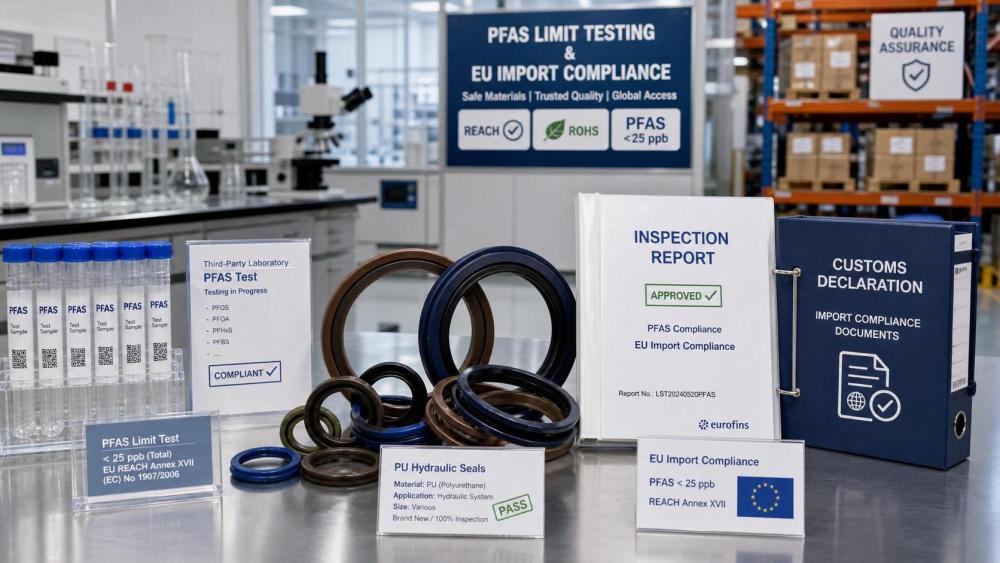
On October 1, 2026, a new compliance threshold takes effect for PU hydraulic seals entering the EU market. The change follows an ECHA revision notice issued on July 12, 2026, bringing PFAS-containing polyurethane hydraulic seals within the scope of REACH Annex XVII and requiring a third-party laboratory report showing PFAS content at or below 25 ppb. For exporters, distributors, import-facing supply chains, and compliance teams, the development deserves attention because it links market access more directly to test documentation, customs readiness, and supplier qualification.
What the revised requirement confirms
The confirmed facts are limited but commercially significant. ECHA issued a revision notice on July 12, 2026. Under that notice, polyurethane hydraulic seals containing PFAS were added to the control scope of REACH Annex XVII. From October 1, 2026, all PU hydraulic seals imported into the EU must be accompanied by a third-party compliance test report confirming PFAS content of no more than 25 ppb.
The input also confirms that this requirement directly affects the certification route and customs clearance process for Chinese sealing product exporters. It further indicates that overseas distributors need to update their supplier audit checklists in advance.
Where the practical pressure is likely to appear
Export shipments now depend more heavily on test-ready documentation
For export-oriented seal manufacturers and traders, the most immediate impact is on shipment preparation rather than on commercial messaging. Because the rule ties EU import access to a third-party PFAS report, affected companies will need to pay closer attention to whether product files, laboratory evidence, and shipment documents can support customs and customer review without delay.
Distributor screening is moving closer to compliance verification
For overseas distributors, the change matters because supplier approval is no longer only a sourcing and quality question. The input specifically notes that supplier audit checklists need to be updated. In practice, this means distributors are likely to focus more on whether upstream suppliers can provide the required PFAS test evidence for PU hydraulic seals before goods move into the EU channel.
Certification and testing functions may become earlier checkpoints
For compliance teams, certification-related service providers, and testing laboratories, the rule change shifts attention toward document timing and report availability. The issue is not only whether a product can meet the threshold, but whether the supporting third-party report is available in a form that aligns with customer review, import processing, and transaction schedules.
What companies should watch now
Review whether current product files can support the new threshold
Analysis shows that affected businesses should first examine whether existing technical and compliance files for PU hydraulic seals are sufficient to support the new PFAS reporting requirement. What deserves closer attention is whether the current documentation path matches a third-party laboratory report requirement rather than relying on older internal or supplier-side material alone.
Check how the new rule may alter export and clearance workflows
From an industry perspective, the rule is not only about substance control. It may also affect how export documentation is assembled and when compliance evidence must be ready in relation to shipment and customs processing. Since the input confirms an effect on customs clearance, companies should monitor whether internal trade, logistics, and document handoff steps need adjustment.
Update supplier qualification and procurement review points
Observably, procurement and channel management teams should pay attention to supplier qualification criteria. The input already points to distributor checklist updates, so businesses involved in sourcing or resale should watch whether contracts, onboarding files, and supplier review standards need to reflect the PFAS test report requirement for relevant PU hydraulic seals.
Keep watching for execution language and market-side adoption
Because the input does not provide detailed implementation language beyond the announced threshold and effective date, it would be premature to describe a fully settled enforcement pattern. What deserves closer attention is how the requirement is reflected in customer specifications, tender documents, clearance practice, and routine compliance review after the effective date.
Why this looks like an execution signal, not just a headline
Analysis shows that this development is better understood as a concrete market-access signal than as a general policy discussion. The effective date is specified, the affected product category is identified, and the compliance evidence is framed as a third-party laboratory report with a defined PFAS threshold. At the same time, it is still appropriate to keep part of the picture under observation, because the input does not provide fuller detail on operational interpretation, documentation format, or downstream enforcement practice.
How to read the change at this stage
At this stage, the update is most appropriately understood as a rule change with direct compliance and trade relevance for PU hydraulic seals entering the EU. It does not justify broad conclusions beyond the affected scope described in the input, but it does indicate that exporters, distributors, and compliance-facing teams should treat PFAS test evidence as a more immediate condition for market access, document review, and shipment readiness.
Basis of this article and what still needs verification
This article is based on the user-provided title, event date, and event summary. For developments of this kind, source types typically associated with verification may include official notices, regulatory authority publications, customs or trade administration information, industry association updates, standards-related documents, and reporting from authoritative trade media. No specific official source link was provided in the input, so the exact official link still needs to be verified on an ongoing basis.
Further observation is still needed regarding detailed implementation language, certification and testing interpretation, possible changes in tender or procurement documents, market feedback from distributors and import-side reviewers, and how companies are adapting their execution processes after the effective date.
Want to dive deeper into these market dynamics, or need data-driven support for your next business move? Drop a line below and let the analysts at PCTS provide customized insights.
We respect your privacy. Your information is strictly confidential.
Related News
- 00
0000-00
How sealing technology reduces contamination in semiconductor manufacturing - 00
0000-00
Where to install vibration sensors on rotating machinery - 00
0000-00
NTSB Probe Finds Boeing Warned of MD-11 Engine Bearing Risk Years Earlier - 00
0000-00
How to size pneumatic grippers for packaging system integration - 00
0000-00
How to size alloy steel power transmission chains for heavy loads
Weekly Insights
Stay ahead with our curated technology reports delivered every Monday.