





On June 1, 2026, China began enforcing new customs registration requirements for overseas factories that export food and food-contact materials to the Chinese market. While PU Hydraulic Seals are not themselves classified as direct food-contact products, the update matters to polyurethane-related supply chains when raw materials such as PU Timing Belts base materials or plasticizers come from the same corporate group as registered food-grade polyurethane plants. For traders, manufacturers, procurement teams, and customs-facing supply chain operators, the immediate concern is not product reclassification but whether upstream traceability checks could affect clearance speed and batch release stability.
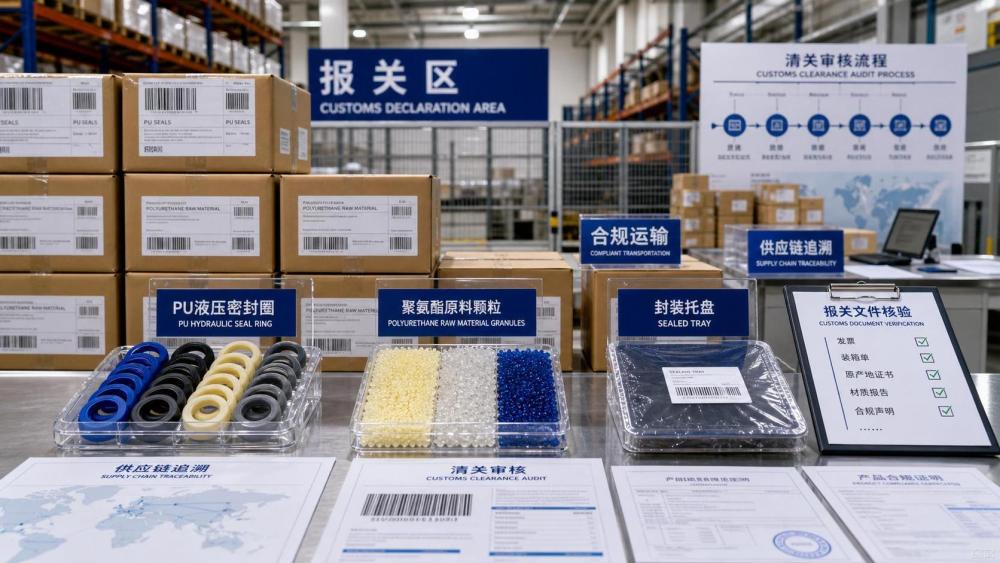
What the new rule clearly covers
According to the information provided, the Regulation on the Registration and Administration of Overseas Manufacturers of Imported Food took effect on June 1, 2026. Under this rule, all overseas factories exporting food and food-contact materials to China must complete registration with China Customs.
The same information also makes clear that PU Hydraulic Seals are not direct food-contact items. However, if their raw materials, including examples such as PU Timing Belts base materials or plasticizers, originate from a food-grade polyurethane factory within the same corporate group that falls under the registration framework, that related supply chain may enter the scope of upstream qualification traceability review.
The stated business consequence is practical rather than theoretical: clearance efficiency and the stability of batch-by-batch release may be affected where such traceability review is triggered.
Where the operational impact may surface first
Import and trading workflows may face closer document matching
From an industry perspective, direct trade participants may be affected because they sit closest to customs declarations and shipment release. The relevant pressure point is whether product origin, raw material lineage, and upstream plant qualifications can be explained consistently when a shipment is reviewed in connection with a registered food-grade polyurethane source within the same group structure.
Raw material sourcing teams need to watch group-level linkages
For procurement functions, the issue is not limited to whether a purchased material is used in a non-food application. Analysis shows that attention may shift to whether the raw material source is connected to a registered food-related overseas factory in the same group, which could bring additional scrutiny to supplier qualification files and sourcing continuity.
Manufacturing and delivery planning may feel the effect through release timing
Processors and manufacturers using polyurethane-based inputs may see the impact in production scheduling and customer delivery commitments. If traceability checks lengthen customs processing or make batch release less predictable, the effect may appear in inbound material timing rather than in a direct change to product specifications.
Supply chain service providers may need stronger traceability coordination
Customs brokers, logistics coordinators, and other service providers may need to pay closer attention to supporting documents and communication between importer, supplier, and manufacturer. What deserves closer attention is the consistency of chain-of-custody explanations when the shipment itself is outside the food-contact category but its upstream source is not fully isolated from a regulated food-grade production context.
What companies should monitor now
Track whether official wording changes in implementation practice
Businesses should closely follow whether the rule's implementation produces more explicit customs language around upstream traceability, related-party sourcing, or documentation expectations for non-food end products linked to food-grade raw material origins.
Review supplier qualification files beyond the finished product category
In practical terms, companies may need to look beyond the classification of PU Hydraulic Seals themselves and review whether upstream suppliers, affiliated factories, and shared raw material sources create traceability questions during import clearance.
Prepare documents that explain source relationships clearly
Observably, one key distinction is between the legal scope of the rule and the operational scope of customs review. Companies should therefore pay attention to whether their existing records can clearly explain material origin, affiliated factory relationships, and the difference between food-grade production registration and the actual application of the imported goods.
Set expectations on lead times and customer communication
Where shipments depend on polyurethane inputs with potentially sensitive upstream links, firms may need internal contingency plans for customs timing, batch release uncertainty, and customer communication if clearance becomes less stable on certain lots.
Why this reads more like a traceability signal than a category change
Analysis shows that the core significance of this development is not that PU Hydraulic Seals are being redefined as food-contact products. It is more appropriate to understand this as a traceability and qualification signal: customs attention may extend upstream when a non-food product draws from a supply chain connected to registered food-grade polyurethane production within the same group.
At the current stage, this should not be read as a confirmed broad restriction on all polyurethane-related industrial goods. Instead, it points to a compliance environment in which supply chain relationships, source documentation, and affiliated manufacturing structures may matter more to day-to-day clearance outcomes.
How the market may best interpret the update
For the industry, the immediate meaning of this update lies in process sensitivity rather than in a proven market-wide disruption. The more neutral reading is that companies exposed to overlapping food-grade and industrial polyurethane sourcing should be alert to documentation quality and customs responsiveness. It is more appropriate to treat this as an actionable compliance development with possible operational effects, while continuing to watch how consistently it is applied in practice.
Basis of this article
This article is based on the user-provided news title, event date, and event summary. For developments of this type, market participants typically also watch official notices, company disclosures, industry association updates, authoritative media reporting, and standards-related documents. No specific official source link was provided in the input, so the precise source documentation still requires ongoing verification. The main follow-up focus should remain on any further official clarification about registration scope, upstream traceability review, and how such review affects customs clearance and batch release in actual operations.
Want to dive deeper into these market dynamics, or need data-driven support for your next business move? Drop a line below and let the analysts at PCTS provide customized insights.
We respect your privacy. Your information is strictly confidential.
Related News
- 00
0000-00
IndexBox Forecasts 3.8% Annual Growth for Global Radial Seals Market Through 2035 - 00
0000-00
How to assess the chemical compatibility of FFKM sealing sheets - 00
0000-00
IndexBox Forecasts 3.6% Annual Growth for Construction Bearings Market - 00
0000-00
When do hydraulic components require an export license? - 00
0000-00
How to size modular pneumatic valve systems for adequate airflow
Weekly Insights
Stay ahead with our curated technology reports delivered every Monday.