





Semiconductor Equipment Components Seals: Materials That Reduce Particle Risk
In semiconductor manufacturing, contamination control is never a side issue. It sits at the center of yield, equipment uptime, and process stability.
That is why semiconductor equipment components seals deserve close attention. A poorly chosen seal can shed particles, react with process chemicals, and shorten maintenance intervals.
A well-matched seal does the opposite. It supports cleaner chamber conditions, steadier vacuum performance, and lower risk during aggressive cleaning cycles.
For quality and safety decisions, material selection matters more than catalog labels. The real question is how each material behaves under plasma, heat, vacuum, friction, and chemical attack.
This is where semiconductor equipment components seals become a technical control point. Their particle performance is shaped by polymer structure, filler type, surface finish, and installation quality.
From recent fab upgrades, the stronger signal is clear. Buyers are no longer selecting seals only by hardness or price. They are asking about outgassing, extractables, and cleanroom durability.
Why Particle Risk Starts at the Seal Interface
Particles often originate where the seal contacts metal, ceramic, or coated surfaces. Small motion, pressure cycling, and thermal change can slowly wear the material.
In static applications, material brittleness is a common issue. In dynamic applications, abrasion and stick-slip become more serious.
Vacuum systems add another layer of risk. Outgassing residues can later turn into contamination sources, especially during temperature swings or plasma exposure.
Chemical cleaning also changes the picture. Repeated exposure to acids, solvents, or ozone can harden some compounds and raise surface cracking risk.
So when evaluating semiconductor equipment components seals, the target is not only sealing force. The target is stable sealing with the lowest possible contamination burden.
Main particle-generation mechanisms
- Mechanical wear from sliding, vibration, or compression set recovery
- Chemical degradation from plasma gases, solvents, acids, and oxidizers
- Thermal aging that causes embrittlement, shrinkage, or microcracking
- Outgassing and residue formation under high vacuum or elevated temperature
- Installation damage, including twist, over-compression, and surface scoring
Seal Materials Commonly Used in Semiconductor Equipment
Not every elastomer belongs in a fab environment. Semiconductor equipment components seals usually rely on a narrower group of high-performance materials.
Each option brings a tradeoff between cleanliness, chemical resistance, flexibility, and lifecycle cost. The best choice depends on the exact process zone.
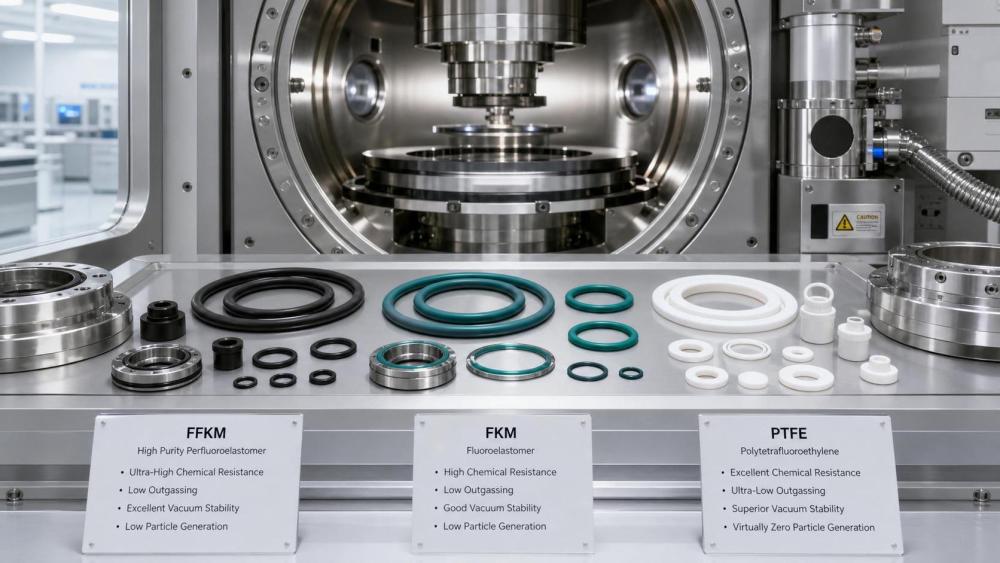
FFKM
FFKM is widely selected for advanced semiconductor equipment components seals. It offers strong resistance to high temperature, plasma chemistry, and aggressive cleaning agents.
Its main advantage is stability under severe process conditions. Lower degradation usually means fewer particles and more predictable maintenance timing.
Still, not all FFKM grades perform the same. Filler design, cure system, and post-processing strongly affect particle behavior.
FKM
FKM can work in less aggressive sections of the tool. It is usually more economical than FFKM, but it has a narrower operating window.
For semiconductor equipment components seals exposed to harsher plasma or stronger oxidizers, FKM may age faster and generate more contamination over time.
PTFE and modified PTFE
PTFE is valued for low friction and broad chemical compatibility. It is often used where dynamic motion or chemical exposure makes elastomers less suitable.
However, PTFE is not elastic in the same way as rubber compounds. Design support, energizers, and groove control become more important.
EPDM and specialty compounds
EPDM may appear in selected wet process or utility applications. Specialty compounds can also be engineered for narrow chemical and thermal requirements.
The key point is practical fit. Semiconductor equipment components seals must match the chamber, gas set, cleaning recipe, and duty cycle together.
How to Compare Materials for Low-Particle Performance
A datasheet alone rarely answers contamination questions. A stronger review uses material behavior, process exposure, and actual failure modes.
In practice, semiconductor equipment components seals should be compared across five areas. These factors usually explain most particle-related differences.
This comparison should also include lot consistency. Even high-grade semiconductor equipment components seals can vary if molding and post-cure control are weak.
What Quality Teams Should Verify Before Approval
Supplier claims need confirmation through practical checks. The aim is to reduce uncertainty before the seal reaches a critical chamber or fluid path.
For semiconductor equipment components seals, approval should connect incoming quality, process risk, and maintenance history into one review.
Useful verification points
- Check material traceability, cure batch records, and post-cure conditions.
- Review particle, extractables, and outgassing data under relevant conditions.
- Confirm compatibility with chamber gases, wet chemicals, and cleaning chemistry.
- Inspect dimensions, flash, surface defects, and packaging cleanliness.
- Run field trials with defined wear intervals and contamination checkpoints.
This also means looking beyond purchase price. A lower-cost seal that doubles cleaning failures is usually the more expensive option in total ownership terms.
Application-Specific Material Choices
Different tool areas impose different stresses. Material selection becomes more accurate when the process location is clearly defined.
Vacuum chambers and plasma zones
These are the harshest conditions for semiconductor equipment components seals. High-purity FFKM grades are commonly favored because they resist erosion and contamination better.
Wet process equipment
Chemical resistance becomes the main filter here. Strong acids, solvents, and oxidizers can eliminate otherwise good materials very quickly.
Gas delivery and fluid handling
Low extractables and dimensional stability matter most. Small sealing failures can affect flow control, purity, and maintenance planning at the same time.
Motion-related assemblies
Where movement exists, friction and wear dominate. PTFE-based designs or engineered composite solutions may outperform standard elastomer seals.
Practical Steps to Reduce Particle Risk
The strongest results usually come from combining material choice with better handling and equipment discipline. Semiconductor equipment components seals perform best inside a controlled system.
- Use installation tools that prevent twisting, cutting, and local overstress.
- Control groove finish and compression ratio within supplier limits.
- Avoid mixing seal grades across similar tools without validation.
- Track failure mode data, not only replacement frequency.
- Align replacement cycles with actual process severity, not calendar habit.
In real operations, this approach helps separate random contamination events from repeatable seal-related causes. That makes future sourcing decisions much sharper.
Final Takeaway
Choosing semiconductor equipment components seals is really a contamination control decision, not only a sealing decision. The wrong material can quietly raise risk long before a visible leak appears.
FFKM, FKM, PTFE, and specialty compounds all have valid roles, but only when matched to real process conditions. Plasma exposure, chemicals, vacuum behavior, and motion must be reviewed together.
For cleaner performance, focus on verified particle behavior, supplier consistency, and application-specific testing. That is the most reliable path to lower contamination risk, steadier yield, and fewer unplanned shutdowns.
Across the broader industrial sealing market, this same principle continues to hold. Better material decisions upstream usually deliver stronger quality outcomes downstream.
Want to dive deeper into these market dynamics, or need data-driven support for your next business move? Drop a line below and let the analysts at PCTS provide customized insights.
We respect your privacy. Your information is strictly confidential.
Related News
- 00
0000-00
How sealing technology reduces contamination in semiconductor manufacturing - 00
0000-00
Where to install vibration sensors on rotating machinery - 00
0000-00
NTSB Probe Finds Boeing Warned of MD-11 Engine Bearing Risk Years Earlier - 00
0000-00
How to size pneumatic grippers for packaging system integration - 00
0000-00
How to size alloy steel power transmission chains for heavy loads
Weekly Insights
Stay ahead with our curated technology reports delivered every Monday.