





Seal export compliance sits at the intersection of trade rules, material traceability, and shipment accuracy. For cross-border movements of O-rings, mechanical seals, gasket sets, and engineered sealing parts, small documentation gaps can trigger large commercial delays.
That matters even more in industrial supply chains where seals protect pumps, actuators, bearings, valves, and transmission systems from leakage, contamination, and unplanned downtime. A practical checklist helps turn compliance from a last-minute shipping task into a more reliable sourcing decision.
Why seal export compliance deserves closer attention
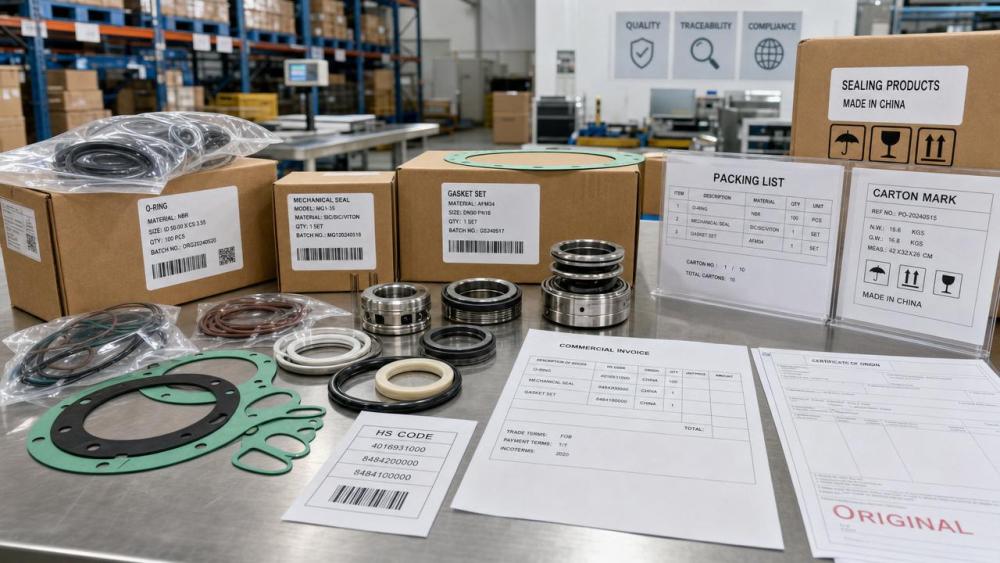
Industrial seals may look simple on a packing list, yet they often involve highly specific polymers, elastomers, fillers, coatings, and performance claims. Those details influence classification, labeling, customs review, and destination-market acceptance.
In sectors covered by PCTS, sealing components support hydraulic power, pneumatic motion, rotating machinery, chemical handling, and heavy-duty MRO activity. A compliance failure can therefore affect not just one shipment, but also maintenance schedules, equipment availability, and supplier credibility.
Recent market conditions have added pressure. Customs authorities now examine product descriptions more closely. Buyers ask for stronger material transparency. Exporters face broader sanctions screening, while distributors need cleaner technical files for multi-country distribution.
In that environment, seal export compliance is not only a legal checkpoint. It is also a signal of operational maturity, document discipline, and readiness for global industrial business.
What the checklist actually covers
A good checklist goes beyond export paperwork. It connects product identity, material data, regulatory exposure, shipping information, and transaction controls into one review path.
At a basic level, seal export compliance usually includes correct product classification, restricted-party screening, country-of-origin confirmation, invoice accuracy, and packaging labels that match shipment contents.
For industrial sealing products, the checklist should also test whether technical descriptions are specific enough. Terms like “rubber seal” are often too vague. Customs and downstream users may need dimensions, material family, application type, and operating context.
The most useful compliance files also connect commercial and engineering records. That means part numbers, drawings, compound references, test data, and shipping documents should point to the same product identity.
Core items that usually need review
- HS code and product description consistency across invoice, packing list, and customs filing
- Material declaration for NBR, FKM, EPDM, PTFE, FFKM, metal-backed, or composite seal structures
- End-use and end-destination checks, especially for sensitive industrial sectors
- Origin evidence, supplier records, and batch traceability
- Labeling accuracy for quantity, net weight, part number, and destination requirements
- Supporting certificates where the destination market or contract requests them
Where problems usually appear in cross-border shipments
Most failures do not come from one dramatic violation. They come from small mismatches that accumulate across technical, commercial, and logistics documents.
One common issue is incomplete classification. A rotary shaft seal, a spring-energized PTFE seal, and a general-purpose O-ring may not be described the same way for customs purposes. Broad descriptions create avoidable questions.
Another issue is material ambiguity. In sealing technology, material choice is tied to media resistance, temperature range, wear behavior, and compliance exposure. If the shipment file says FKM but the technical data sheet says fluoroelastomer blend without clarification, confidence drops quickly.
Labeling can also become a weak point. Carton labels, internal bag labels, and packing lists often diverge after last-minute quantity changes. For spare parts shipments, even a minor count error can delay clearance or receiving inspection.
There is also growing attention on sanctioned destinations, dual-use concerns, and re-export pathways. Most sealing products are routine industrial items, but transaction context still matters. Compliance teams increasingly review customer identity, declared use, and onward shipment risk.
Typical review points by shipment stage
The material and labeling details that often decide outcomes
Seal export compliance becomes more robust when material data is handled as a business document, not just an engineering note. Different compounds carry different commercial and regulatory implications.
For example, seals used in chemical processing, semiconductor tools, food systems, or high-temperature hydraulic units may require stronger declarations. The destination may ask about restricted substances, media compatibility, cure systems, or cleanliness expectations.
Labeling should reflect that same precision. The outer box should not simply say “seal kit” if the invoice lists specialized spring-energized PTFE seals for corrosive service. More specific identification reduces inspection friction.
In practice, the strongest files align five elements: commercial name, technical part number, material designation, quantity, and origin statement. When those items stay synchronized, customs questions are easier to answer.
Details worth checking before release
- Whether the material name is commercially clear and technically defensible
- Whether kit contents are broken down or hidden under one broad label
- Whether the packaging shows the same revision level as the order file
- Whether batch or lot information can support later claims or recalls
- Whether destination labeling rules require additional marks or statements
How to use the checklist for supplier evaluation
Seal export compliance is useful not only for shipping teams. It is also a practical filter for comparing suppliers in global industrial sourcing.
A supplier with stable compliance habits usually shows broader control discipline. Technical files are easier to verify. Part traceability is clearer. Change management tends to be more visible. That matters in sealing products because performance depends on small material and dimensional differences.
Platforms such as PCTS help frame that wider view. Seals do not operate alone. They interact with bearings, shafts, hydraulic cylinders, pneumatic actuators, couplings, pumps, and other moving components. Evaluating compliance in isolation can miss the total operating context.
For example, a compliant shipment of chemical-resistant seals still creates risk if the supplier cannot explain media compatibility, wear life, or replacement cycles within the broader MRO plan. Compliance and application knowledge should reinforce each other.
Useful signs during supplier review
- Document sets remain consistent across repeated shipments
- Technical data sheets match invoice terminology and part coding
- Origin and traceability records are available without delay
- Material substitutions follow controlled approval steps
- Application discussions include compliance implications, not only price and lead time
A working approach for better cross-border decisions
The most effective seal export compliance process starts early, before cartons are sealed and freight is booked. It should begin when the product is quoted and identified.
A practical method is to build one internal record that links product specification, export classification, material declaration, origin data, and shipping document fields. That reduces manual re-entry and lowers the chance of conflicting versions.
It also helps to separate routine shipments from sensitive ones. Standard elastomer O-rings for general MRO may need a light review. Engineered seals for aerospace support systems, corrosive processing lines, or tightly regulated destinations deserve deeper scrutiny.
From there, the next step is straightforward: review recent shipments, identify where description quality or document alignment breaks down, and convert those gaps into a repeatable seal export compliance checklist. That creates a firmer base for cleaner customs clearance, more reliable supplier comparison, and lower transaction risk across future cross-border shipments.
Want to dive deeper into these market dynamics, or need data-driven support for your next business move? Drop a line below and let the analysts at PCTS provide customized insights.
We respect your privacy. Your information is strictly confidential.
Related News
- 00
0000-00
How sealing technology reduces contamination in semiconductor manufacturing - 00
0000-00
Where to install vibration sensors on rotating machinery - 00
0000-00
NTSB Probe Finds Boeing Warned of MD-11 Engine Bearing Risk Years Earlier - 00
0000-00
How to size pneumatic grippers for packaging system integration - 00
0000-00
How to size alloy steel power transmission chains for heavy loads
Weekly Insights
Stay ahead with our curated technology reports delivered every Monday.