





Why Pump Leakage Happens More Often Than Teams Expect
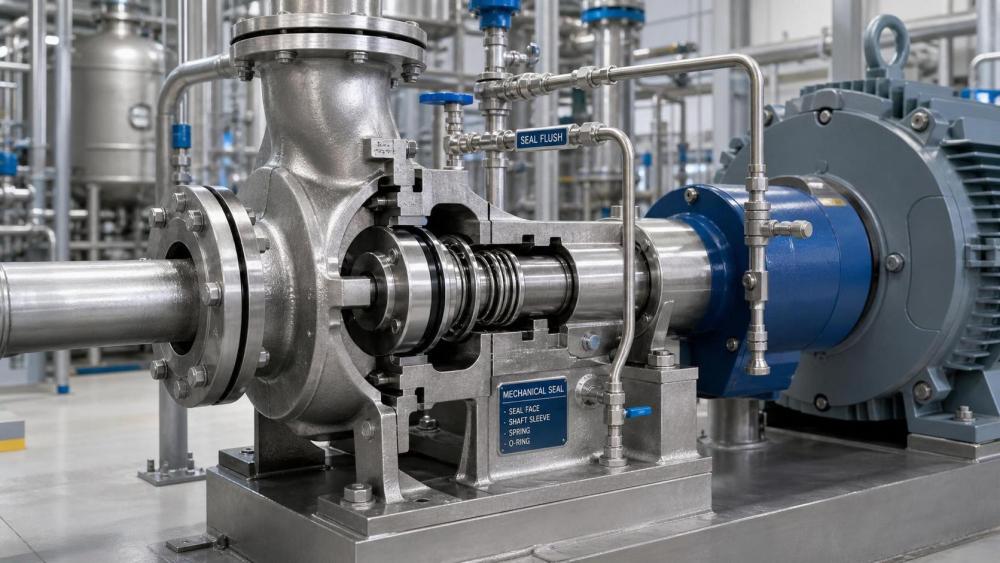
Pump leakage rarely starts as a dramatic failure. It usually begins with a small drip, a light film, or rising seal temperature.
That small sign can quickly turn into product loss, bearing damage, shaft wear, and sudden shutdowns.
For maintenance teams, effective mechanical seal solutions for pumps are not only about stopping leakage.
They are also about extending service life, stabilizing production, and reducing repeat service calls.
In real operating conditions, seals fail because the entire pump system changes over time.
Shaft movement increases, media becomes more aggressive, temperature rises, or startup habits become less controlled.
This is why choosing mechanical seal solutions for pumps requires looking beyond the seal alone.
The better approach is to connect seal design, operating conditions, installation quality, and maintenance routines.
Common Leakage Points and What They Usually Mean
Before selecting mechanical seal solutions for pumps, identify where the leakage appears.
The leak path often tells you more than the damaged part itself.
Leakage at the seal faces
This usually points to worn faces, dry running, thermal distortion, or poor lubrication.
It can also indicate pressure fluctuations that separate the faces during operation.
Leakage at secondary seals
O-rings, bellows, or gaskets may harden, crack, swell, or lose elasticity.
Chemical incompatibility is often the root cause here.
Leakage around the shaft or sleeve
This may suggest sleeve scoring, shaft runout, incorrect compression, or damaged elastomers.
In many cases, replacing only the seal will not solve the issue for long.
Leakage during startup only
That often signals air entrapment, improper venting, or unstable flush conditions.
It may also mean the seal faces are sticking after idle periods.
The Most Frequent Root Causes Behind Seal Failure
Strong mechanical seal solutions for pumps start with root cause analysis.
If the original failure mode stays in place, new seals will fail the same way.
Misalignment and shaft movement
Even a high-quality seal cannot compensate for excessive shaft deflection.
Check coupling alignment, bearing condition, baseplate stability, and pipe strain.
More noticeable leakage after maintenance often traces back to alignment drift.
Dry running and poor lubrication
Mechanical seals depend on a controlled fluid film between the faces.
If suction conditions are unstable, the faces overheat very quickly.
That leads to carbon damage, face cracking, and rapid leakage.
Pressure and temperature extremes
Thermal shock can distort seal faces and reduce flatness.
Pressure spikes can overload springs, damage bellows, or force open the sealing interface.
This is especially common in chemical, boiler feed, and process transfer applications.
Contamination and solids
Abrasive particles scratch faces, block springs, and wear sleeves.
Sticky product buildup can prevent smooth movement of secondary sealing elements.
In these cases, sealing strategy must include flushing or barrier support.
Wrong material selection
Many recurring failures come from material mismatch, not poor installation.
Elastomers may swell in solvents, while faces may corrode in aggressive media.
Reliable mechanical seal solutions for pumps always match chemistry, temperature, and duty cycle.
Practical Mechanical Seal Solutions for Pumps
The best mechanical seal solutions for pumps are practical, not theoretical.
They should reduce repeat leakage, fit site conditions, and stay maintainable over time.
Upgrade to cartridge seals when installation errors repeat
Cartridge seals reduce setting mistakes and shorten replacement time.
They work well where multiple technicians handle service across different shifts.
They also help standardize mechanical seal solutions for pumps across similar assets.
Use balanced seal designs for higher pressure duty
Balanced seals reduce face loading and heat generation.
That improves leakage control in demanding process services and variable pressure conditions.
Choose seal face materials based on real wear conditions
Silicon carbide handles abrasion and chemical attack well.
Carbon faces offer good running behavior in many clean fluid applications.
Tungsten carbide may fit slurry or high-load service better.
Match elastomers to media and temperature
FKM, EPDM, NBR, and FFKM each perform differently.
A seal that survives water service may fail quickly in oils, acids, or steam.
This is one of the most overlooked mechanical seal solutions for pumps.
Add flush, quench, or barrier support when conditions require it
Support systems protect seals from heat, solids, crystallization, and dry running.
In harsher services, the support plan matters as much as the seal design.
A Fast Troubleshooting Routine That Saves Time
When leakage appears, a simple routine helps separate symptom from cause.
This makes mechanical seal solutions for pumps more accurate and faster to apply.
- Confirm the exact leak location before disassembly.
- Review operating pressure, temperature, fluid type, and startup history.
- Inspect shaft sleeve condition, runout, and bearing play.
- Check for pipe strain, alignment shifts, and base looseness.
- Examine seal faces for heat marks, chips, grooves, or blistering.
- Look at elastomers for swelling, flattening, cracking, or hardening.
- Verify flush lines, vents, and cooling paths are open and stable.
This process also creates better service records.
Over time, those records help standardize mechanical seal solutions for pumps across equipment families.
How to Prevent Repeat Failures After Seal Replacement
A new seal does not guarantee a reliable result.
Prevention depends on what happens before startup and during the first operating hours.
- Clean the seal chamber and sleeve carefully.
- Lubricate elastomers with a compatible assembly aid.
- Use correct setting dimensions and tightening sequence.
- Prime the pump fully before startup.
- Open flush or cooling support before rotation begins.
- Monitor temperature, vibration, and visible leakage during early operation.
These steps sound basic, but they eliminate many repeat callbacks.
In actual service environments, consistency usually beats complexity.
Selection Guide for Different Pump Conditions
The table below helps connect common operating conditions with practical mechanical seal solutions for pumps.
Building a More Reliable Seal Strategy
Long-term reliability comes from treating leakage as a system issue, not just a parts issue.
The most effective mechanical seal solutions for pumps combine correct design, correct materials, and correct operating discipline.
That also aligns with how industrial buyers and service teams now evaluate total maintenance cost.
A slightly better seal choice can reduce downtime, spare usage, labor hours, and product waste.
For businesses managing rotating equipment, that difference becomes visible very quickly.
If leakage keeps returning, review the full duty profile, failure history, and installation process together.
That is usually the fastest path to mechanical seal solutions for pumps that last longer and perform more consistently.
Want to dive deeper into these market dynamics, or need data-driven support for your next business move? Drop a line below and let the analysts at PCTS provide customized insights.
We respect your privacy. Your information is strictly confidential.
Related News
- 00
0000-00
IndexBox Forecasts 3.8% Annual Growth for Global Radial Seals Market Through 2035 - 00
0000-00
How to assess the chemical compatibility of FFKM sealing sheets - 00
0000-00
IndexBox Forecasts 3.6% Annual Growth for Construction Bearings Market - 00
0000-00
When do hydraulic components require an export license? - 00
0000-00
How to size modular pneumatic valve systems for adequate airflow
Weekly Insights
Stay ahead with our curated technology reports delivered every Monday.