





Industrial sealing technologies are moving from component detail to uptime strategy
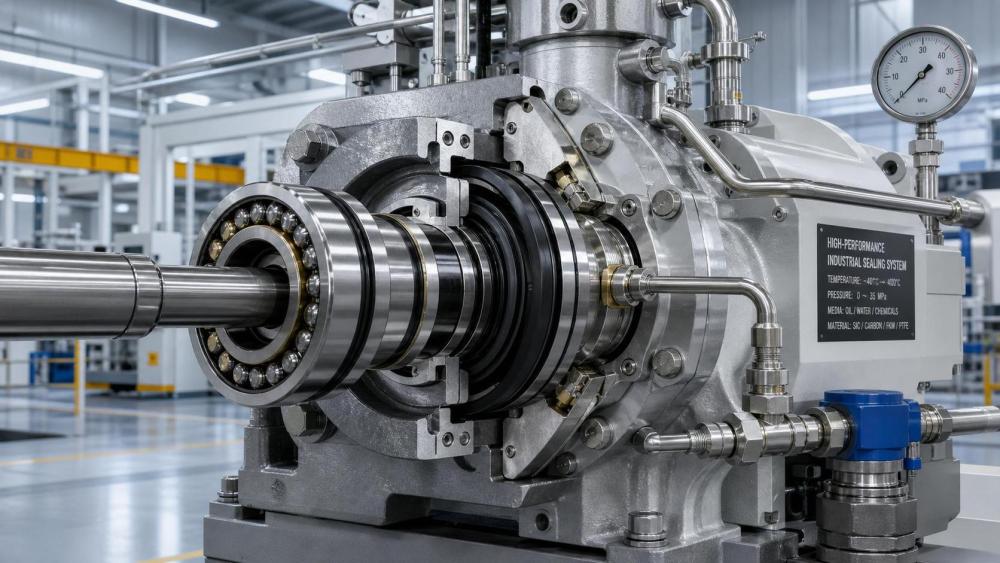
In 2026, leakage control is no longer treated as a minor maintenance issue.
Across rotating equipment, hydraulic circuits, pneumatic systems, and process lines, industrial sealing technologies now shape uptime, asset risk, and operating margin.
That shift is becoming clearer because production environments are getting less forgiving.
Higher pressures, mixed media, tighter cleanliness targets, and longer service intervals expose weak sealing choices much faster than before.
The result is practical, not theoretical.
A seal that fails early can contaminate bearings, destabilize hydraulic performance, increase energy use, and trigger unplanned shutdowns across connected equipment.
This is why industrial sealing technologies are receiving more board-level attention inside reliability, capital planning, and MRO discussions.
From the wider precision components market, the signal is consistent.
Seals are increasingly evaluated alongside bearings, couplings, pumps, cylinders, and condition monitoring devices as part of one performance system.
That broader view also reflects how platforms such as PCTS frame equipment reliability.
Sealing performance is tied to tribology, fluid power behavior, transmission stability, spare parts cycles, and total cost of ownership.
Why the recent change is becoming harder to ignore
The market is not reacting to one single innovation.
It is reacting to a cluster of operating pressures that make older sealing assumptions less reliable.
One of the strongest drivers is equipment intensity.
Machines are being asked to run faster, longer, and with less maintenance downtime, especially in automated and continuous-process environments.
Another driver is media complexity.
Seals increasingly face aggressive chemicals, low-viscosity fluids, thermal cycling, abrasive particles, and stricter washdown conditions.
Digital maintenance is also changing expectations.
Once plants invest in vibration sensing, oil analysis, and edge-based fault alerts, seal failures stand out more clearly as avoidable causes of stoppage.
In actual operations, that visibility changes buying and engineering behavior.
Industrial sealing technologies are no longer chosen only by dimensions and price.
They are being judged by leakage tolerance, media compatibility, compliance readiness, and replacement predictability.
Materials innovation is reshaping what industrial sealing technologies are expected to do
The most visible trend in industrial sealing technologies is not simply durability.
It is fit-for-environment performance.
Recent demand is moving toward seals that hold performance across wider pressure ranges, harsher chemical exposure, and more unstable temperatures.
That is especially relevant in semiconductor equipment, food processing, energy systems, heavy industry, and advanced fluid handling.
High-temperature seals and chemical-resistant seals are gaining attention because failure costs have widened.
A seal breakdown now often damages nearby bearings, affects lubrication quality, or compromises precision motion in connected transmission elements.
That is one reason material science is moving closer to maintenance economics.
An elastomer choice is not only a technical detail when replacement labor, contamination cleanup, and restart losses are included.
More advanced industrial sealing technologies also aim to balance competing demands.
Lower friction is needed for efficiency, but sealing force cannot be compromised.
Chemical resistance is necessary, but excessive stiffness can reduce conformity and shorten service life in dynamic motion.
This is where material and geometry are being considered together, not separately.
What recent selection priorities reveal
- Broader temperature tolerance is valued because operating windows are less stable.
- Media compatibility now includes cleaners, additives, and mixed-process exposure.
- Lower wear debris matters more where cleanliness targets affect downstream precision.
- Predictable compression set behavior supports longer maintenance intervals.
The next step is not smarter seals alone, but smarter sealing decisions
A stronger signal in 2026 is the connection between industrial sealing technologies and predictive maintenance.
Most seals are still passive components, yet the decision process around them is becoming far more data-driven.
Plants are correlating seal life with vibration shifts, pressure instability, fluid contamination, and thermal events.
That makes sealing failure easier to trace and harder to dismiss as routine wear.
In sectors where hydraulic pumps, cylinders, air systems, and rotating shafts work in tight cycles, this changes maintenance planning.
Instead of fixed replacement intervals alone, teams are using operating context to decide which sealing points deserve earlier attention.
This matters because not all leakage risks are equal.
A minor external leak may be manageable.
Internal bypass, lubricant loss, or contamination ingress can quietly erode system efficiency long before visible failure appears.
PCTS has highlighted this broader reliability logic across bearings, fluid power, and MRO analysis.
The value is in seeing industrial sealing technologies as part of a monitored performance chain, not as isolated consumables.
The impact is spreading across more than one equipment category
One reason this topic is gaining strategic weight is its cross-system effect.
Industrial sealing technologies influence several asset classes at the same time, often through indirect losses.
In rotating equipment, sealing quality affects bearing life, lubricant retention, shaft protection, and debris exclusion.
In hydraulic systems, it influences volumetric efficiency, pressure stability, and fluid cleanliness.
In pneumatic automation, poor sealing can reduce response consistency and increase compressed air waste.
In process industries, the stakes rise further because sealing failure may affect compliance, product integrity, and worker safety.
This broad effect explains why application-specific sealing solutions are gaining ground over generic substitutions.
A seal that performs well in one duty cycle may underperform badly in another, even when dimensions appear interchangeable.
The market is therefore moving toward better alignment between sealing design and actual duty conditions.
Where the pressure is rising fastest
- High-speed rotating systems with strict lubrication retention needs.
- Hydraulic equipment exposed to pressure spikes and contaminated fluids.
- Chemical and clean-process environments requiring stronger media resistance.
- Automated production lines where unplanned stops carry high restart costs.
What should be watched next in industrial sealing technologies
The next phase will likely be shaped less by dramatic product launches and more by better technical discipline.
Industrial sealing technologies will keep advancing, but the bigger gains may come from more accurate specification and lifecycle tracking.
That starts with clearer definition of media, pressure variation, temperature cycling, motion profile, and contamination exposure.
It also requires attention to adjacent components.
Surface finish, housing tolerances, lubrication regime, shaft alignment, and fluid condition all influence sealing outcomes.
From a market perspective, supplier evaluation is also becoming more technical.
Documentation quality, material traceability, test transparency, and application knowledge are gaining weight beside price and availability.
That is consistent with how industrial intelligence platforms such as PCTS are used.
The real advantage is not just product visibility.
It is the ability to compare sealing materials, linked components, reliability signals, and lifecycle implications in one decision frame.
For 2026, the clearest practical move is to treat industrial sealing technologies as a measurable uptime lever.
Review failure history by application, check whether service conditions have changed, compare material assumptions against current media exposure, and align replacement plans with monitored asset behavior.
That kind of review usually reveals where leakage risk is still being underestimated.
In a year defined by tighter reliability targets, that is where better sealing decisions start to pay back fastest.
Want to dive deeper into these market dynamics, or need data-driven support for your next business move? Drop a line below and let the analysts at PCTS provide customized insights.
We respect your privacy. Your information is strictly confidential.
Related News
- 00
0000-00
How sealing technology reduces contamination in semiconductor manufacturing - 00
0000-00
Where to install vibration sensors on rotating machinery - 00
0000-00
NTSB Probe Finds Boeing Warned of MD-11 Engine Bearing Risk Years Earlier - 00
0000-00
How to size pneumatic grippers for packaging system integration - 00
0000-00
How to size alloy steel power transmission chains for heavy loads
Weekly Insights
Stay ahead with our curated technology reports delivered every Monday.