





Industrial Sealing Technologies: Key Differences in Wear, Heat, and Leakage Control
Industrial sealing technologies play a decisive role in machine reliability. They sit at the boundary between motion and containment.
When seals fail, wear rises, temperatures climb, and leakage becomes expensive very quickly. That pattern appears across pumps, gearboxes, cylinders, mixers, compressors, and rotating shafts.
For technical evaluation, the challenge is rarely choosing a seal by catalog size alone. The real task is matching sealing behavior to operating reality.
This is where industrial sealing technologies differ most. Contact pressure, material chemistry, shaft speed, media type, and surface condition all change the outcome.
A seal that performs well in a clean electric motor may struggle in a hot slurry pump. A low-friction lip seal may also behave differently from a mechanical seal.
Why Industrial Sealing Technologies Matter in Real Equipment
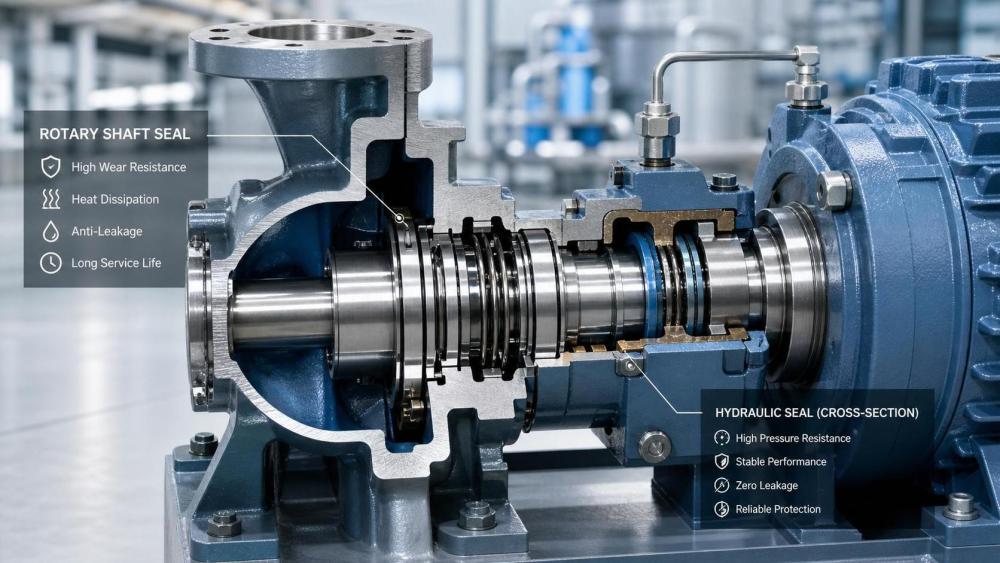
Industrial sealing technologies do more than stop visible leaks. They also control lubricant retention, dirt ingress, pressure stability, and energy loss.
In practice, the seal often decides whether a precision bearing stays protected or becomes contaminated. That directly affects fatigue life and maintenance intervals.
The same principle applies in hydraulic systems. Poor leakage control reduces volumetric efficiency and can trigger unstable pressure, overheating, and fluid degradation.
More importantly, leakage is not always external. Internal bypass leakage can quietly reduce system performance long before operators see fluid on the floor.
That is why industrial sealing technologies must be evaluated as performance components, not as low-value accessories. Their influence reaches uptime, safety, compliance, and total cost.
The Main Seal Types and Their Performance Logic
Different industrial sealing technologies control leakage in different ways. Understanding that logic makes comparison easier.
Contact seals
Lip seals, radial shaft seals, and many rod seals rely on direct contact. They create a sealing line through interference and elastic preload.
These designs are common because they are compact and cost-effective. However, contact also creates friction, wear particles, and heat.
Mechanical seals
Mechanical seals use rotating and stationary faces with controlled flatness. A thin fluid film supports sealing while limiting leakage.
They are often selected for pumps, mixers, and aggressive media. Their performance depends heavily on face materials, balance ratio, and flush conditions.
Non-contact and engineered sealing designs
Labyrinth seals, air seals, and some dry-running designs reduce physical contact. This helps lower wear and heat under high-speed conditions.
The trade-off is that absolute leakage control may be weaker. These solutions often work best when contamination exclusion matters more than zero leakage.
Wear Control: Where Industrial Sealing Technologies Diverge Most
Wear is the first major comparison point. It develops from friction, abrasive particles, poor lubrication, misalignment, and pressure distortion.
In many industrial sealing technologies, wear begins at the interface between the seal and the moving surface. Surface finish and hardness are critical here.
A rough shaft can tear a seal lip. A surface that is too smooth can also disrupt lubrication film formation.
Material choice changes wear behavior significantly. NBR offers good general performance, while FKM handles higher temperatures and many oils more effectively.
PTFE-based seals often lower friction and resist chemicals well. Yet they may need better hardware precision and careful installation support.
For heavy contamination, exclusion features become essential. Secondary lips, scrapers, and dust barriers can protect primary sealing surfaces from abrasive attack.
- Use harder shaft sleeves when particulate wear is expected.
- Check runout, eccentricity, and misalignment before blaming the seal.
- Review start-stop cycles, because boundary friction often peaks there.
- Match elastomer compatibility to both fluid and cleaning chemistry.
In short, wear control in industrial sealing technologies is not only about the seal. It is a system question involving hardware, fluid, motion, and contamination.
Heat Management: Friction, Speed, and Thermal Stability
Heat is the second major separator among industrial sealing technologies. Excess temperature changes hardness, elasticity, lubrication behavior, and leakage risk.
Contact seals generate heat through rubbing. At higher shaft speeds, that heat may rise faster than the seal can dissipate it.
Once temperature climbs, elastomers can harden, crack, or lose resilience. That usually reduces sealing force and accelerates failure.
Mechanical seals face a similar issue, but in a different form. Seal faces must maintain a stable fluid film without flashing, scoring, or thermal distortion.
This is why flush plans, cooling paths, and pressure balance matter. Heat control is built into the seal support strategy, not only the seal material.
From recent application trends, higher power density makes this issue more visible. Equipment is getting smaller, faster, and less tolerant of thermal drift.
Leakage Control: Static, Dynamic, Internal, and External
Leakage control is often the most visible test, but it should not be the only one. Some industrial sealing technologies minimize visible leakage while hiding wear or heat stress.
Static sealing is usually simpler. Gaskets and O-rings seal between stationary parts, and success depends on compression, groove design, and chemical compatibility.
Dynamic sealing is harder. Motion introduces friction, pressure reversals, micro-vibration, and surface tracking issues.
In hydraulic cylinders, internal leakage affects holding force and motion accuracy. In rotating equipment, external leakage may trigger safety or environmental concerns.
This also means acceptable leakage is application-specific. A food process pump, a refinery mixer, and a machine tool spindle do not share the same threshold.
Good evaluation asks a practical question first: what kind of leakage matters most here, and what happens if it rises gradually?
Common leakage drivers
- Thermal expansion mismatch between seal and hardware.
- Chemical swelling, shrinking, or embrittlement.
- Pressure pulsation and extrusion into clearances.
- Installation damage, twisted lips, or cut O-rings.
- Shaft grooves formed by long-term abrasive contact.
How to Compare Industrial Sealing Technologies Systematically
A useful comparison framework should connect technical performance with operating consequence. That keeps seal selection grounded in risk, not only in nominal ratings.
- Define the motion type: rotary, reciprocating, oscillating, or static.
- Map pressure, speed, temperature, and contamination together.
- Identify the fluid, including additives, cleaning agents, and upset conditions.
- Review hardware finish, tolerances, runout, and installation access.
- Set leakage acceptance by safety, compliance, and process impact.
- Compare lifecycle cost, not purchase price alone.
This approach highlights where industrial sealing technologies really differ. Some reduce energy loss. Some extend service intervals. Others improve contamination control under unstable conditions.
In actual procurement and engineering work, the best choice is often the one with the widest stability window, not the highest single-point specification.
Material and Standard Considerations That Should Not Be Skipped
Industrial sealing technologies are strongly shaped by material science. The same seal geometry can perform very differently when made from NBR, HNBR, FKM, EPDM, PTFE, or FFKM.
Chemical resistance should be checked against actual media concentration and temperature. A material that survives intermittent contact may fail under continuous immersion.
Standards also matter because they affect interchangeability and validation. Depending on the application, ISO, ASTM, DIN, FDA, or sector-specific requirements may apply.
This becomes more important in export projects, regulated sectors, and critical maintenance planning. Documentation quality can reduce approval time and supplier risk.
Final Selection Guidance for Better Reliability
The key differences in industrial sealing technologies come down to three linked outcomes: how fast the seal wears, how much heat it generates or tolerates, and how well it controls leakage over time.
A strong seal choice balances these outcomes instead of optimizing only one. Lower friction means little if leakage rises. Tight sealing means little if thermal damage follows.
The most reliable evaluations combine material data, operating limits, hardware condition, and field maintenance feedback. That is usually where hidden risk becomes visible.
For equipment teams comparing industrial sealing technologies, the practical next step is simple: build a selection matrix around wear mode, heat load, leakage consequence, and service interval targets.
That process creates more consistent seal decisions, better supplier discussions, and stronger long-term equipment reliability across demanding industrial applications.
Want to dive deeper into these market dynamics, or need data-driven support for your next business move? Drop a line below and let the analysts at PCTS provide customized insights.
We respect your privacy. Your information is strictly confidential.
Related News
- 00
0000-00
How to check vibration analysis software for sensor compatibility - 00
0000-00
IndexBox Forecasts 3.8% Annual Growth for Global Radial Seals Market Through 2035 - 00
0000-00
How to assess the chemical compatibility of FFKM sealing sheets - 00
0000-00
IndexBox Forecasts 3.6% Annual Growth for Construction Bearings Market - 00
0000-00
When do hydraulic components require an export license?
Weekly Insights
Stay ahead with our curated technology reports delivered every Monday.