





Selecting mechanical seals for compressors in high-pressure service is rarely a matter of choosing the highest pressure rating on a datasheet. In real projects, leakage performance, operating stability, service life, and maintenance burden are shaped by a much larger set of variables: gas composition, pressure profile, shaft dynamics, process temperature, upset conditions, auxiliary systems, and the practical quality level of manufacturing and installation. For technical evaluators, the central question is not simply which seal can survive pressure, but which seal arrangement can remain predictable under the compressor’s actual operating envelope.
That distinction matters because high-pressure compressor service tends to compress small design weaknesses into expensive failures. A seal that appears acceptable under steady-state conditions may perform poorly during startup, shutdown, pressure reversal, dry running, contamination events, or transient temperature swings. In procurement discussions, teams also run into a second problem: suppliers may describe products with similar terminology while meaning different levels of design maturity, test validation, or support capability. A useful evaluation process therefore has to connect application physics with commercial risk, not treat them as separate decisions.
What technical evaluators are really trying to decide
Most readers looking into mechanical seals for compressors are not asking what a seal is. They are trying to determine four things. First, does the compressor duty justify a higher-spec sealing solution, including support systems and monitoring? Second, which operating conditions are genuinely critical, and which are only nominal nameplate data? Third, where are the hidden failure modes that do not show up in a basic RFQ? And fourth, how should supplier claims be compared when lifecycle reliability matters more than initial purchase price?
In high-pressure gas service, those questions are connected. If the process gas is hazardous, flammable, valuable, or regulated, a small leakage issue becomes a safety, environmental, and production issue at the same time. If the compressor is part of a continuous plant, downtime cost may exceed seal cost by an order of magnitude. If the gas contains contaminants, condensable fractions, or poor lubricity characteristics, then seal face behavior becomes more application-specific than many buyers expect. This is why “standard seal suitable for compressor duty” is often too vague to be useful.
Start with the gas, not the seal catalog
The first screening step should be a disciplined review of the gas itself. High-pressure service is not one homogeneous category. Dry hydrogen, hydrocarbon mixtures, CO2-rich gas, sour gas, inert gas, refrigerants, and process gases with trace contamination place different demands on face materials, secondary seals, and barrier or buffer arrangements. Molecular size, lubricity, toxicity, chemical compatibility, and phase behavior all matter.
For example, a gas with low viscosity and high leakage tendency may push the evaluation toward tighter control of face flatness, more robust secondary sealing materials, and closer attention to support system cleanliness. A gas that can polymerize, coke, or condense under certain temperature-pressure combinations introduces a different risk: deposits can interfere with face tracking, restrict small passages, and shorten seal life even when the nominal pressure rating appears sufficient. In corrosive or chemically aggressive duty, the question becomes less about whether a seal can operate initially and more about how long elastomers, metal parts, and mating faces retain performance under continuous exposure.
This is also the point where technical teams should resist the common shortcut of treating “process pressure” as the main design input. For seal selection, the relevant condition is the full pressure regime: normal operating pressure, maximum upset pressure, pressure cycling frequency, pressure reversals if any, and the differential pressures seen across the seal in each operating mode. Without that, comparisons between suppliers are often misleading.
Pressure rating alone is not a selection method
One of the more persistent misunderstandings in compressor sealing is the idea that a higher pressure capability automatically means a safer choice. In practice, high-pressure capability is only one aspect of seal suitability. A design may tolerate pressure statically but still perform poorly if shaft runout is excessive, if vibration levels are unstable, or if thermal distortion changes face contact under load.
Technical evaluators should therefore ask how the seal behaves as a system, not just how it is classified. Key questions include:
- What is the maximum differential pressure across the seal faces in normal and abnormal operating states?
- What shaft speed and PV conditions will the faces see during continuous operation?
- How sensitive is the design to axial movement, misalignment, and transient rotor behavior?
- What happens during startup and shutdown, when gas films may be less stable?
- Does the seal depend on a support system whose failure would immediately reduce reliability?
These questions often reveal that two seal options with similar headline ratings belong to very different risk categories. One may be adequate in a stable, clean, well-instrumented installation. The other may be better suited to plants where process upsets, variable loads, or maintenance constraints are more common.
Seal arrangement often matters more than face geometry alone
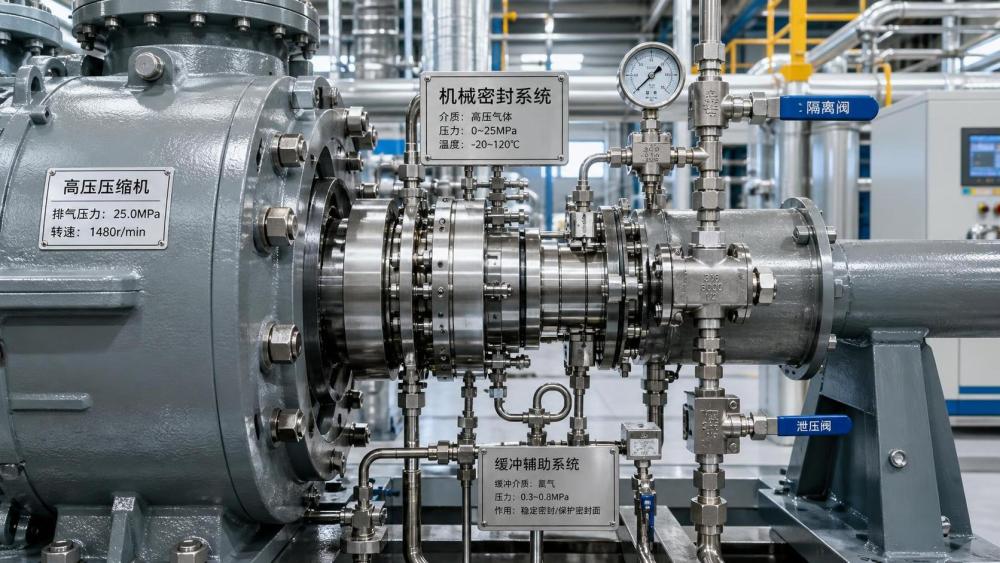
For compressors in demanding high-pressure service, the real decision is frequently about seal arrangement rather than a single seal component. Whether the application is better served by a single, tandem, or double arrangement depends on leakage tolerance, safety requirements, gas characteristics, and the plant’s willingness to manage auxiliary systems.
Single arrangements may still be used in some lower-risk services, but in high-pressure compressor applications the conversation often moves quickly toward engineered arrangements that improve containment and manage leakage more predictably. Tandem and double configurations can reduce risk, but they also introduce additional system requirements: barrier or buffer fluid management, instrumentation, pressure control logic, cleanliness discipline, and operator competence. A technically superior arrangement on paper can become a practical weak point if the plant does not maintain the support system to the same standard as the compressor itself.
This is where procurement and engineering should stay aligned. The right question is not “Which arrangement is best in theory?” but “Which arrangement can this site actually support over five years of operation?” In some cases, the lower-maintenance option with slightly lower theoretical performance may produce better lifecycle results than a more advanced arrangement that the organization is not prepared to monitor properly.
Face materials and secondary seals deserve closer scrutiny
Seal face material selection in compressor duty is often discussed in shorthand, but the details matter. Carbon, silicon carbide, tungsten carbide, and other combinations each bring tradeoffs in hardness, thermal conductivity, wear resistance, dry-running tolerance, and compatibility with the gas and support media. There is no universally “best” pair. The right choice depends on the expected lubrication regime, contamination profile, and upset scenarios.
In high-pressure gas service, thermal behavior is particularly important. Face distortion under temperature change can affect leakage and wear far earlier than catastrophic failure becomes visible. Evaluators should ask how the proposed material pair behaves under the site’s realistic temperature range, including excursions. They should also ask whether the face combination has application history in similar compressor service, not merely in pumps or generic rotating equipment.
Secondary sealing elements require the same discipline. Elastomer selection is frequently underestimated, especially when RFQs are built around broad labels rather than detailed media compatibility and temperature exposure. FKM, FFKM, HNBR, PTFE-based elements, and other options may all appear in compressor seal discussions, but the correct choice depends on actual chemistry, decompression behavior, contamination sensitivity, and cost tolerance. In high-pressure gas service, explosive decompression resistance may need careful review depending on the duty and shutdown profile; this should be treated as an application-specific requirement rather than a default assumption【待核实】.
Compressor operating behavior can invalidate a good seal selection
Some seal failures are rooted less in the seal design than in the compressor’s real mechanical behavior. Technical evaluators should therefore examine rotor movement, vibration trends, shaft runout, bearing condition, and expected excursions across the operating map. If the compressor frequently moves away from its preferred operating window, sealing performance may become inconsistent no matter how reputable the seal supplier is.
This is especially relevant in plants where compressors are cycled, loaded variably, or pushed by process instability. Repeated thermal transients, intermittent contamination, and vibration spikes can shorten seal life without producing an immediate root cause that is obvious to operations. When seal vendors request rotor dynamic data or tighter dimensional controls, that is not necessarily overengineering. It may reflect genuine sensitivity in high-pressure gas applications.
For the evaluator, a useful warning sign is when the seal selection process proceeds with only pressure, temperature, speed, and shaft size. Those parameters are necessary, but they are not enough. A more defensible review includes compressor type, duty cycle, gas cleanliness, upset history, venting arrangement, support system philosophy, and maintenance capabilities at site.
Supplier evaluation should test engineering depth, not just product availability
In B2B purchasing, buyers often discover that the hardest part is not identifying a seal category but distinguishing between suppliers that can genuinely support compressor service and those that are primarily selling from a broad industrial catalog. For high-pressure service, supplier evaluation should go beyond dimensional interchangeability.
Useful comparison points include:
- Application engineering process: Does the supplier ask for full operating data, upset conditions, and compressor behavior, or only basic dimensions?
- Validation approach: Has the design been tested or field-proven in comparable gas service and pressure class?
- Material traceability and manufacturing control: Are face materials, springs, metal parts, and secondary seals consistently controlled?
- Support system integration: Can the supplier specify instrumentation, piping logic, cleanliness requirements, and commissioning guidance?
- Failure analysis capability: If leakage rises or service life is short, can the supplier diagnose root causes in a structured way?
- Aftermarket stability: Are spare parts, refurbishment, and field service realistically available in the buyer’s region?
For critical compressors, it is often reasonable to ask for reference cases in similar industries, while recognizing that exact one-to-one comparability is rare. A supplier that can explain why a prior application is similar or different is generally more credible than one that simply claims broad experience.
Total cost of ownership is where many decisions change
On paper, seal procurement may look like a component purchase. In operation, it behaves more like a reliability decision with cascading cost effects. Initial seal price is only one part of the equation. Technical evaluators should account for planned maintenance interval, leakage control performance, support system cost, energy implications if relevant, installation precision, spare inventory, technician training, and the cost of an unplanned shutdown.
This is why low bid selection is often weak in high-pressure compressor duty. A less expensive seal package may still be the right choice, but only if the underlying assumptions are explicit: moderate consequence of leakage, easy maintenance access, lower continuous load, noncritical production role, or good site familiarity with that design. In higher-consequence service, the more useful metric is often cost per operating year or cost per avoided shutdown event, even if exact figures require site-specific modeling.
Where organizations struggle is that not all costs are easy to quantify at RFQ stage. Some are contingent costs: delayed restart, emission exposure, product loss, emergency service mobilization, or repeated troubleshooting time. These do not always appear in procurement comparisons, but they are often what separates an acceptable seal choice from a poor one.
Common claims that deserve caution
Several common market claims should be treated carefully in technical evaluation.
- “Suitable for high pressure”: This statement is too broad unless supported by operating limits, media compatibility, and arrangement details.
- “Drop-in replacement”: Dimensional fit does not guarantee equivalent face loading, thermal behavior, or leakage control.
- “Maintenance-free”: High-pressure compressor seals may reduce intervention frequency, but they still depend on installation quality, support system condition, and monitoring discipline.
- “Universal material compatibility”: Secondary sealing and metal compatibility always require media-specific review.
- “Lower leakage by design”: Leakage performance should be discussed in the context of operating mode, not as a single standalone promise.
These claims are not necessarily false. The issue is that they can become misleading when stripped of operating context. For technical teams, the practical habit is to convert every broad claim into a request for application-specific boundaries.
A practical selection framework for technical teams
When narrowing options, it helps to build a short evaluation matrix that combines engineering fit and execution risk. A simple structure can keep cross-functional discussions grounded.
The value of this approach is not that it creates a perfect score. It forces technical evaluators to make assumptions visible early, before a seal is approved on incomplete data and the real risks emerge only after commissioning.
What to watch going forward
The selection environment is also changing. In many industrial markets, expectations around emissions control, process containment, reliability documentation, and predictive maintenance are becoming stricter, even when local requirements vary by sector and region【待核实】. At the same time, supply chains for advanced materials and precision-machined components can remain uneven, which means lead time and replacement strategy deserve more attention than they did in more stable periods.
Another shift is that buyers increasingly expect seals to be considered within a broader reliability architecture. That includes condition monitoring, maintenance planning, and root-cause feedback loops rather than isolated component replacement. For compressor service, this is a sensible direction. Mechanical seals do not fail in isolation very often; they usually reflect interactions among process conditions, machine behavior, materials, and operating discipline.
For technical evaluators, that is the most useful way to approach the decision. Choose the seal as part of the compressor system, not as a catalog item. Once that mindset is in place, the selection becomes less about chasing the highest rating and more about identifying the design and supplier combination that will stay stable when the compressor stops behaving ideally.
Want to dive deeper into these market dynamics, or need data-driven support for your next business move? Drop a line below and let the analysts at PCTS provide customized insights.
We respect your privacy. Your information is strictly confidential.
Related News
- 00
0000-00
How to check vibration analysis software for sensor compatibility - 00
0000-00
IndexBox Forecasts 3.8% Annual Growth for Global Radial Seals Market Through 2035 - 00
0000-00
How to assess the chemical compatibility of FFKM sealing sheets - 00
0000-00
IndexBox Forecasts 3.6% Annual Growth for Construction Bearings Market - 00
0000-00
When do hydraulic components require an export license?
Weekly Insights
Stay ahead with our curated technology reports delivered every Monday.