





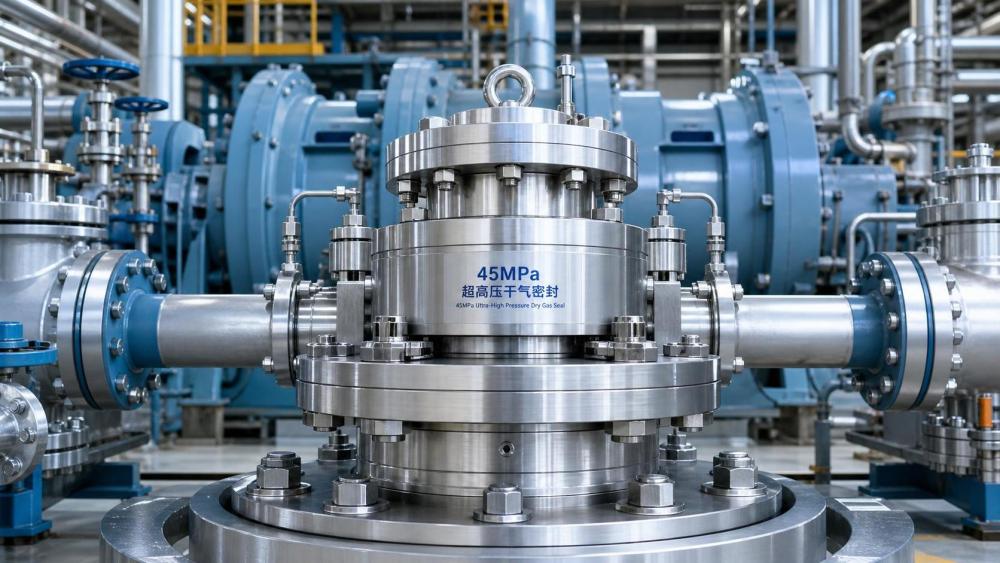
On June 2, 2026, Chengdu Yitong Sealing announced a localized 45MPa ultra-high-pressure dry gas seal achievement at a petrochemical equipment maintenance conference, marking a newly filled domestic technology gap in China. For petrochemical and nuclear power applications that require high reliability, the release is worth close attention not only as a product update, but also as a signal for procurement teams, OEMs, EPC contractors, and end users assessing whether high-parameter sealing solutions from Chinese suppliers can now be considered within global delivery and compliance frameworks.
A confirmed step into the 45MPa segment
The confirmed information indicates that the newly released product is a 45MPa ultra-high-pressure dry gas seal and that its localization result was formally presented by Chengdu Yitong Sealing on June 2, 2026. The announcement states that the product fills a domestic technical blank, directly benchmarks against leading international brands, and is positioned for high-reliability scenarios including petrochemicals and nuclear power.
The same release also states that this development is expected to strengthen the global delivery capability and compliance adaptability of Chinese sealing suppliers in the high-end process industry. It further identifies the result as a relevant reference point for overseas EPC contractors, OEMs, and end users when evaluating import-substitution options for high-parameter sealing components.
Why different market participants may pay attention
Procurement and owner-side evaluation may become more comparative
From an industry perspective, owner operators and procurement teams in petrochemical and nuclear-related supply chains may be affected because a domestically developed 45MPa dry gas seal changes the set of options under review for critical equipment support. The immediate business impact is most likely to appear in technical comparison, supplier prequalification review, and bid-stage evaluation of whether a localized alternative can meet reliability and compliance expectations.
What deserves closer attention is not only the headline breakthrough itself, but also how procurement documents, approved vendor lists, and technical communication with end users may respond if interest in domestic high-parameter sealing options increases.
EPC and OEM discussions may shift toward substitution feasibility
For EPC contractors and OEMs, the relevance lies in project execution and equipment integration. The event summary specifically highlights the value of this product for overseas EPC firms and OEMs that are assessing import-substitution pathways. In practical terms, that can affect vendor selection discussions, interface reviews with project owners, and the preparation of documentation needed to support cross-border delivery and compliance matching.
Analysis shows that these participants will likely focus on whether a localized supplier can be assessed in the same decision process as established international brands for high-specification applications.
Service and supply chain coordination may require earlier preparation
Service providers and broader supply chain participants may also be affected because high-reliability sealing components influence maintenance planning, spare-parts strategy, and delivery coordination. If more end users begin evaluating localized ultra-high-pressure dry gas seals, the effect may first appear in communication cycles around technical validation, supply readiness, and after-sales support expectations rather than in immediate volume shifts.
What companies should watch next
How the product is described in follow-up official communication
Companies tracking this development should watch for subsequent official wording from the company or related event disclosures. Analysis shows that in high-parameter equipment markets, small differences in how capability, application boundary, and compliance readiness are described can materially shape procurement interpretation.
Where the earliest business attention is most likely to emerge
The most relevant near-term focus areas are the high-reliability segments already identified in the announcement, especially petrochemicals and nuclear power. For companies active in these fields, it is more practical to monitor whether customer conversations begin centering on alternative sourcing, qualification pathways, and scenario-specific fit rather than assuming immediate purchasing conversion.
Documentation and qualification readiness
For suppliers, OEMs, and project-facing teams, a key practical issue is readiness of qualification materials, compliance documents, and technical submission packages. Because the event summary explicitly links the product to global delivery capability and compliance adaptability, companies involved in bidding, sourcing, or integration should pay attention to the documentation burden that often accompanies substitution assessments in high-reliability applications.
Customer communication and contingency planning
Procurement and commercial teams may also need clearer customer communication. Observably, when a new domestic option enters a previously concentrated high-end segment, customers often need a structured explanation of applicable use cases, review boundaries, and delivery assumptions. That makes internal alignment between sales, engineering, and supply functions more important than broad promotional messaging.
How this development is best understood at this stage
Analysis shows that this news should be read first as a meaningful capability signal rather than as proof that market substitution has already been completed. The confirmed facts establish a localized breakthrough at 45MPa and indicate relevance for high-reliability sectors and overseas project participants. However, the broader commercial effect still depends on how market actors evaluate technical fit, supplier qualification, compliance alignment, and project acceptance in actual workflows.
It is more appropriate to understand this as a development with both immediate signaling value and longer-term industry implications. The immediate signal is that Chinese suppliers are moving into a more demanding sealing segment; the longer-term question is how consistently that capability can translate into accepted options in global high-end process industry procurement.
A measured takeaway for the sealing market
This update matters because it points to a new reference point in China’s high-parameter dry gas seal capability, especially in application areas where reliability requirements are stringent and supplier evaluation is cautious. For the market, the significance lies less in a single announcement by itself and more in the fact that overseas EPC contractors, OEMs, and end users now have a clearer reason to include Chinese high-parameter sealing solutions in formal assessment discussions.
At the current stage, the most balanced reading is that the event represents a concrete technical milestone and a practical market signal, while the scale of business impact still requires continued observation.
Basis of this article and points for continued verification
This article is generated based on the user-provided news title, event date, and event summary. The specific official source link was not provided in the input, so continued verification is still necessary.
For this type of industry update, commonly relevant source categories may include official company announcements, corporate releases, industry association information, authoritative media reporting, and standard-related documents. Follow-up attention should remain on subsequent official disclosures, qualification-related statements, and any further clarification on delivery and compliance applicability in target sectors.
Related News
- 00
0000-00
Where are axial piston pumps used in mining equipment? - 00
0000-00
Embodied AI Robotics and Drive Control Forum Held in Shanghai - 00
0000-00
How does seal service life affect the total cost of ownership? - 00
0000-00
Schaeffler to Cut 3,460 Jobs and Close Five European Plants - 00
0000-00
How does system size affect the price of a belt drive system?
Weekly Insights
Stay ahead with our curated technology reports delivered every Monday.