





In high-temperature service, a seal rarely fails for one simple reason. The visible symptom may be leakage, but the underlying mechanism can be permanent compression loss, chemical swelling, extrusion under pressure, oxidation, thermal cracking, or a dimensional change that removes the contact load needed to keep the joint tight. That is why selecting a high-temperature seal cannot begin and end with a material’s published maximum temperature.
For technical evaluation teams, the most useful question is not “Which material has the highest heat rating?” It is: Which sealing material properties will remain stable in this specific combination of temperature, pressure, media, movement, exposure time, and maintenance reality? A static O-ring in a clean, dry flange behaves very differently from a piston seal in hot hydraulic oil, a rotary shaft seal near a bearing, or a chamber seal exposed to aggressive process gases.
The practical decision is usually a balance rather than a search for one “best” compound. Fluoroelastomers, perfluoroelastomers, silicone, EPDM, HNBR, PTFE-based materials, graphite, and metallic sealing solutions all have credible roles in high-temperature applications. Their suitability depends on what the equipment actually asks them to survive.
Thermal stability matters, but continuous exposure matters more
Thermal stability is the starting point among all sealing material properties. It describes whether a polymer, composite, graphite structure, or metal seal can retain its functional characteristics as temperature rises. Yet the temperature number on a datasheet needs interpretation. It may refer to short-term exposure, a particular test medium, or a static condition. It should not automatically be treated as a reliable continuous-service limit in a pressurized, chemically active system.
A seal can tolerate occasional temperature excursions that it cannot withstand for months. Continuous heat accelerates aging reactions in elastomers. The material may harden, lose elasticity, become brittle, or suffer chain scission and crosslink changes. In field maintenance, this is often seen as an O-ring that looks flattened, unusually hard, cracked at its outer diameter, or bonded to the mating surface during disassembly.
Temperature measurement also deserves more skepticism than it often receives. The temperature displayed on a hydraulic reservoir, oven controller, or process line may not match the temperature at the seal lip, gland corner, piston groove, or bearing housing. Local heat can build up through friction, poor cooling, restricted lubrication, steam tracing, or a hot shaft. A rotating seal may run considerably hotter at the contact interface than the surrounding fluid suggests.
This is especially relevant in assemblies where sealing sits beside bearings, pumps, motors, gearboxes, and transmission components. A problem that appears to be a material limitation can sometimes be traced to excessive shaft runout, inadequate lubrication, pressure spikes, bearing wear, or a changed operating cycle. The seal is often the first part to reveal a broader reliability issue.
Compression set and stress relaxation determine whether sealing force survives
For static O-rings, gaskets, face seals, and many flange applications, compression set resistance is among the most commercially important properties. A seal works because it is compressed and pushes back against the mating surfaces. If heat causes it to take a permanent set, the restoring force declines. The joint may remain tight at first, then leak after cooling, thermal cycling, vibration, or a pressure change.
Compression set should not be read as an isolated laboratory ranking. Test methods such as ASTM D395 and ISO 815 provide a basis for comparison, but the result depends on test temperature, duration, specimen geometry, and recovery conditions. A compound with an attractive result under one test condition may still struggle in a hot, chemically aggressive process stream.
Stress relaxation is closely related but deserves separate attention. A material may retain its shape reasonably well while gradually losing the contact stress that keeps a joint sealed. In long-duration static service, particularly where bolts, flanges, or seal glands also move with temperature, this loss of sealing load can be the real concern.
The gland design has a direct influence here. Over-compressing an elastomer does not necessarily create a safer seal. It can accelerate permanent deformation, increase assembly damage, and leave too little space for thermal expansion. Under-compression, on the other hand, leaves little margin for pressure fluctuation or surface irregularity. Material selection and gland geometry must be evaluated as one system.
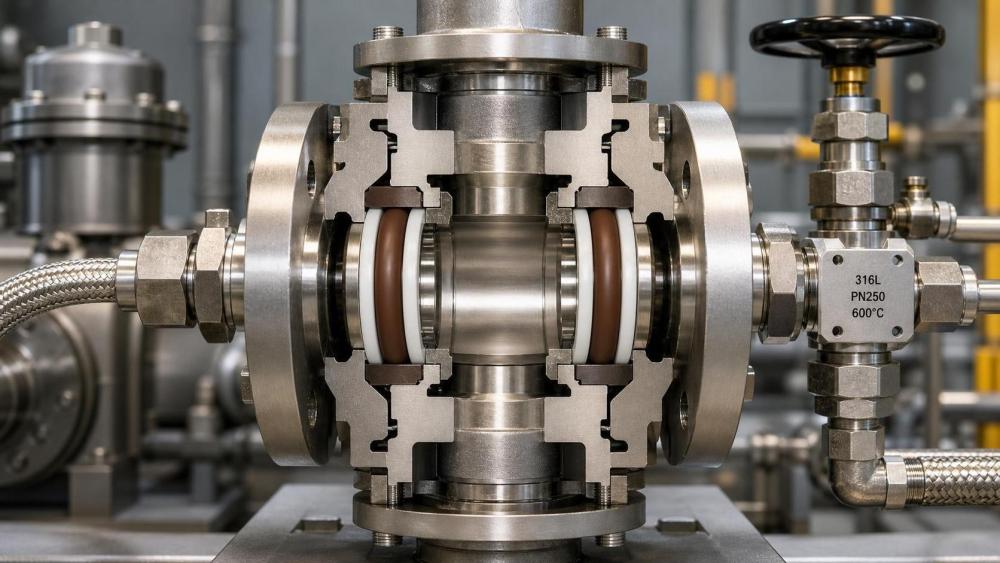
Chemical compatibility changes at elevated temperature
A material that is compatible with a fluid at room temperature may not remain compatible at elevated temperature. Heat generally increases diffusion, extraction, swelling, and chemical reaction rates. Oils can oxidize, process fluids may change composition, cleaning agents may become more aggressive, and trace contaminants can become relevant over a long service interval.
This is why generic statements such as “resistant to chemicals” are not sufficient for technical approval. The evaluation should identify the actual media: base oil type, additives, fuel composition, refrigerant, steam quality, solvents, acids, alkaline wash fluids, gases, particulates, and any cleaning or sterilization cycle. In hydraulic systems, for example, a shift in fluid formulation can alter seal behavior even if operating pressure remains unchanged.
FKM materials are often considered for elevated-temperature oils, fuels, and many industrial fluids, while FFKM compounds are considered where demanding chemical resistance and heat resistance must coexist. That does not make either material universally suitable. Particular formulations can behave differently in hot amines, ketones, steam, strong bases, or certain low-molecular-weight fluids. EPDM may be a strong candidate for hot water and steam-related duties, but it is generally not the default choice for mineral-oil exposure. Material family names are useful screening tools, not final specifications.
Fluid immersion testing, often considered with reference to methods such as ASTM D471, can help reveal changes in volume, mass, hardness, and tensile behavior. However, test fluid selection must reflect the real application. Testing in a generic oil while the installed seal sees an additive-rich or degraded fluid can produce false confidence.
Mechanical strength becomes critical when heat and pressure arrive together
As elastomer temperature rises, hardness and modulus often decrease. The material becomes more compliant, which may help it conform to a surface but can reduce its ability to resist extrusion into clearance gaps. This is a frequent risk in hydraulic cylinders, pumps, valves, and high-pressure pneumatic systems. A seal that looks chemically intact may still fail because hot pressure forces it into an extrusion gap.
The key properties in these cases include tensile strength, tear resistance, modulus, hardness retention, and resistance to extrusion. But the application geometry matters just as much. Clearance gap, pressure cycling, groove dimensions, backup ring design, hardware tolerances, and thermal expansion of the housing and rod all affect the result.
A common mistake is specifying a harder compound to solve every extrusion concern. Higher hardness may improve gap resistance, but it can also make installation harder, reduce low-pressure sealing, increase friction, and perform poorly on rough or imperfect surfaces. In reciprocating applications, friction and heat generation can then become the next failure mechanism. PTFE-based sealing elements, energized seals, or suitable backup arrangements may be more appropriate where pressure, speed, and temperature make a conventional elastomer compromise too severe.
Thermal cycling, expansion, and permeability are often underestimated
Steady heat is one challenge; repeated heating and cooling is another. Materials expand at different rates, and a seal’s thermal expansion may not match that of the metal gland, shaft, flange, or housing. During a heat-up cycle, squeeze may rise sharply. During cooldown, contact stress can fall away. Repeated cycles can cause fretting, compression damage, microleakage, or crack initiation at stress concentrations.
This matters in equipment with batch processing, startup-shutdown operation, steam cleaning, heat treatment, semiconductor processing, exhaust systems, and outdoor machinery exposed to changing ambient conditions. It also matters where a seal is installed near a high-precision bearing or spindle assembly, because heat-driven dimensional movement can alter both lubrication conditions and shaft alignment.
Gas permeability deserves attention where vacuum, hydrogen, refrigerants, compressed gases, or high-purity process gases are involved. A seal can remain mechanically intact while allowing unacceptable permeation. In some pressurized-gas applications, rapid decompression behavior may also need review. This is not a property to assume from a broad material category; compound formulation, gas type, pressure profile, and section thickness all matter.
Do not separate material choice from seal design
High-temperature sealing performance is a system outcome. The same compound can produce very different results in a static radial gland, a rotary lip seal, a spring-energized PTFE seal, a mechanical seal secondary element, or a compressed fiber gasket. Surface finish, runout, groove fill, installation lubrication, assembly tools, and contamination control all influence service life.
For dynamic service, frictional heat must be considered explicitly. A seal with good static thermal capability may be unsuitable at a given shaft speed or reciprocating frequency. In rotary equipment, worn bearings, shaft eccentricity, misalignment, and vibration can generate local contact conditions that no elastomer selection chart will solve. For mechanical seals, compatibility extends beyond the secondary elastomer: face materials, springs, drive components, flush plans, and dry-running risk require review together.
Procurement specifications should therefore avoid overly broad descriptions such as “high-temperature Viton” or “chemical-resistant O-ring.” A more useful specification identifies the compound or approved material family, medium, normal and peak temperatures, pressure range, motion type, gland dimensions, required hardness where relevant, applicable compliance needs, expected maintenance interval, and any requirement for traceability or batch documentation.
A practical evaluation sequence before approving a seal
Technical teams can reduce selection risk by gathering operating facts before comparing catalog materials. The essential questions are usually straightforward, although the answers may require input from operations, maintenance, process engineering, and suppliers:
- What is the actual seal temperature at the interface, including startup, upset, and shutdown conditions?
- Is the seal static, reciprocating, rotary, oscillating, or exposed to pressure cycling?
- What fluids, gases, additives, cleaning agents, and contaminants contact it over its full service life?
- What are the pressure level, pressure spikes, extrusion gaps, and expected thermal expansion of the assembly?
- Is leakage merely a maintenance issue, or does it create safety, product purity, environmental, or compliance exposure?
- Can the equipment tolerate a premium material cost, or is scheduled replacement a more realistic lifecycle strategy?
Where the duty is severe, representative testing is usually more valuable than relying on a nominal temperature rating. The test should reflect actual media, realistic dwell time, pressure cycling where relevant, and the installed geometry as closely as practical. A coupon test can screen materials; it cannot fully reproduce a dynamic seal interface or a poorly controlled gland.
The property that matters most is the one linked to the failure mode
There is no universal ranking of sealing material properties for high-temperature service. For a static hot-oil flange, compression set and fluid compatibility may dominate. For a high-pressure cylinder, extrusion resistance and hot hardness retention may be more urgent. For a vacuum process chamber, permeability, outgassing behavior, media resistance, and thermal cycling can control the decision. For a shaft seal near a bearing, friction, surface condition, runout, and local temperature may matter as much as the polymer itself.
That systems view is central to reliable industrial MRO planning. PCTS follows the connection between sealing technology, fluid power, rotating equipment, condition monitoring, and lifecycle cost because component failures do not stay neatly inside one category. A seal is inexpensive compared with the machine it protects, but its selection should receive the same disciplined review as the pump, bearing, actuator, or transmission system around it.
When a high-temperature seal is being evaluated, start with the failure mechanism expected in the real assembly—not the most impressive number in a material brochure. That is usually where the correct material, gland design, and maintenance strategy become clear.
Want to dive deeper into these market dynamics, or need data-driven support for your next business move? Drop a line below and let the analysts at PCTS provide customized insights.
We respect your privacy. Your information is strictly confidential.
Related News
- 00
0000-00
How sealing technology reduces contamination in semiconductor manufacturing - 00
0000-00
Where to install vibration sensors on rotating machinery - 00
0000-00
NTSB Probe Finds Boeing Warned of MD-11 Engine Bearing Risk Years Earlier - 00
0000-00
How to size pneumatic grippers for packaging system integration - 00
0000-00
How to size alloy steel power transmission chains for heavy loads
Weekly Insights
Stay ahead with our curated technology reports delivered every Monday.