





Use semiconductor-grade FFKM seals when aggressive process chemistry, elevated seal temperatures, or contamination limits exceed the validated capability of less expensive elastomers. A chamber that develops seal erosion after plasma cleaning, loses sealing force during repeated thermal cycles, or shows seal-related contamination is a strong candidate. The decision should follow the actual exposure at the seal—not simply the chamber’s maximum temperature or the presence of vacuum.
FFKM is not automatically the best choice for every vacuum boundary. A shielded, relatively cool access seal may perform adequately in a qualified FKM compound, while a directly exposed process seal may require a specialized FFKM formulation. For semiconductor sealing for vacuum chambers, the practical question is whether a particular compound can maintain leak integrity and cleanliness throughout the intended process and maintenance interval.
Identify the exposure at the seal before choosing the material
A chamber contains several sealing environments. A lid O-ring, gas inlet seal, slit-valve seal, and foreline connection may see different temperatures, reactive species, deposits, and mechanical loads. Treating them as one application can lead either to unnecessary spending or premature failure.
Start with an exposure map covering production recipes, chamber cleaning, conditioning, idle periods, and venting. Cleaning can be more damaging to an elastomer than normal processing. Likewise, a seal protected from direct plasma may still encounter reactive radicals or aggressive cleaning byproducts.
- Chemistry: Record process gases, likely reaction products, cleaning agents, and any wet maintenance chemicals that can contact the seal.
- Local temperature: Establish temperature at the gland during steady operation, heat-up, cooldown, and abnormal but credible operating conditions.
- Plasma access: Distinguish direct ion bombardment, remote-plasma radical exposure, and exposure behind a shield.
- Mechanical duty: Identify static compression, repeated opening, sliding contact, pressure cycling, and installation stretching.
- Contamination limits: Define acceptable particle contribution, outgassing behavior, and relevant extractable or elemental contaminants.
Without this information, “high-temperature FFKM” is only a broad material description. It does not establish suitability for a specific chamber position.
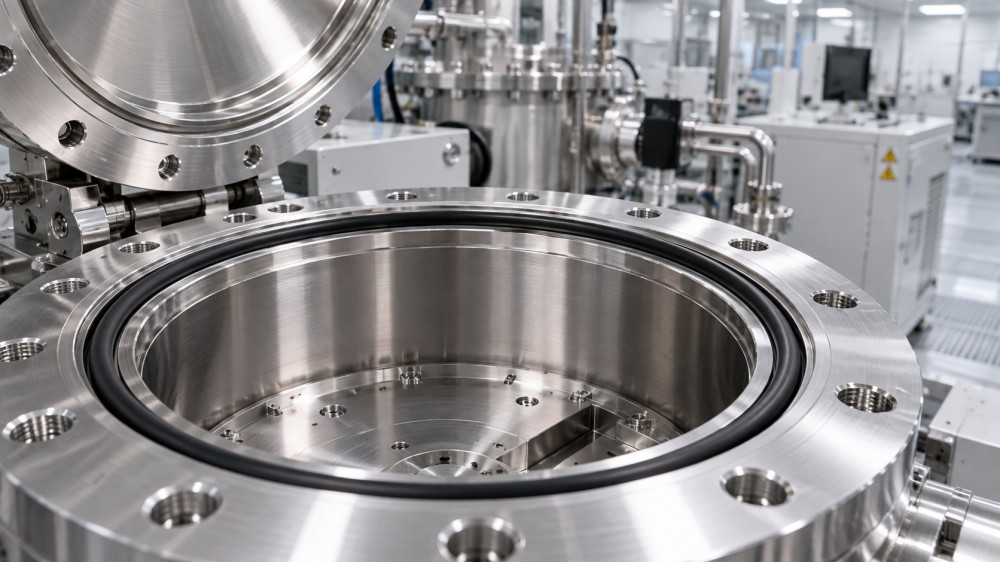
Where FFKM earns its higher cost
Aggressive chemistry is degrading the existing seal
Perfluoroelastomers offer broad chemical resistance, making FFKM a serious candidate where other elastomers swell, harden, crack, or lose mechanical strength. In etch and deposition equipment, however, compatibility must cover the complete exposure sequence. Resistance to an individual feed gas does not establish resistance to plasma-generated species, deposited films, or cleaning chemistry.
Look for evidence connecting the failure to the compound. Dimensional change, altered hardness, surface embrittlement, and reduced elasticity can support a chemical-degradation diagnosis. Cuts, pinching, or damage concentrated at a joint may instead indicate installation or gland problems that a material upgrade will not solve.
Thermal cycling is reducing sealing force
FFKM merits evaluation when operating temperatures or repeated heating cycles push an existing elastomer beyond its qualified service envelope. The relevant property is not merely resistance to immediate thermal damage; the seal must retain sufficient contact force after prolonged compression and cycling.
Published maximum temperature ratings are screening information, not chamber approval criteria. They may reflect test conditions unlike the application and do not necessarily describe vacuum cleanliness, chemical exposure, or long-term sealing performance. Compare compression-set and aging data at temperatures and durations relevant to the actual gland.
Seal degradation threatens contamination control
A seal can remain leak-tight while becoming an unacceptable contamination source. Surface erosion may release particles, and volatile constituents or degradation products may affect chamber background. This matters particularly where wafer acceptance depends on contamination levels below what a routine leak test can reveal.
Semiconductor-grade FFKM formulations are candidates because their formulation and processing can be tailored for demanding cleanliness requirements. Nevertheless, the label alone does not establish purity or plasma durability. Filler systems, cure chemistry, post-curing, cleaning, and packaging all influence performance and require compound-specific evidence.
Plasma resistance is a compound-level decision
Two FFKM compounds can behave differently in the same chamber. A formulation selected for thermal stability may not provide the best resistance to a particular plasma. Another may resist erosion but have different compression recovery or contamination characteristics.
Direct plasma exposure introduces mechanisms that chemical immersion tests cannot reproduce. Ion bombardment, radical reactions, ultraviolet exposure, and local heating may act together. Oxygen-rich and fluorine-rich environments can also produce different degradation behavior, so a general claim of “plasma resistance” is insufficient.
Request test conditions alongside reported results: gas composition, plasma source, exposure configuration, temperature, duration, and sample geometry. Weight loss can indicate erosion, but it does not independently establish particle cleanliness. Surface changes, released particles, dimensional stability, and retained mechanical properties may also matter.
Shielding or relocating the seal can sometimes improve life more effectively than changing elastomer alone. Where the gland is directly exposed, evaluate the shield, seal protrusion, and local temperature together with the compound. A material substitution should not conceal a correctable exposure problem.
Compare alternatives against the actual boundary conditions
These options are not necessarily interchangeable within an existing O-ring groove. PTFE-based and metal seals often require different hardware and assembly practices. Even an FKM-to-FFKM change requires confirmation of dimensions, hardness, thermal expansion, and gland fill.
Vacuum level alone does not justify FFKM. Elastomers permit gas permeation, and FFKM does not universally have lower outgassing or permeability than every alternative. When the pressure target or residual-gas specification is exceptionally demanding, assess whether any elastomeric boundary is acceptable before selecting a premium elastomer.
Separate a material problem from a sealing-system problem
A rising base pressure after maintenance does not, by itself, indicate chemical attack. Trapped volumes, chamber moisture, damaged flange surfaces, contamination in the groove, or uneven compression can create similar symptoms. Installing a more expensive seal without isolating the mechanism may leave the problem unchanged.
Use helium leak testing to investigate leak paths, while recognizing that permeation can produce a delayed signal. Pressure-rise testing and residual gas analysis can help distinguish leakage from other gas loads when interpreted against controlled chamber conditions. Compare results at relevant temperatures rather than relying only on a room-temperature acceptance test.
Inspect removed seals and retain their operating history. Permanent flattening may indicate inadequate recovery, excessive squeeze, or thermal aging; a localized cut points toward a different corrective action. Deposits adhering to the seal can also cause damage during opening, making maintenance technique part of the failure mechanism.
The gland review should address squeeze, available expansion volume, tolerances, surface finish, and pressure differential. Thermal expansion can overfill a groove even when room-temperature dimensions appear acceptable. Follow compound-specific design guidance and chamber requirements rather than transferring an existing squeeze target without review.
Evidence to request before approving a compound
A useful qualification package connects supplier data with the proposed application. Generic polymer-family charts are suitable for initial screening, but approval should identify the exact compound, seal geometry, processing condition, and supplied cleanliness state.
- Define acceptance limits first. Set requirements for leak rate, pumpdown behavior, particle contribution, relevant contamination, and service interval. Include performance after thermal and process exposure, not just immediately after installation.
- Review relevant material data. Request chemical compatibility evidence, compression-set conditions, thermal-aging information, and plasma-exposure results where applicable. Ask suppliers to identify gaps between their tests and the proposed process.
- Evaluate vacuum cleanliness. Obtain outgassing data with conditioning and test details. Where needed, use residual gas analysis to examine species relevant to the process; a single bulk outgassing value may hide important differences.
- Verify the supplied seal. Confirm dimensional tolerances, surface condition, cleanliness handling, packaging, traceability, and any restrictions on cleaning or bakeout.
- Run a controlled chamber trial. Compare candidates using the same installation procedure, conditioning sequence, recipes, and inspection method. Include enough representative cycling to expose aging mechanisms rather than accepting initial leak tightness as proof of service life.
Bench tests and chamber trials answer different questions. Bench testing can isolate material behavior, while chamber qualification captures interactions with deposits, hardware, cleaning, and handling. When process details cannot be disclosed fully, provide the seal supplier with an agreed exposure envelope and document the remaining uncertainty.
Make the replacement interval part of the selection
The economic case for FFKM is strongest when a validated improvement in service life or cleanliness avoids meaningful maintenance disruption. Compare seal purchase cost with replacement labor, conditioning time, qualification effort, and the consequences of an unplanned intervention. Do not assume a higher-priced compound will extend the maintenance interval without supporting exposure data.
Conversely, upgrading a seal that already survives comfortably until scheduled maintenance may offer little operational benefit. The better decision may be to retain the qualified material and improve installation controls or spare-part traceability.
Set an initial replacement interval from qualification evidence, then refine it through documented inspections and chamber performance trends. Keep compound identity under change control: a different formulation, even within FFKM, can require renewed evaluation. Approve FFKM where it resolves a demonstrated chemical, thermal, or contamination constraint—not as a blanket specification for every chamber seal.
Related News
- 00
0000-00
Where are axial piston pumps used in mining equipment? - 00
0000-00
Embodied AI Robotics and Drive Control Forum Held in Shanghai - 00
0000-00
How does seal service life affect the total cost of ownership? - 00
0000-00
Schaeffler to Cut 3,460 Jobs and Close Five European Plants - 00
0000-00
How does system size affect the price of a belt drive system?
Weekly Insights
Stay ahead with our curated technology reports delivered every Monday.