





When High Purity FFKM Sealing Materials Are Needed for Contamination Control
In contamination-sensitive operations, a seal is not merely a leakage-control component. It can be a source of particles, extractable compounds, absorbed process chemicals, or degraded elastomer fragments. Where the process medium is valuable, highly reactive, ultra-clean, or tightly regulated, those risks can affect product yield, equipment availability, cleaning validation, and qualification work. High purity FFKM sealing materials are designed for the difficult intersection of chemical resistance, elevated-temperature stability, and low contamination potential.
That does not mean FFKM is automatically the right answer whenever a process is demanding. It is among the most capable elastomer families, but it is also a premium material whose performance depends on the compound, the curing system, the seal geometry, the hardware finish, and the actual duty cycle. Technical evaluators should therefore begin with a more useful question: what contamination mechanism must the seal prevent, and can a lower-complexity material control it with adequate margin?
This distinction matters in semiconductor tools, pharmaceutical and bioprocess equipment, analytical instruments, specialty chemical handling, high-purity gas systems, vacuum equipment, and advanced fluid-processing skids. In each setting, “clean” means something different. A semiconductor vacuum chamber may be sensitive to molecular outgassing and particle generation. A pharmaceutical system may prioritize extractables, cleaning compatibility, and documented material suitability. A chemical process may be less concerned with trace organics but unable to tolerate a seal that swells, cracks, or loses compression after exposure to mixed solvents.
Purity is more than chemical resistance
FFKM, or perfluoroelastomer, has a polymer backbone with a high degree of fluorination. This generally gives it broad resistance to aggressive chemicals and better thermal endurance than many common elastomers. However, a general-purpose FFKM compound and a high-purity FFKM compound should not be treated as interchangeable. The first may be selected mainly for media and temperature resistance; the second is formulated and processed with contamination control in mind.
For a purity-critical seal, technical review may need to consider more than a standard compatibility chart. Relevant questions can include the compound’s volatile or extractable profile, filler selection, pigment use, post-curing practice, batch consistency, packaging cleanliness, and whether the manufacturer can provide application-relevant documentation. A material that survives a chemical attack but releases undesirable residues may still be unsuitable for the process.
This is why “chemical resistant” is not a sufficient procurement specification for high-purity systems. A seal can resist a process gas or solvent in the narrow sense of not dissolving or cracking, while still creating yield risk through outgassing, surface degradation, or transfer of trace compounds during repeated thermal and chemical exposure.
The conditions that usually justify high purity FFKM
The strongest case for high purity FFKM sealing materials emerges when several constraints occur together rather than in isolation. A hot process alone does not always require FFKM. Nor does a cleanroom environment by itself. The material becomes more compelling when conventional fluorocarbon, EPDM, silicone, or other elastomers leave too little margin across the full operating profile.
One common trigger is exposure to aggressive chemicals at elevated temperature. Plasma-processing environments, reactive gas delivery systems, chemical-vapor processes, and high-temperature cleaning operations can impose conditions that accelerate elastomer aging. A seal that is acceptable during short laboratory exposure may perform differently after repeated temperature cycling, pressure cycling, purge sequences, and cleaning steps. The decision should be based on the full process recipe, including off-line cleaning and maintenance chemistry, not just the primary medium.
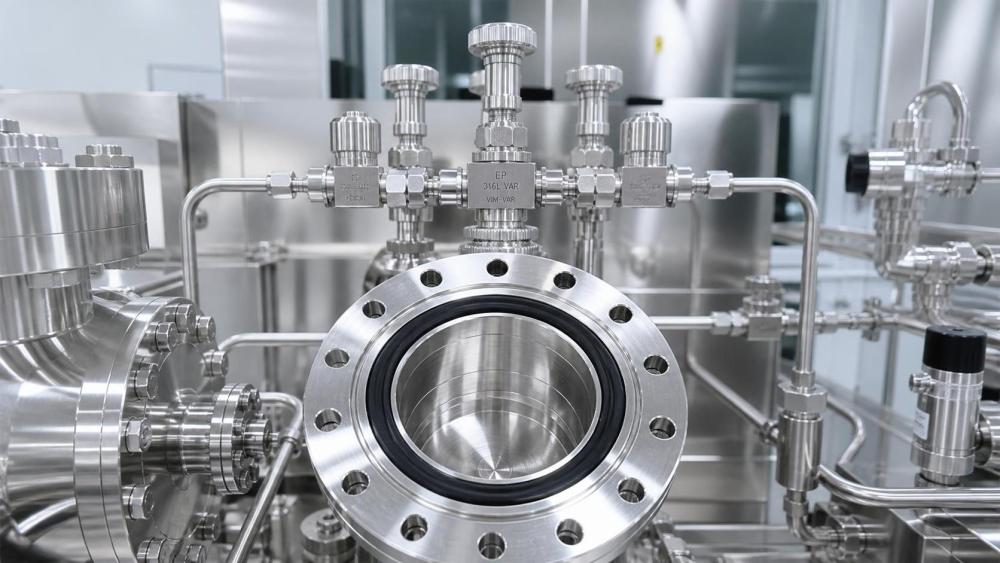
Another trigger is vacuum or low-pressure service where outgassing becomes a functional problem. Under vacuum, volatile constituents that are insignificant in a conventional fluid system can migrate into the chamber environment. In sensitive deposition, etch, analytical, or optical applications, this may affect process stability or create deposits on critical surfaces. High purity compounds are often evaluated here because lower extractables and controlled formulation may reduce that risk. Actual suitability, however, still depends on the required vacuum level, temperature, exposure time, and the equipment maker’s contamination criteria.
A third condition is direct contact with high-value or highly sensitive fluids. Examples may include ultrapure chemicals, process media used in precision manufacturing, and certain pharmaceutical or laboratory systems. If a seal has a credible path to contaminate the fluid, the engineering team needs to assess not only media resistance but also extractables, leachables where relevant, cleaning procedures, and the possibility of retained fluid in grooves or dead-leg regions. The material choice cannot be separated from sanitary or fluid-path design.
Where over-specification starts
High purity FFKM is not a universal upgrade. Specifying it without a defined contamination or durability requirement can add cost, lengthen sourcing lead times, and complicate spare-parts management without improving process reliability. In less severe applications, a carefully selected FKM, EPDM, silicone, PTFE-based solution, or another engineered elastomer may be entirely appropriate.
The most common over-specification pattern is selecting the highest-grade material because the equipment is described as “high tech,” while the actual seal location is outside the critical process boundary. A cabinet door gasket, external pneumatic connection, or non-product-contact utility line may face a very different chemical, temperature, and cleanliness profile from the chamber, manifold, or wetted valve it supports. Segregating seals by risk zone often produces a more rational bill of materials than applying one premium compound everywhere.
There is also a mechanical limit to material substitution. FFKM compounds can differ significantly in hardness, compression-set behavior, rapid gas decompression resistance, thermal expansion, and extrusion resistance. An O-ring groove designed around a different elastomer may not automatically deliver the same sealing performance after a material change. In dynamic service, friction, stick-slip, heat generation, and wear must be reviewed as well. Material purity cannot compensate for poor gland design or unsuitable surface condition.
A decision framework for technical evaluation
A productive evaluation begins with the failure consequences rather than the material name. If seal failure causes an external nuisance leak in a maintainable utility circuit, the threshold is different from failure in a process chamber where a shutdown can require cleaning, requalification, or disposal of valuable product. The same is true for contamination: identify whether the concern is particles, volatile residues, chemical leachables, ionic contamination, absorbed media released during later cycles, or a combination of these.
The following information should be assembled before comparing compounds:
- All process media, including cleaning agents, purge gases, lubricants, and foreseeable upset conditions.
- Minimum and maximum temperature, pressure, vacuum exposure, cycle frequency, and dwell time.
- Seal function: static face seal, radial O-ring, valve seat, dynamic reciprocating seal, or another geometry.
- The contamination-control requirement and the method by which it is assessed.
- Hardware dimensions, groove tolerances, surface finish, assembly lubricants, and installation method.
- Required documentation, traceability level, storage constraints, and replacement planning.
It is worth being precise about the phrase “high purity.” Buyers should request the supplier’s definition rather than assuming a common industry threshold. One supplier may emphasize low outgassing for vacuum service; another may focus on controlled compounding for semiconductor wet processes; another may have documentation aimed at pharmaceutical contact applications. Those are overlapping but not identical requirements. A data sheet is useful, yet it rarely replaces a discussion of the exact medium, exposure profile, and contamination concern.
Compare compounds at the application level
The selection process should compare candidate compounds against the mechanism most likely to end service life. In an oxidizing or reactive chemical environment, chemical stability may dominate. In a heated vacuum chamber, thermal endurance and outgassing may be the governing variables. In a valve or actuator, compression set and dynamic behavior may determine the maintenance interval. Where multiple factors are severe, a high purity FFKM grade may be justified precisely because it narrows the trade-off between cleanliness and durability.
Do not overlook permeation. Every elastomer has some degree of gas or vapor permeability, and a seal can appear mechanically intact while allowing gradual transfer of a medium through the polymer. In gas-handling and vacuum systems, this can affect leak-rate targets, background contamination, or process stability. Permeation behavior must be evaluated with the actual gas, temperature, pressure differential, seal cross-section, and time at condition. It should not be inferred from broad material labels alone.
Qualification should include the seal’s real life, not just its first installation
A new seal can pass a leak test and still become unsuitable after its first cleaning cycle or extended thermal exposure. Qualification plans should reflect the events the seal will experience in service: assembly, initial pump-down or pressurization, process exposure, purge, cleaning, cooldown, maintenance, and replacement. Where risk is high, engineering teams often benefit from retaining representative seals after exposure and examining changes in hardness, dimensions, surface condition, or mass. The appropriate tests and acceptance criteria depend on the application and should be set by the responsible equipment, process, and quality teams.
Installation control is equally important. A clean compound can be compromised by an unsuitable lubricant, contaminated handling surface, poor packaging discipline, incorrect cleaning method, or damage from sharp groove edges. Avoid treating the material certificate as the end of contamination control. The seal’s condition at installation, the tools used, and the way spare parts are stored can all affect the final result.
For maintenance organizations, this has a practical implication: critical high-purity seals should not simply be stocked under a generic “FFKM O-ring” description. Part identification should preserve compound designation, size, revision status where applicable, packaging expectations, approved lubricant or cleaning instructions, and the equipment location in which the seal is used. Mixing visually similar compounds is an avoidable source of reliability and qualification risk.
Treat seal selection as a system decision
Contamination control rarely belongs to one component. It is shaped by the relationship between seals, valves, pumps, fittings, tubing, filters, bearings, lubricants, cleaning practices, and maintenance intervals. A seal chosen for excellent purity characteristics may still have limited value if adjacent components shed particles, trap residues, or introduce incompatible materials into the process path.
This system view is central to the work covered by Global Precision Components & Transmission Systems (PCTS). Across sealing technology, fluid power, mechanical transmission, precision components, and industrial MRO, the recurring question is not simply which component has the strongest specification. It is how component behavior affects uptime, process risk, replacement planning, and total operating cost in a real machine.
High purity FFKM sealing materials are needed when conventional elastomers cannot reliably meet the combined demands of process chemistry, heat, cleanliness, and service life. The decision becomes defensible when the contamination path is defined, the duty cycle is documented, the seal design has been checked, and supplier information is matched to the actual application rather than a broad material category. Before release, confirm the compound identity, required cleanliness documentation, compatibility with all process and cleaning media, gland geometry, handling controls, and realistic spare-parts availability. That level of discipline is usually more valuable than choosing the most expensive elastomer by default.
Related News
- 00
0000-00
Where are axial piston pumps used in mining equipment? - 00
0000-00
Embodied AI Robotics and Drive Control Forum Held in Shanghai - 00
0000-00
How does seal service life affect the total cost of ownership? - 00
0000-00
Schaeffler to Cut 3,460 Jobs and Close Five European Plants - 00
0000-00
How does system size affect the price of a belt drive system?
Weekly Insights
Stay ahead with our curated technology reports delivered every Monday.