





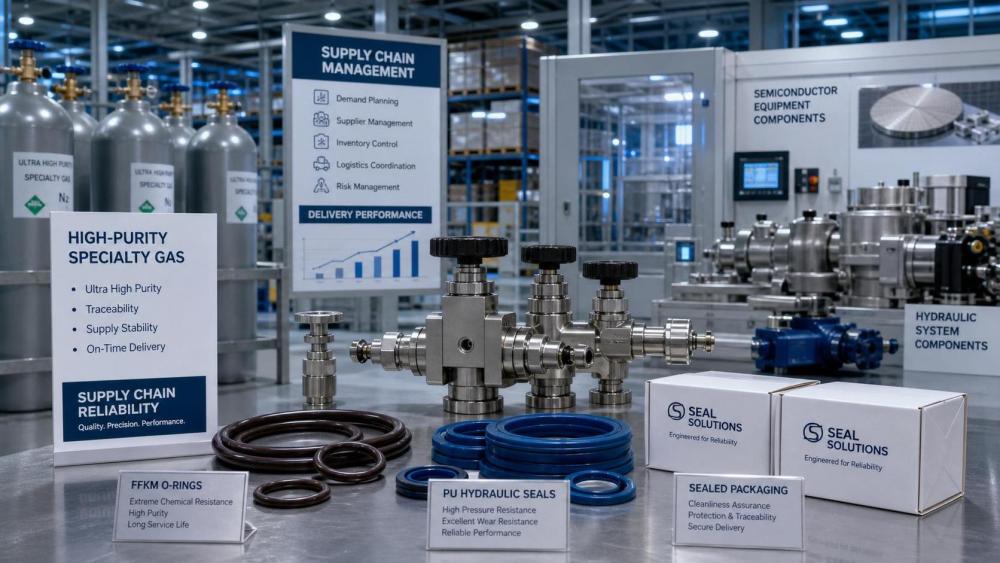
In April 2026, a sharp rise in China’s export unit price for tungsten hexafluoride coincided with tighter trade controls on tungsten powder exports to Japan and production cuts by Kanto Denka and Central Glass, adding pressure to the supply of high-purity specialty gases. This matters beyond the gas market itself: the change is relevant for procurement, delivery planning, and supply risk management across high-end sealing components such as FFKM O-rings and PU Hydraulic Seals, as well as for overseas hydraulic system integrators, wind bearing manufacturers, and semiconductor equipment producers that depend on imported sealing parts.
What the April 2026 Signal Confirms
Confirmed information shows that China’s export unit price for tungsten hexafluoride reached USD 150 per kilogram in April 2026, up 204% year on year. The event summary also confirms that China’s controls on tungsten powder exports to Japan, together with production cuts by Kanto Denka and Central Glass, have tightened global supply of high-purity specialty gases. Based on the same confirmed information, this tightening is directly affecting the raw material cost and delivery stability of high-end sealing products including FFKM O-rings and PU Hydraulic Seals, while creating supply chain risk for overseas hydraulic system integrators, wind bearing manufacturers, and semiconductor equipment makers that rely on imported sealing components.
Where the Pressure Appears Along the Chain
Imported sealing buyers face a procurement timing problem
From an industry perspective, companies buying imported sealing components may be affected because the confirmed price spike and tighter specialty gas supply point to more pressure on raw material cost and lead-time stability. The business impact is most likely to appear in sourcing schedules, delivery commitments, and supplier confirmation processes. What deserves closer attention is whether purchasing documents, technical specifications, and delivery terms need tighter review when the affected components include high-end sealing materials.
Equipment and system manufacturers may see delivery risk move upstream
For overseas hydraulic system integrators, wind bearing manufacturers, and semiconductor equipment producers named in the event summary, the issue is not only component price. Analysis shows the more immediate concern is whether imported sealing parts remain available on the required timetable for assembly, maintenance, or project execution. In practice, this places more attention on supplier qualification checks, replacement part planning, and any contract clauses linked to delivery windows or specification consistency.
Trade and supply-chain service providers need closer document control
Observably, firms involved in trade execution, supply-chain coordination, and cross-border delivery may also be affected because the underlying trigger includes export control changes and tightening upstream availability. Their exposure is likely to center on order confirmation, shipment scheduling, and document completeness for affected product categories. It is more appropriate to understand this as a need for closer monitoring of trade-related documentation and execution requirements rather than as proof of a single settled market outcome.
What Companies Should Watch Now
Review specification-linked sourcing exposure
Analysis shows companies using FFKM O-rings, PU Hydraulic Seals, or other high-end sealing components should first identify where these items are tied to critical operating requirements, because cost pressure and supply instability matter most where substitution is difficult. The immediate priority is not broad cost control, but a clear map of which orders, service parts, or production lines depend on tightly specified imported seals.
Track compliance language and trade execution signals
What deserves closer attention is the compliance and trade wording that may shape execution in follow-on transactions. Because the confirmed facts refer to export controls and tighter upstream supply, companies should watch how suppliers describe lead times, product availability, and supporting trade documents in quotations, contracts, and shipment arrangements. If detailed execution rules are not yet provided in the input, they should not be treated as settled.
Recheck supplier qualification and delivery commitments
From an industry perspective, procurement teams should pay closer attention to supplier qualification status, delivery assurances, and technical document consistency for affected sealing categories. This is especially relevant where after-sales support, maintenance schedules, or project delivery depend on imported parts with narrow specification tolerances.
Prepare for bid and service-file adjustments
Observably, companies participating in tenders or long-cycle equipment projects may need to review whether technical bid files, test records, traceability materials, or service documentation still align with current sourcing conditions. This is not evidence that tender requirements have already changed, but it is a practical area to monitor if the upstream supply situation continues to affect cost and delivery certainty.
How to Read This Development at This Stage
Analysis shows this development is best read as a concrete execution signal rather than as a fully defined new rule set for every downstream buyer. The confirmed facts already point to a real change in trade conditions and supply tightness, but the downstream impact will depend on how procurement practice, technical acceptance, and delivery arrangements respond in individual transactions. Observably, the market should continue watching for more clarity in implementation language, customer documentation requirements, and supplier-side operating responses before treating all effects as fixed.
Why This Matters More as a Supply Rule Signal
At this stage, it is more appropriate to understand the event as a warning that upstream trade controls and production adjustments can quickly transmit into sealing procurement and equipment delivery risk. The significance lies less in a single month’s price point than in the way rule-related and supply-related changes are appearing together in one chain. A neutral reading is that companies exposed to high-spec imported sealing components should strengthen monitoring of sourcing, compliance, and delivery execution, while avoiding premature assumptions about outcomes that have not yet been confirmed.
Basis of This Article and What Still Needs Verification
This article is generated from the user-provided news title, event time, and event summary. For developments of this type, relevant source categories usually include official notices, regulator releases, customs or trade authority information, industry association updates, standards organization documents, and reporting from authoritative media. No specific official source link was provided in the input, so the exact official source path remains to be verified. Observably, the areas that still require continued checking include detailed policy wording, compliance interpretation, tender document changes, market feedback, and how companies are actually executing procurement and delivery decisions.
Want to dive deeper into these market dynamics, or need data-driven support for your next business move? Drop a line below and let the analysts at PCTS provide customized insights.
We respect your privacy. Your information is strictly confidential.
Related News
- 00
0000-00
How sealing technology reduces contamination in semiconductor manufacturing - 00
0000-00
Where to install vibration sensors on rotating machinery - 00
0000-00
NTSB Probe Finds Boeing Warned of MD-11 Engine Bearing Risk Years Earlier - 00
0000-00
How to size pneumatic grippers for packaging system integration - 00
0000-00
How to size alloy steel power transmission chains for heavy loads
Weekly Insights
Stay ahead with our curated technology reports delivered every Monday.