





On August 1, 2026, a new REACH compliance issue emerged for the sealing supply chain after ECHA added a PFOSA-based fluoroelastomer additive to the SVHC Candidate List. Because this substance is used in FFKM O-rings to improve plasma resistance and sealing performance in semiconductor process chambers, the update deserves close attention from manufacturers, equipment makers, line integrators, importers, and export-facing compliance teams. The immediate relevance is not only regulatory classification itself, but also the effect on declarations, customs clearance, and supply-chain documentation ahead of the November 2026 notification and SDS update requirement.
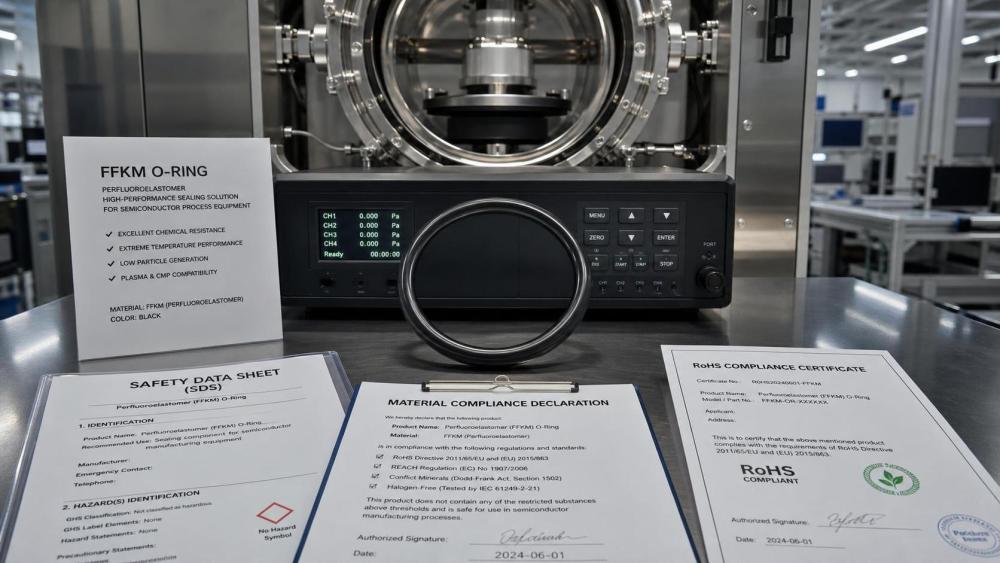
What ECHA Has Formally Added
According to the information provided, ECHA officially added PFOSA-based fluoroelastomer additives to the SVHC Candidate List on August 1, 2026. The update directly affects compliance declarations and export customs clearance for companies producing FFKM O-rings.
The substance is described as being widely used to enhance plasma resistance and sealing performance in semiconductor process chamber applications. The new rule requires, from November 2026, supply-chain notification and Safety Data Sheet updates for seals containing this component.
The provided information also states that overseas equipment manufacturers, semiconductor production line integrators, and importers need to review the compliance qualifications of their current FFKM suppliers and examine possible substitution options.
Where the Pressure Will Show Up First
Export-oriented FFKM seal manufacturing
From an industry perspective, manufacturers of FFKM O-rings may feel the earliest impact because their products sit at the point where material composition, compliance statements, and shipment documents meet. The main pressure is likely to appear in product declarations, customer document requests, and export clearance preparation for products that contain the listed additive.
Equipment makers and system integrators
For overseas equipment manufacturers and semiconductor line integrators, the issue is less about the listing in isolation and more about whether installed or planned sealing specifications remain commercially workable under updated documentation rules. What deserves closer attention is whether existing approved parts, supplier files, and procurement specifications still align with customer and import requirements after November 2026.
Importers and supply-chain service functions
Importers and related supply-chain teams may be affected through document completeness and supplier traceability. Analysis shows that the practical risk sits in whether product content information, SDS revisions, and supplier compliance credentials can be verified quickly enough to avoid disruption in customs handling or customer-side compliance review.
Procurement teams in semiconductor-facing operations
For procurement functions tied to semiconductor equipment or chamber sealing supply, the key concern is continuity. Because the listed additive is associated with plasma-resistant FFKM performance, any move toward alternatives may require careful comparison at the sourcing level, even where no immediate product change has yet been confirmed.
What Companies Should Review Now
Check whether current FFKM parts involve the listed additive
Analysis shows that the first practical step is product-level screening. Companies purchasing, importing, or specifying FFKM O-rings should determine which seal models or formulations may contain the PFOSA-based additive referenced in the update, especially in semiconductor process chamber applications.
Reconfirm supplier compliance credentials and document readiness
What deserves closer attention is whether existing suppliers can support updated compliance declarations and SDS documentation within the required timeline. This is particularly important for businesses that rely on cross-border shipments and customer audits tied to material disclosure.
Separate immediate document obligations from longer-term substitution work
Observably, the November 2026 requirement creates a near-term documentation task, while supplier replacement or material substitution may be a separate and more complex workstream. Companies should avoid treating these as the same issue, because document updates may be urgent even where an alternative sealing solution is still under evaluation.
Prepare customer and internal communication paths
For teams handling delivery schedules, qualification files, or after-sales support, it is advisable to prepare a clear internal process for responding to questions on composition disclosure, SDS changes, and supplier status. In practice, this can reduce delays when customers or import-side reviewers request confirmation on affected FFKM parts.
Why This Looks Like More Than a Routine List Update
As an editorial observation, this development is more appropriate to understand as both a short-term compliance change and a longer-term signal for fluorinated sealing materials used in demanding process environments. The confirmed fact is the SVHC Candidate List addition and the coming notification and SDS obligations. The broader implication, however, is that highly specialized sealing materials are no longer only a performance discussion; they are also a documentation and supply-chain risk issue.
Observably, the event has not yet established a single final market outcome. It does, however, create a clear checkpoint for companies that depend on FFKM O-rings in semiconductor-related use cases. That is why continued attention is warranted, particularly around supplier qualification and substitution feasibility.
How the Industry May Need to Read This Stage
At this stage, the most balanced reading is that the update has already created a concrete compliance obligation, while its broader commercial effect still needs to be tracked through actual supplier responses and downstream customer requirements. It should not be overstated as a complete market reset, but it also should not be treated as a narrow paperwork issue. For affected companies, the near-term priority is verification, documentation, and communication across the supply chain.
Basis of This Article and What Still Needs Verification
This article is based on the user-provided news title, event date, and event summary. For this type of industry development, relevant source categories typically include official regulatory notices, company disclosures, industry association updates, authoritative media reporting, and standard-setting or compliance documentation.
No specific official source link was provided in the input, so the exact official reference still needs ongoing verification. Follow-up attention should remain on any later official wording, supplier-side compliance statements, SDS revisions, and practical changes in how affected FFKM O-ring products are declared and cleared in cross-border trade.
Want to dive deeper into these market dynamics, or need data-driven support for your next business move? Drop a line below and let the analysts at PCTS provide customized insights.
We respect your privacy. Your information is strictly confidential.
Related News
- 00
0000-00
How to check vibration analysis software for sensor compatibility - 00
0000-00
IndexBox Forecasts 3.8% Annual Growth for Global Radial Seals Market Through 2035 - 00
0000-00
How to assess the chemical compatibility of FFKM sealing sheets - 00
0000-00
IndexBox Forecasts 3.6% Annual Growth for Construction Bearings Market - 00
0000-00
When do hydraulic components require an export license?
Weekly Insights
Stay ahead with our curated technology reports delivered every Monday.