





Comparing o ring manufacturers is rarely a simple price exercise. Seal life, delivery stability, and downstream reliability all depend on how well a supplier controls materials, dimensions, curing, and production planning. In sectors tied to fluid power, rotating equipment, industrial automation, and MRO, a weak sealing source can shorten maintenance cycles, raise leakage risk, and disrupt spare parts availability. A better comparison method looks at performance over time, not just cost per piece.
Why the comparison matters beyond unit price
An O-ring sits at a small scale, but it influences large system outcomes. In hydraulic pumps, pneumatic cylinders, valves, gearboxes, and process equipment, seal failure can mean contamination, pressure loss, unplanned stoppage, or product scrap.
That is why experienced sourcing teams compare o ring manufacturers through total ownership cost. A lower quote loses value quickly when replacement intervals shorten or urgent air freight becomes routine.
Across the broader precision components market, this issue connects directly with the priorities tracked by PCTS. Reliability, tribology, fluid power stability, spare parts planning, and lifecycle economics often converge at the sealing point.
What separates one supplier from another
At a basic level, o ring manufacturers may offer similar catalog sizes, compounds, and standards. The real differences appear in consistency, application knowledge, and response speed when conditions become demanding.
A reliable supplier is not defined only by product range. It is defined by how repeatably that range performs under pressure, heat, chemical exposure, motion, and storage constraints.
Material control is usually the first divider
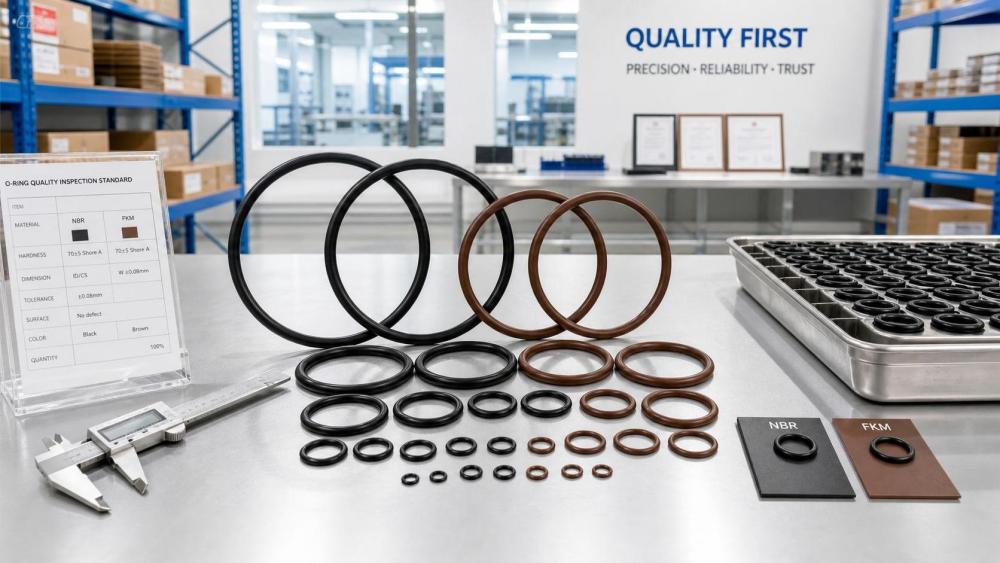
Different compounds behave very differently in service. NBR, FKM, EPDM, HNBR, silicone, and FFKM each fit specific media, temperatures, and motion profiles.
Strong o ring manufacturers can explain compound selection with clarity. They should discuss compression set, swell, abrasion, low-temperature flexibility, and chemical compatibility without relying on generic claims.
Dimensional stability affects seal life directly
Small dimensional variation can change squeeze, groove fit, and friction. That matters in dynamic sealing, high-pressure hydraulics, and compact equipment where tolerance windows are narrow.
The best o ring manufacturers treat molding, trimming, post-curing, and inspection as linked controls. That discipline usually shows up in lower batch variation and fewer field surprises.
How to judge seal life potential before long field trials
Seal life cannot be predicted from a catalog line alone. It must be estimated from the fit between the compound, the operating environment, and the supplier’s process discipline.
A useful comparison starts with the actual duty cycle. Static and dynamic sealing impose different stresses, even when the same size is used.
When comparing o ring manufacturers, request test evidence that relates to the real application. Generic hardness values are useful, but they are not enough on their own.
Look for application-specific evidence
- Compression set data at relevant temperatures
- Chemical resistance results for actual media
- Certificates tied to each batch or lot
- Case history in hydraulics, pneumatics, food processing, or semiconductor sealing
- Evidence of change control for tooling or formulation adjustments
Lead time is a capability issue, not just a logistics issue
Lead time is often treated as a shipping conversation. In reality, it begins with raw material access, tooling readiness, scheduling discipline, curing capacity, and inventory strategy.
Some o ring manufacturers quote attractive standard lead times but depend on fragile upstream supply. Others keep realistic buffers for common compounds and sizes, which creates better continuity during demand spikes.
Questions that reveal real delivery strength
Ask how much of the lead time is manufacturing and how much is waiting. That distinction exposes whether a supplier controls its process or simply passes through delays.
- Which compounds are kept in regular production?
- Are molds dedicated, shared, or outsourced?
- What is the on-time delivery rate by product family?
- Can emergency orders be supported without quality shortcuts?
- How are forecast changes handled across quarterly demand swings?
These questions matter especially in MRO and export environments, where downtime costs can outweigh component value by a wide margin.
Where supplier comparisons should become more rigorous
Not every application needs the same level of evaluation. Standard utility sealing is one thing. Critical or harsh-service sealing requires much deeper review.
Typical higher-risk use cases
- Hydraulic systems with pressure cycling and elevated temperatures
- Pneumatic automation where speed and friction affect cycle stability
- Chemical process equipment exposed to aggressive media
- Food, medical, or clean-process sealing with traceability demands
- Exported machinery requiring stable spare parts support over long service lives
In these settings, the best o ring manufacturers usually show stronger documentation, clearer application boundaries, and faster technical feedback when a failure mode appears.
A practical comparison framework for sourcing decisions
A side-by-side review works better than a broad impression. The goal is to rank suppliers by risk exposure and long-term fit, not by marketing language.
This kind of structure aligns well with the broader sourcing logic seen across bearings, seals, hydraulic components, and transmission parts. PCTS often frames supplier evaluation through the same lens: performance, continuity, and lifecycle cost.
What to do next with the shortlist
Once several o ring manufacturers meet baseline requirements, the next step is controlled validation. Start with a limited set of high-volume and high-risk part numbers.
Review compound fit, lot consistency, and actual delivery behavior over several order cycles. Compare replacements, leakage incidents, and line interruptions, not just invoice totals.
It also helps to separate standard stock items from critical custom seals. Some suppliers are strong in one area and average in the other.
A disciplined comparison of o ring manufacturers becomes more valuable over time. It supports cleaner sourcing decisions, steadier maintenance planning, and better control of reliability risk across the equipment base.
The most useful next move is to build a scorecard around application conditions, material evidence, and proven lead time performance. That creates a decision standard that stays useful well beyond a single quote request.
Want to dive deeper into these market dynamics, or need data-driven support for your next business move? Drop a line below and let the analysts at PCTS provide customized insights.
We respect your privacy. Your information is strictly confidential.
Related News
- 00
0000-00
How to check vibration analysis software for sensor compatibility - 00
0000-00
IndexBox Forecasts 3.8% Annual Growth for Global Radial Seals Market Through 2035 - 00
0000-00
How to assess the chemical compatibility of FFKM sealing sheets - 00
0000-00
IndexBox Forecasts 3.6% Annual Growth for Construction Bearings Market - 00
0000-00
When do hydraulic components require an export license?
Weekly Insights
Stay ahead with our curated technology reports delivered every Monday.