





On July 1, 2026, a confirmed compliance change begins to affect fluorinated elastomer seals shipped into the EU, including FFKM O-rings: products must be accompanied by a full supply-chain SVHC declaration aligned with REACH and verified by an Only Representative (OR) established in the EU. This matters not only to seal exporters and importers, but also to manufacturers, compliance teams, and downstream equipment businesses because the requirement reaches customs clearance, CE-related compliance work, and complete equipment certification, while non-compliant products may be denied entry or face recall risk.
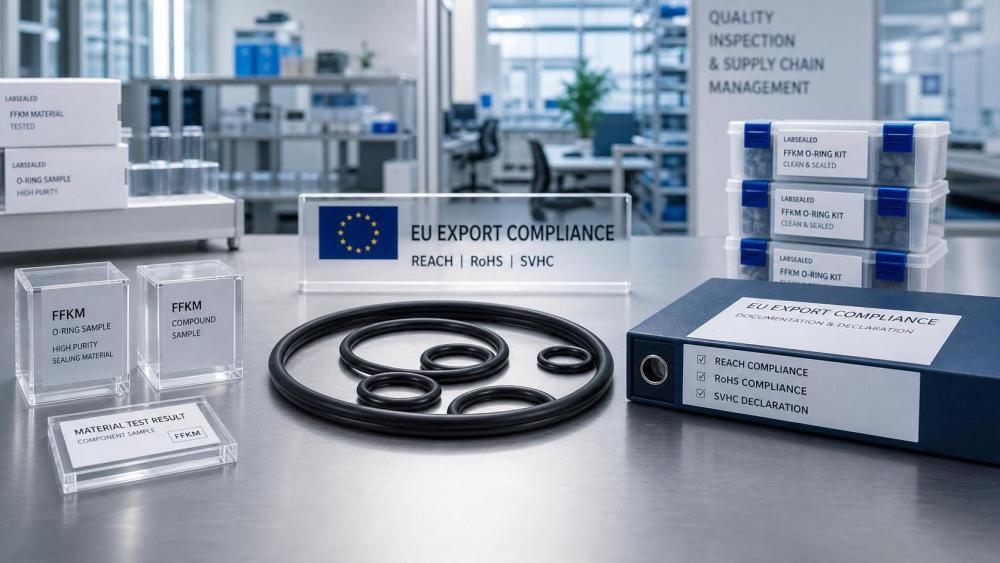
What Has Been Confirmed for EU-Bound Seals
ECHA has formally confirmed that from July 1, 2026, all fluorinated elastomer sealing products exported to the EU, including FFKM O-rings, must carry a full supply-chain declaration covering SVHC content under REACH. The required declaration must be verified by an EU-based Only Representative (OR).
The confirmed impact described in the provided information is direct: the requirement affects customs clearance for seal importers, CE compliance processes, and certification of finished equipment that uses these sealing components. Products that do not meet the requirement may be refused entry into the EU market or face market recall risk.
Where the Pressure Will Likely Appear First
Export and import transactions face document-sensitive risk
From an industry perspective, companies directly shipping fluorinated elastomer seals into the EU are likely to feel the earliest impact because the rule is tied to accompanying documentation and verification. The business effect may show up at shipment preparation, customs clearance, and importer acceptance, where incomplete or unverified SVHC statements could interrupt delivery.
Manufacturing supply chains may need tighter upstream traceability
Analysis shows that manufacturers using FFKM O-rings or other fluorinated elastomer seals may be affected beyond component sourcing alone. Because the declaration is described as a full supply-chain SVHC statement, the practical pressure is likely to fall on supplier coordination, material disclosure collection, and internal compliance handover between procurement, quality, and regulatory teams.
Downstream equipment certification may face knock-on checks
What deserves closer attention is the downstream effect on complete equipment makers. The provided information states that the new requirement directly affects finished equipment certification. That means businesses integrating these seals into broader assemblies may need to pay attention to whether component-level SVHC documentation is complete and OR-verified before final compliance files are closed.
Service and channel participants may be pulled into compliance coordination
Observably, distributors, sourcing partners, and supply-chain service providers may also be drawn into the process where they manage product documents, support importer communications, or coordinate delivery into the EU. Their exposure is less about material formulation itself and more about document flow, timing, and proof of verification.
What Companies Should Watch Closely Now
Whether documentation is complete across the full chain
Analysis shows that the central operational issue is not the product label alone, but whether the SVHC declaration can follow the product through the full supply chain in a form that meets REACH-related expectations described in the input. Companies should pay close attention to document continuity between upstream suppliers, exporters, importers, and end customers.
The role and readiness of the EU-based OR
What deserves closer attention is the verification step by an EU-based Only Representative. In practical terms, businesses involved in EU shipments should distinguish between having a declaration and having one that has been verified in the required way, because the input indicates that verification is part of the compliance threshold.
Products and deliveries already tied to EU market access
From an industry perspective, priority should go to product lines, orders, and customer programs that already depend on EU customs clearance, CE-related compliance work, or complete equipment certification. These appear to be the most exposed points in the business process based on the confirmed scope of impact in the provided information.
Customer communication and delivery planning
Analysis shows that the rule should also be viewed as a contract and delivery issue. Where customers in the EU or EU-bound supply chains require uninterrupted qualification, companies may need to prepare for document requests, verification lead time, and discussions about shipment readiness before goods are dispatched.
Why This Looks Like More Than a Routine Paperwork Update
This section is analysis. It is more appropriate to understand this development as an active compliance requirement with immediate operational consequences rather than a distant policy signal. The reason is straightforward: the confirmed information already ties the rule to customs clearance, CE-related compliance, finished equipment certification, and the possibility of denied entry or recalls.
At the same time, it is also more appropriate to understand this as a longer-term signal about documentation depth in regulated supply chains. The requirement described here points attention toward supply-chain-level material disclosure and verification, not just end-product declarations. That does not by itself establish broader future rule expansion, but it does indicate why the sector will keep watching official interpretation and implementation practice.
How the Market May Need to Read This Change
On the confirmed facts alone, this is a rule change with direct consequences for EU-bound fluorinated elastomer seals, including FFKM O-rings. The practical significance is that compliance responsibility does not stop at manufacturing or shipment; it extends into document integrity, OR verification, importer handling, and downstream certification pathways.
From an editorial perspective, the most balanced reading is that this is both a near-term operational requirement and a compliance signal worth continued monitoring. It should not be overstated beyond the provided facts, but it should also not be treated as a minor administrative adjustment where EU market access depends on supporting documentation.
Basis of This Article and Ongoing Verification
This article is generated on the basis of the user-provided news title, event date, and event summary. The confirmed factual basis used here is limited to the stated effective date of July 1, 2026, ECHA's confirmation, the scope covering fluorinated elastomer seals including FFKM O-rings, the requirement for a REACH-aligned full supply-chain SVHC declaration, the need for verification by an EU-based OR, and the stated effects on customs clearance, CE compliance, finished equipment certification, and market access risk.
For this type of industry update, source categories commonly relevant include official notices, company compliance statements, industry association updates, authoritative media reporting, and standard or regulatory documentation. No specific official source link was provided in the input, so the exact official link remains to be verified on an ongoing basis. What remains worth following is whether additional official wording, implementation clarification, or practical documentation guidance emerges around this requirement.
Related News
- 00
0000-00
Where are axial piston pumps used in mining equipment? - 00
0000-00
Embodied AI Robotics and Drive Control Forum Held in Shanghai - 00
0000-00
How does seal service life affect the total cost of ownership? - 00
0000-00
Schaeffler to Cut 3,460 Jobs and Close Five European Plants - 00
0000-00
How does system size affect the price of a belt drive system?
Weekly Insights
Stay ahead with our curated technology reports delivered every Monday.