





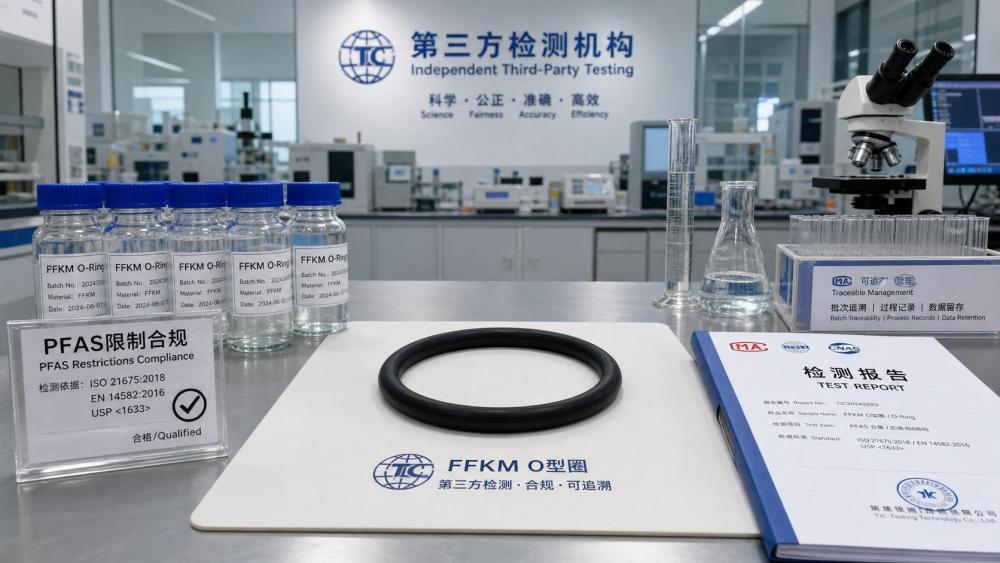
On July 1, 2026, a new compliance requirement for FFKM O-rings enters into force in the EU market. The European Commission has brought PFAS restrictions into REACH Annex XVII through Regulation (EU) 2026/1389, with the rule explicitly covering fluoroelastomer seals including FFKM O-rings. For exporters, importers, and supply chain teams handling these products, the issue is no longer only material performance or delivery, but whether PFAS declarations, test documentation, and traceability records can support market access.
What the Regulation Now Requires
According to the information provided, the European Commission has formally issued Regulation (EU) 2026/1389 and added per- and polyfluoroalkyl substances (PFAS) to REACH Annex XVII. The restriction is stated to apply to fluoroelastomer sealing products, including FFKM O-rings.
From July 1, 2026, FFKM products placed on the EU market must demonstrate that PFAS content is below 25 ppb. The information provided also states that this requirement directly affects compliance declarations, testing and certification, and supply chain traceability for Chinese sealing exporters. Importers are required to immediately review existing supplier PFAS statements and third-party test reports.
Where the Pressure Falls Across the Supply Chain
Export shipments face a documentation threshold
From an industry perspective, exporters of FFKM sealing products may be affected first at the point of compliance submission. The immediate pressure is likely to appear in product declarations, supporting test records, and the ability to show that supplied goods meet the stated PFAS threshold for EU market placement.
Importers must reassess supplier reliability
For EU importers, the information provided points directly to supplier review. The impact is likely to center on whether current suppliers can provide credible PFAS statements and third-party testing documents, and whether those records are current, consistent, and usable in compliance review.
Traceability becomes a practical supply chain issue
For sourcing and supply chain teams, the change is not only about a regulatory text. Analysis shows that traceability may become a day-to-day operational requirement, especially where materials, formulations, test evidence, and shipment records need to align across multiple suppliers or production stages.
What Companies Should Review Now
Check whether product scope and paperwork match
What deserves closer attention is whether internal product classifications, customer-facing declarations, and test materials all refer to the same product scope. Where FFKM O-rings are supplied into the EU, companies may need to confirm that the supporting paperwork clearly corresponds to the goods being placed on the market.
Verify third-party test support before shipment decisions
Analysis shows that the stated threshold makes third-party test reports a practical issue, not a formal one. Companies involved in export or import review may need to examine whether existing reports are available, whether they are suitable for customer or regulatory review, and whether additional testing could affect fulfillment timing.
Review supplier statements as part of procurement control
For procurement and supplier management teams, the immediate point is the quality of PFAS declarations already on file. Observably, the regulation increases the importance of checking whether supplier statements are complete, current, and supported by external evidence rather than treated as routine paperwork.
Prepare for customer communication around compliance evidence
What also deserves closer attention is customer communication. Where EU buyers or importers request proof tied to the new rule, response speed and document consistency may affect order continuity, approval cycles, and confidence in ongoing supply arrangements.
Why This Looks Like More Than a Short-Term Adjustment
Observably, this development can be read as more than a one-off shipment issue because it links market access to proof, not only product description. Analysis shows that the current significance lies in the shift from general material claims to evidence-backed compliance handling for specific sealing products entering the EU market.
At the same time, it is more appropriate to understand this as a confirmed regulatory requirement rather than a speculative policy signal, because the regulation has been formally issued and an effective date has been stated in the information provided. What remains open is how individual companies will operationalize testing, declarations, and traceability in actual transactions.
How the Industry Should Read This Development
In practical terms, this update is best understood as an immediate compliance and documentation issue for FFKM products sold into the EU, with wider implications for supplier screening and traceability discipline. It does not by itself define every downstream commercial outcome, but it clearly raises the standard for proving conformity. A neutral reading is that the rule has created a concrete operational checkpoint for exporters and importers, while the broader business impact will depend on how smoothly companies can align documents, testing, and supplier controls.
Basis of This Article and What Still Needs Verification
This article is based on the user-provided news title, event date, and event summary. For this type of industry update, relevant source categories usually include official regulatory notices, company compliance statements, industry association updates, authoritative media coverage, and standards-related documents.
No specific official source link was provided in the input, so the exact source document link still needs ongoing verification. Continued attention should focus on any subsequent official wording, implementation-related clarifications, and how market participants interpret documentation and testing requirements in practice.
Want to dive deeper into these market dynamics, or need data-driven support for your next business move? Drop a line below and let the analysts at PCTS provide customized insights.
We respect your privacy. Your information is strictly confidential.
Related News
- 00
0000-00
How sealing technology reduces contamination in semiconductor manufacturing - 00
0000-00
Where to install vibration sensors on rotating machinery - 00
0000-00
NTSB Probe Finds Boeing Warned of MD-11 Engine Bearing Risk Years Earlier - 00
0000-00
How to size pneumatic grippers for packaging system integration - 00
0000-00
How to size alloy steel power transmission chains for heavy loads
Weekly Insights
Stay ahead with our curated technology reports delivered every Monday.