





From July 1, 2026, the EU’s REACH Regulation (EU) 2023/2055 is being applied as a broad restriction on PFAS, with fluorinated elastomer sealing products including FFKM O-rings explicitly covered. For exporters, this is not just a regulatory update but an immediate customs compliance issue: third-party test reports and declarations of conformity are required at clearance, with shipment detention or return identified as the direct risk. Industrial equipment OEMs, semiconductor maintenance providers, and importers of high-purity fluid systems are among the business groups that need to assess the impact on purchasing, documentation, and delivery planning.
What Has Taken Effect on July 1
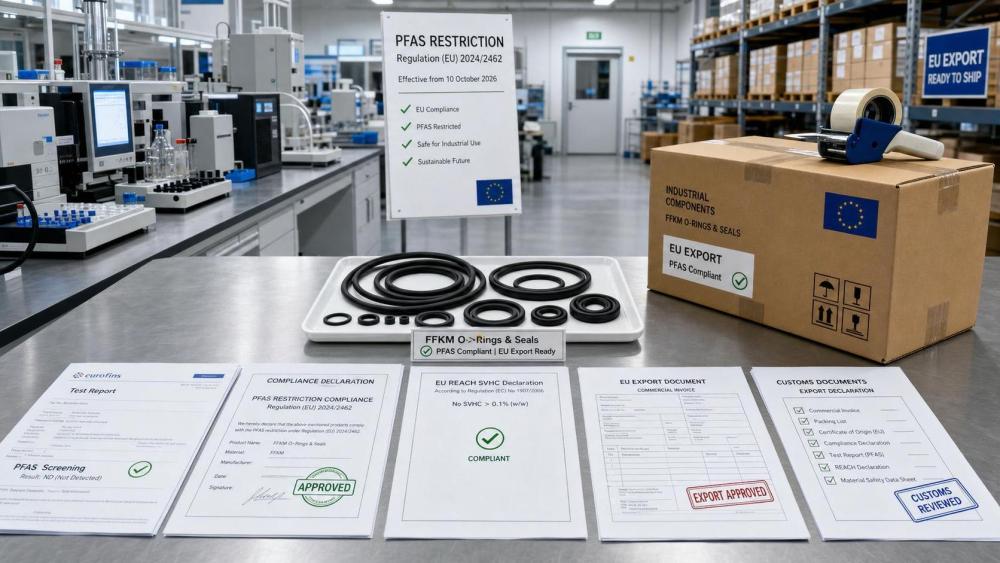
The confirmed change is that, as of July 1, 2026, the EU has formally enforced the PFAS restriction under REACH Regulation (EU) 2023/2055. The scope explicitly includes fluorinated elastomer seals, including FFKM O-rings. According to the provided information, exporters must submit a third-party test report and a declaration of conformity during customs clearance. If those materials are not provided, shipments may be detained or returned.
Where the Compliance Pressure Will Be Felt First
Export-facing suppliers and manufacturers
From an industry perspective, this group is likely to face the most immediate operational pressure because the requirement is tied directly to customs clearance. The impact is likely to concentrate on shipment readiness, product-document matching, and the ability to present compliant paperwork without delaying export execution.
Industrial equipment OEM procurement chains
Analysis shows that OEMs relying on FFKM O-rings in equipment deliveries may need to pay closer attention to whether upstream suppliers can provide the required supporting documents on time. The effect is less about the existence of demand and more about whether procurement and delivery schedules can proceed without customs disruption.
Semiconductor maintenance and service operations
For semiconductor line maintenance providers, the issue appears particularly sensitive because the supplied information directly identifies this group as affected. What deserves closer attention is the risk that replacement parts procurement may become more document-dependent, especially where continuity of service depends on timely import of sealing components.
Importers of high-purity fluid systems
For importers in high-cleanliness fluid applications, the impact is likely to appear in supplier qualification, import documentation review, and pre-shipment verification. Observably, the change raises the compliance threshold at the purchasing and receiving stages rather than only at the point of customs interaction.
What Companies Should Watch Now
Whether shipment files are complete before customs submission
The most immediate practical issue is whether third-party test reports and declarations of conformity are ready before goods enter the customs process. Based on the provided information, incomplete documentation now carries a direct logistics risk.
Which product categories are explicitly within scope
Companies handling fluorinated elastomer seals should focus on the fact that FFKM O-rings are expressly covered in the information provided. In practical terms, businesses should avoid treating these items as a peripheral compliance issue when they are part of regular export or import flows tied to the EU market.
The gap between rule text and daily procurement execution
Analysis shows that one of the key business challenges is not simply understanding that the restriction is in force, but translating that requirement into procurement, order confirmation, and shipping routines. Teams involved in sales support, logistics, and sourcing may need to align on what documents must be available at each stage.
Supplier communication and delivery planning
What deserves closer attention is whether suppliers, exporters, and buyers are using the same compliance checklist before shipment. For affected transactions, document readiness may become part of delivery reliability, customer communication, and order scheduling.
Why This Looks Bigger Than a One-Off Customs Notice
It is more appropriate to understand this as a concrete compliance trigger rather than a speculative policy signal, because the effective date, covered material category, and customs documentation requirement are all clearly stated in the provided information. At the same time, this should not yet be overstated as a fully measurable market outcome. Analysis shows that the immediate significance lies in how quickly affected supply chains adapt their documentation and purchasing controls around FFKM O-rings and related fluorinated sealing products.
How the Market May Need to Read This Development
At this stage, the development is best understood as an active regulatory requirement with immediate operational consequences for EU-bound trade involving covered sealing products. The confirmed facts point to a near-term compliance and clearance issue first, while the broader supply-chain effect still requires continued observation. A neutral reading is that this is both a current execution issue and a longer-term signal for stricter procurement compliance around PFAS-related components.
Basis of This Article and Ongoing Verification
This article is based on the user-provided news title, event date, and event summary. For developments of this kind, source types commonly relevant to verification may include official regulatory notices, company announcements, industry association updates, authoritative media reporting, and standards-related documents. No specific official source link was provided in the input, so the exact official link remains to be continuously verified. Follow-up attention should remain on any further official wording, customs-side implementation details, and practical documentation expectations affecting covered exports and imports.
Want to dive deeper into these market dynamics, or need data-driven support for your next business move? Drop a line below and let the analysts at PCTS provide customized insights.
We respect your privacy. Your information is strictly confidential.
Related News
- 00
0000-00
How to check vibration analysis software for sensor compatibility - 00
0000-00
IndexBox Forecasts 3.8% Annual Growth for Global Radial Seals Market Through 2035 - 00
0000-00
How to assess the chemical compatibility of FFKM sealing sheets - 00
0000-00
IndexBox Forecasts 3.6% Annual Growth for Construction Bearings Market - 00
0000-00
When do hydraulic components require an export license?
Weekly Insights
Stay ahead with our curated technology reports delivered every Monday.