





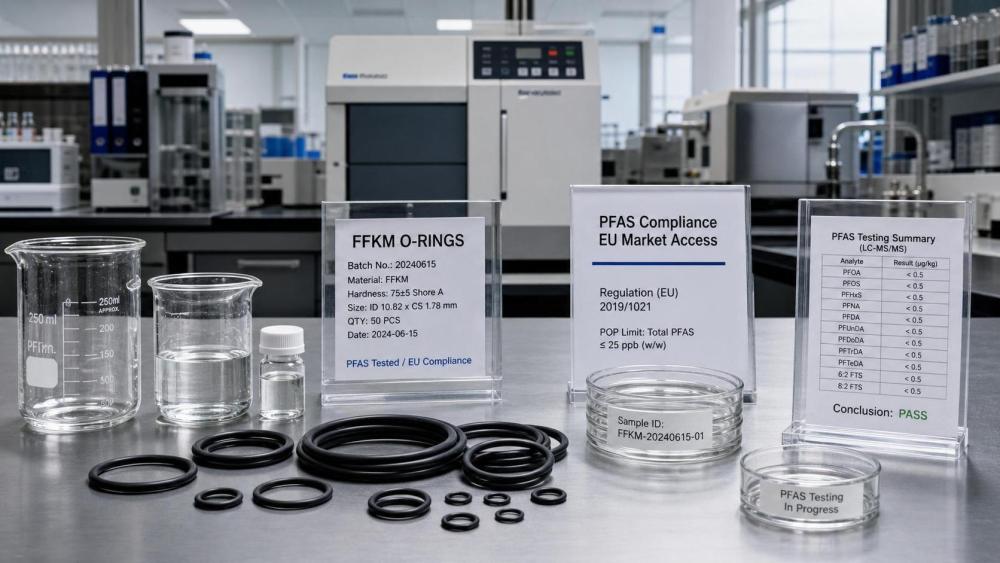
On July 1, 2026, a new EU REACH restriction begins full enforcement for imported sealing products containing FFKM elastomers, tightening the migration limit for all PFAS substances to 0.001 mg/kg under Regulation (EU) 2026/1289. For exporters, buyers, compliance teams, and testing-related service providers, this is not just a technical threshold change; it directly affects how FFKM O-rings are qualified, documented, tested, and delivered into the EU market.
What the rule change confirms
The confirmed facts are clear. The European Commission has formally issued Regulation (EU) 2026/1289. Under this rule, the migration limit for all PFAS substances in FFKM elastomers, including PFOA, PFOS, and structurally similar substances, is tightened to 0.001 mg/kg. The requirement becomes mandatory from July 1, 2026, and applies to all imported sealing products. The event summary also states that this limit is significantly stricter than the threshold recommended in ISO 21675:2025, and that it directly affects the compliance certification route and batch testing costs for Chinese exporters of FFKM O-rings.
Where pressure is likely to appear across the supply chain
Export qualification moves closer to batch-level scrutiny
From an industry perspective, exporters of FFKM O-rings are likely to face the most immediate pressure because the rule applies at the point of entry into the EU market. The practical impact is likely to fall on product qualification, shipment documentation, test evidence, and consistency between declared material performance and compliance records. What deserves closer attention is whether existing certification pathways and technical files remain sufficient once the lower migration threshold becomes the controlling requirement.
Procurement teams may need tighter supplier evidence
For procurement functions buying FFKM sealing products for EU-bound projects or resale, the change matters because the acceptable compliance margin has narrowed. The impact is likely to appear in supplier selection, incoming documentation review, and purchasing specifications. Buyers should pay closer attention to whether suppliers can provide material declarations, test reports, and technical documentation aligned with the new EU requirement rather than relying on older internal specifications or recommendations based on less stringent thresholds.
Testing and certification workflows are likely to become more demanding
For laboratories, certification-related service providers, and internal compliance teams, the stricter PFAS migration limit may increase the weight placed on test methodology, report validity, and lot-to-lot verification. Analysis shows that the issue is not only whether a product can pass once, but whether supporting evidence remains usable for repeated shipments, audits, or customer-side qualification reviews. The event summary already points to higher batch testing costs, which means the testing stage itself becomes a more visible commercial and delivery factor.
Delivery and after-sales risk may shift upstream
For distributors, project suppliers, and after-sales service teams, the rule may affect delivery commitments and traceability obligations. If compliance review moves earlier in the transaction cycle, any gap in technical records or test support could influence shipment timing, replacement planning, or dispute handling after delivery. Observably, the commercial risk is not limited to customs-facing paperwork; it can also extend into customer acceptance and product replacement decisions where traceable compliance evidence is requested.
What companies should review now
Recheck whether current compliance files still match EU entry requirements
Companies dealing in FFKM O-rings for the EU market should revisit existing declarations, material compliance files, and certification support documents against the new 0.001 mg/kg migration limit. This is especially relevant where technical documentation was built around prior customer specifications or around thresholds that were less strict than the new rule.
Prepare for more scrutiny of reports and technical records
Analysis shows that test reports, product technical files, and customer-facing compliance statements are likely to receive more attention after July 1, 2026. Businesses should therefore check whether the documents used in tenders, shipments, and customer approvals clearly support the applicable PFAS restriction and whether the records can be tied back to specific product batches where necessary.
Watch for changes in purchasing terms and delivery planning
Where FFKM O-rings are supplied into regulated projects or repeat industrial orders, companies should watch for tighter purchasing language, revised supplier qualification terms, and longer pre-shipment review cycles. The input does not provide detailed enforcement procedures, so it would be premature to treat these outcomes as settled. Still, they are realistic areas to monitor because stricter thresholds often shift review activity into procurement and delivery planning.
Track how execution language develops in practice
What deserves closer attention is not only the published limit itself, but also how it is reflected in customer specifications, compliance checklists, and certification review language. Since the provided information does not include detailed implementation guidance, companies should treat this phase as one that requires ongoing verification rather than assuming a uniform market practice from day one.
Why this looks more like an execution signal than a distant policy discussion
Observably, this development is better understood as an effective market-access rule for a specific product category rather than as a general policy debate. The key point is that the requirement is already tied to a formal regulation and a clear effective date, and it applies to imported sealing products. At the same time, analysis should remain measured: the available information confirms the legal threshold and its likely cost and compliance impact, but it does not yet define every operational detail of market enforcement, documentation review, or downstream purchasing behavior. That is why continued attention to implementation signals remains necessary.
How this update is best interpreted now
At this stage, the most reasonable reading is that the EU has moved from a standards-reference environment to a stricter mandatory compliance condition for imported FFKM sealing products containing PFAS. For affected businesses, the significance lies less in headline policy language and more in the immediate consequences for qualification, testing frequency, technical documentation, and delivery readiness. It is more appropriate to understand this as a landed rule change with operational implications, while still reserving judgment on how consistently market participants will interpret and apply supporting compliance expectations.
Basis of this article and points that still require verification
This article is based on the user-provided news title, event time, and event summary. For events of this type, commonly relevant source categories include official regulatory notices, publications by supervisory authorities, customs or trade administration updates, industry association information, standards organization documents, and reporting by authoritative trade media. A specific official source link was not provided in the input, so the underlying publication path still requires follow-up verification. What should continue to be monitored includes any detailed implementation guidance, certification interpretation, changes in tender or purchasing documents, market feedback, and how companies execute batch testing and compliance documentation in practice.
Want to dive deeper into these market dynamics, or need data-driven support for your next business move? Drop a line below and let the analysts at PCTS provide customized insights.
We respect your privacy. Your information is strictly confidential.
Related News
- 00
0000-00
How to check vibration analysis software for sensor compatibility - 00
0000-00
IndexBox Forecasts 3.8% Annual Growth for Global Radial Seals Market Through 2035 - 00
0000-00
How to assess the chemical compatibility of FFKM sealing sheets - 00
0000-00
IndexBox Forecasts 3.6% Annual Growth for Construction Bearings Market - 00
0000-00
When do hydraulic components require an export license?
Weekly Insights
Stay ahead with our curated technology reports delivered every Monday.