





On July 7, 2026, the European Commission issued Regulation (EU) 2026/1342, extending PFAS restrictions under REACH Annex XVII to industrial sealing products made with FFKM. With a January 1, 2027 compliance date for FFKM O-rings exported to the EU, the update is immediately relevant to seal manufacturers, exporters, importers, and procurement teams that rely on technical documentation and cross-border compliance to keep shipments moving.
What the new rule formally adds
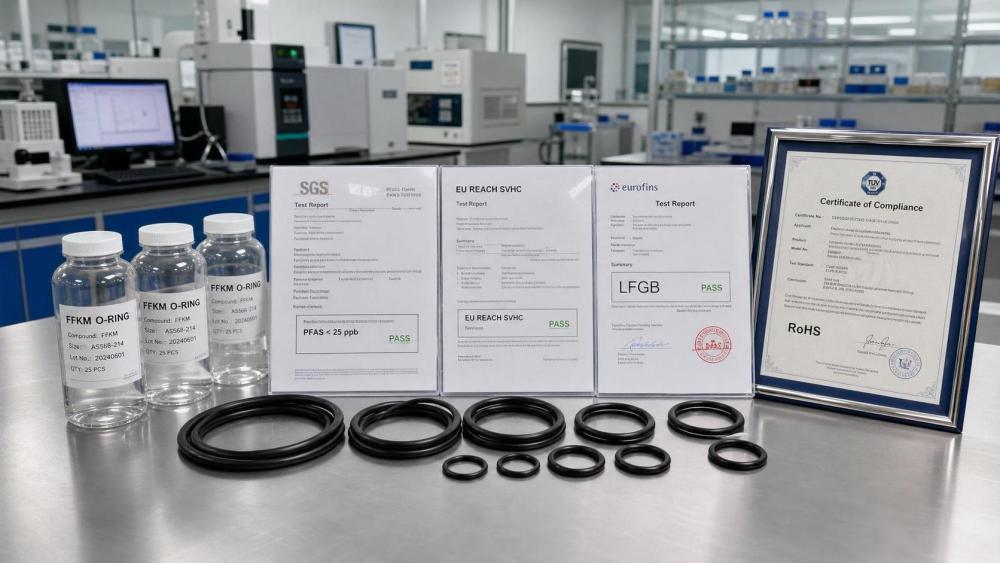
According to the information provided, the new provision expands the scope of PFAS control to industrial seals containing FFKM material. From January 1, 2027, FFKM O-rings exported to the EU must be accompanied by a PFAS content declaration and a third-party test report. The rule was formally published by the European Commission on July 7, 2026, under Regulation (EU) 2026/1342.
Where the impact is likely to be felt first
Export-oriented seal manufacturers face a documentation threshold
From an industry perspective, manufacturers supplying FFKM O-rings to the EU may be affected first because the new requirement is tied directly to export compliance. The practical impact is likely to appear in product qualification files, shipment paperwork, and customer-facing compliance submissions. What deserves closer attention is whether existing product records can support PFAS declarations and third-party testing within customer delivery timelines.
EU importers need to reassess supplier readiness
Importers are also directly exposed because the summary indicates that supply chain certification and technical substitution plans may need to be reviewed. In business terms, this can affect supplier screening, procurement approval, and continuity planning for FFKM-based sealing products entering the EU market. The immediate issue is not only whether goods can be sourced, but whether supplier documents are complete and defensible.
Procurement and supply chain teams may see pressure on lead times
Analysis shows that procurement and supply chain functions may be affected through added verification steps. If PFAS content declarations and third-party reports become necessary for shipment release or customer acceptance, document collection and coordination could become a more visible part of order fulfillment. Teams handling planning, logistics, and customer commitments should therefore watch for changes in document turnaround and approval sequencing.
What companies should focus on now
Track the exact compliance boundary
Companies should pay close attention to how the requirement is described in formal regulatory and customer communications. The confirmed fact is that the rule applies to FFKM O-rings exported to the EU and requires a PFAS content declaration together with third-party testing from January 1, 2027. Any broader internal interpretation should be treated as a working assumption until verified against official wording.
Review product and supplier document chains
For businesses already shipping into the EU, a practical focus area is whether current supplier files can support the new documentation burden. This includes checking how PFAS-related information is collected, who is responsible for issuing declarations, and whether third-party reports can be obtained in a form acceptable to customers or import partners.
Prepare for customer and importer questions earlier
Observably, the rule is likely to move compliance discussions forward in the sales and delivery cycle. Exporters may need earlier alignment with importers and customers on required declarations, report formats, and submission timing. That matters because documentation gaps can become a commercial issue even before the legal effective date if buyers start tightening qualification requirements in advance.
Assess substitution discussions carefully
The provided summary notes that importers need to reassess technical substitution options. Analysis shows that this should be understood as a commercial and compliance planning issue, not as proof that substitution will occur across all applications. Companies should distinguish between immediate documentation obligations and longer-term material decisions that may require separate technical validation.
Why this matters beyond a single paperwork update
Analysis shows that this development is more than a routine filing change for companies involved in FFKM exports to Europe. It signals that compliance expectations are moving closer to the product and material level for industrial sealing applications. At the same time, it is more appropriate to understand this as a defined regulatory step with operational consequences, rather than as a complete picture of future PFAS policy. The industry still needs to watch how implementation is interpreted in real transactions and supplier-customer exchanges.
How this update is best understood at this stage
At this stage, the regulation should be read as a near-term compliance change with longer-term signaling value. The confirmed outcome is clear: FFKM O-rings exported to the EU will require a PFAS content declaration and third-party testing from January 1, 2027. The broader market response, including how quickly supply chains adjust documentation practices or revisit technical alternatives, remains something to monitor rather than assume.
Basis of this article and follow-up watchpoints
This article is based on the user-provided news title, event date, and event summary. For this type of development, relevant source categories typically include official regulatory notices, company compliance statements, industry association updates, authoritative media coverage, and standard-setting or technical documentation. A specific official source link was not provided in the input, so the underlying text and any later implementation details still require ongoing verification. Follow-up attention should remain on official wording, market-side compliance practice, and any further clarification affecting exporters, importers, and supplier certification workflows.
Related News
- 00
0000-00
Where are axial piston pumps used in mining equipment? - 00
0000-00
Embodied AI Robotics and Drive Control Forum Held in Shanghai - 00
0000-00
How does seal service life affect the total cost of ownership? - 00
0000-00
Schaeffler to Cut 3,460 Jobs and Close Five European Plants - 00
0000-00
How does system size affect the price of a belt drive system?
Weekly Insights
Stay ahead with our curated technology reports delivered every Monday.