





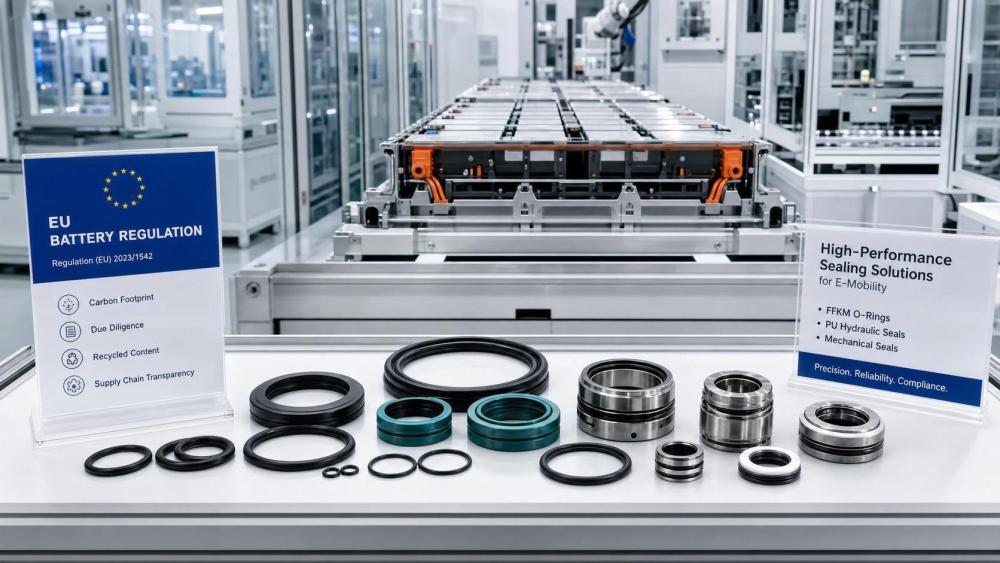
From August 18, 2026, the EU will begin mandatory implementation of carbon footprint performance labeling for rechargeable industrial batteries above 2kWh under Regulation (EU) 2023/1542, with the digital battery passport becoming mandatory in February 2027. Although the rule is aimed at batteries, its compliance effect is already extending into supporting components such as FFKM O-rings, PU hydraulic seals, and mechanical seals, which are used in battery pack thermal management and cell protection. For exporters, importers, procurement teams, and component manufacturers, the immediate point of attention is that carbon data requests are moving beyond battery makers and into upstream sealing supply chains.
What the regulation now requires
The confirmed implementation date is August 18, 2026. From that date, rechargeable industrial batteries with capacity above 2kWh must carry a carbon footprint performance class label under the EU Battery and Waste Battery Regulation (EU) 2023/1542.
A further compliance milestone has also been set: the digital battery passport will become mandatory in February 2027.
The regulation itself is focused on batteries, but the supplied information indicates that EU importers have already extended coordinated carbon-data review to related sealing systems, including FFKM O-rings, PU hydraulic seals, and mechanical seals, because these parts are used in battery pack thermal management and cell protection.
The same supplied information also confirms that overseas buyers have started asking Chinese sealing suppliers for LCA reports and material carbon declarations.
Why the impact reaches beyond battery makers
Procurement is shifting toward carbon-data coordination
From an industry perspective, battery importers and overseas buyers may be affected first because their compliance review is no longer limited to the battery pack itself. The impact is likely to appear in supplier onboarding, quotation review, and document collection, especially where buyers need supporting carbon information from component vendors.
Seal manufacturers face new document-driven pressure
For sealing manufacturers and exporters, the main impact is not that the regulation directly names every seal product, but that customers are beginning to treat these components as part of a broader compliance chain. What deserves closer attention is the growing importance of LCA reports, material carbon declarations, and the ability to respond to importer information requests within normal delivery cycles.
Supply chain service providers may need to support traceability workflows
Supply chain coordinators, quality teams, and compliance service providers may also feel the effect in document handling and cross-border communication. Analysis shows that the practical issue is less about one-time certification and more about whether upstream and downstream records can be aligned when customers ask for carbon-related supporting materials.
What companies should watch now
Track the distinction between battery rules and customer requirements
Companies should pay attention to the difference between the regulation's confirmed battery-specific obligations and the commercial compliance requests now being passed down by EU importers. In practice, customer requirements may move faster than a supplier's internal compliance preparation.
Review product lines linked to battery applications
Businesses supplying FFKM O-rings, PU hydraulic seals, mechanical seals, or other sealing parts used in battery pack thermal management and cell protection should identify which exported products are most likely to be drawn into carbon-data review first.
Prepare carbon-related documentation early
Observably, overseas buyers have already started requesting LCA reports and material carbon declarations from Chinese sealing suppliers. That makes document readiness, response timing, and consistency of material statements a near-term operational issue rather than a distant policy topic.
Align customer communication with the 2026 and 2027 milestones
Firms involved in EU-facing business should closely follow how customers refer to the August 2026 labeling requirement and the February 2027 digital battery passport deadline. The practical focus is whether these milestones change tender language, supplier qualification checks, or pre-shipment information requests.
How this signal should be read
Analysis shows that this development should not be read only as a battery regulation update. It also signals that supporting component suppliers can be drawn into carbon compliance review when their products are tied to battery safety, protection, or thermal management functions.
It is more appropriate to understand this as both a near-term business change and a longer-term supply chain signal. The near-term change is the arrival of concrete buyer requests for LCA and material carbon data. The longer-term signal is that carbon transparency expectations may continue moving upstream through technically critical components.
At the same time, this remains a dynamic area that still requires observation. The confirmed facts relate to the implementation dates, the battery labeling obligation, the future digital battery passport requirement, and the current extension of importer scrutiny into sealing components through supply chain review.
What the development means at this stage
For the sealing sector, this update matters because compliance attention is no longer confined to finished batteries. The more immediate issue is whether suppliers serving battery-related applications can provide the documentation that buyers are already beginning to request.
From an industry perspective, the news is best understood not as a final statement on every component's direct legal status, but as a clear sign that carbon compliance expectations are already influencing supplier management and export communication. That makes continued monitoring and document preparedness more relevant than broad market conclusions.
Basis of this article
This article is generated from the user-provided news title, event date, and summary information concerning the August 18, 2026 mandatory implementation date, Regulation (EU) 2023/1542, the February 2027 digital battery passport milestone, and the reported extension of carbon-data scrutiny to sealing components.
For this type of industry update, commonly relevant source categories may include official regulatory notices, company disclosures, industry association updates, authoritative media reporting, and standard-setting documents. No specific official source link was provided in the input, so any formal citation chain still requires continued verification.
What deserves continued attention is whether later official wording, importer practice, or downstream procurement documentation further clarifies how battery-related component suppliers are expected to support carbon data coordination.
Want to dive deeper into these market dynamics, or need data-driven support for your next business move? Drop a line below and let the analysts at PCTS provide customized insights.
We respect your privacy. Your information is strictly confidential.
Related News
- 00
0000-00
How sealing technology reduces contamination in semiconductor manufacturing - 00
0000-00
Where to install vibration sensors on rotating machinery - 00
0000-00
NTSB Probe Finds Boeing Warned of MD-11 Engine Bearing Risk Years Earlier - 00
0000-00
How to size pneumatic grippers for packaging system integration - 00
0000-00
How to size alloy steel power transmission chains for heavy loads
Weekly Insights
Stay ahead with our curated technology reports delivered every Monday.